

Key facts
- The company confirmed that an intruder used a flaw in its web experimentation platform to insert malicious JavaScript into customer websites.
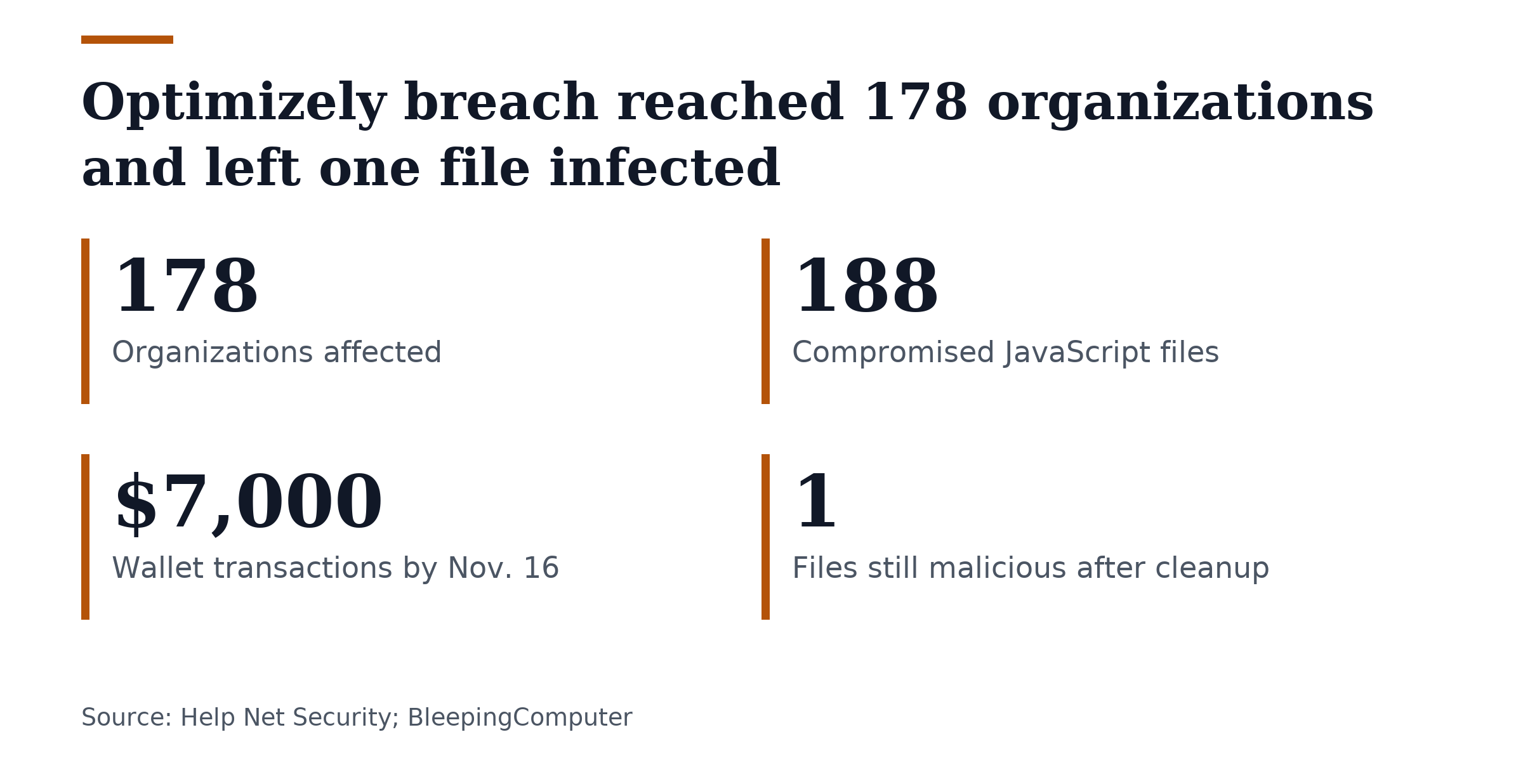
- The supply-chain compromise affected 178 organizations, including BBC, CNN, and Zoom.
- Scott Helme's security research team found 188 compromised Optimizely JavaScript files tied to 178 organizations upon reviewing 1,611 platform scripts.
- Helme's investigation showed the first observed injection happened early on November 16.
Optimizely confirmed an intruder exploited a flaw in its web experimentation platform to insert malicious JavaScript into customer websites, affecting 178 organizations including BBC, CNN and Zoom, with the first injection observed early on November 16.
Scott Helme’s security research team counted 188 tainted script files linked to 178 organizations after reviewing 1,611 platform scripts. The intruders used a weakness in the Experimentation account signup flow to put malicious JavaScript inside customer projects.
Optimizely described the incident as an unauthorized party exploiting a vulnerability in that flow: “Earlier today, Optimizely identified a security incident in which an unauthorized party exploited a vulnerability in the Experimentation account signup flow“. The vendor closed the exposed path, issued a patch, removed the inserted code, ended live sessions, revoked credentials and gave impacted accounts access again.
The company’s model puts its own JavaScript on customers’ pages, so organizations can test and personalize their sites. That is the same channel an intruder used to insert malicious JavaScript into customer websites through a flaw in the platform. For visitors, a single vendor’s code ends up running inside the sites they trust.
Because customer pages load the vendor’s JavaScript, the injected code ran in the context of those customer sites. One compromised vendor script exposed visitors on every customer page that loaded it. The trust relationship is the key issue: customer pages load the vendor script automatically, so visitors receive it without a separate compromise of each site. This is how one supply-chain compromise reached many customer-facing sites at once.
The injected code attempted to load a second malicious script from https://1688360[.]cc/track.js. Attackers sometimes referenced the payload directly by URL and other times hid it with Base64-encoded atob() decoding in others.
Some files pointed to the remote script by URL, while atob() decodes it at runtime. Helme found a variant that could execute a stored copy of the bad code if the remote script failed to load. The saved copy acted as a fallback if the remote host was unreachable.
One function scanned pages for cryptocurrency wallet addresses and replaced them with attacker-controlled addresses to divert transfers. Replacing the address on a page could redirect a visitor’s transfer to the attacker.
A skimming feature searched pages for entered card numbers, expiry dates and security codes on webpages and then attempted to transmit them to https://1688360[.]cc/card.php. That endpoint targeted card data as visitors entered it on the page.
The script served iOS exploit kits named Coruna and DarkSword against different iOS versions. It also collected browser cookies, page URLs and screenshots to send to the attackers. Cookies and page addresses can identify sessions and browsing activity, while screenshots capture visible page content.
Wallets inside track.js showed roughly $7,000 in transactions by November 16, although some wallets existed before the campaign, so the figure is not necessarily all campaign activity. How long the vulnerability lasted and how many visitors were exposed remain unknown.
Salesforce is investigating unauthorized changes to Optimizely scripts on certain websites and has disabled those scripts in preview and production environments. Other affected websites include Fox News, GitLab, KLM, Scheels, American Girl, ManageBuilding, Smartsheet and Stamps.com. Further affected organizations include Mutual of Omaha, American Eagle, Air France, Change.org, HSBC Insurance, Bitly, IG and UNICEF USA.
Join the discussion