

Key facts
- The malware collected payment card numbers, expiry dates and CVV codes as visitors typed them into the site's own payment forms.
- On iPhones and iPads it delivered the Coruna and DarkSword iOS exploit kits.
- A fix was deployed by Optimizely, and access to the vulnerable path was blocked.
- After removing the injected code, Optimizely reset access for affected user accounts, revoked tokens and ended active sessions.
Optimizely confirmed attackers exploited a vulnerability in its Experimentation platform to add malicious JavaScript to customer projects, and Report URI researcher Scott Helme said the code reached visitors of 178 organisations including the BBC, CNN and Zoom on 16 November 2026.
Report URI researcher Scott Helme put it plainly: “On 16 November 2026, malicious JavaScript was served to visitors of 178 organisations through the Optimizely Web experimentation platform.” Organizations load Optimizely Web through a JavaScript snippet from Optimizely’s servers, so one compromised third-party tool reached many sites without a direct breach of each customer’s systems. Attackers planted the code in the Project JavaScript field of customer projects, and visitors’ browsers trusted it because it loaded from Optimizely’s own delivery network.
Examination of 1,611 Optimizely scripts by Report URI found malicious code in 188, which belonged to 178 organizations. Banks and financial firms formed the largest victim group with 32 organizations, ahead of technology companies and retailers. Helme said the true victim count is likely higher because his team only examined the snippets it found in time.
The malicious kit swapped cryptocurrency wallet addresses for the attacker’s, redirecting payments, Report URI said. Report URI said as visitors typed into site payment forms, the malware collected CVV codes, expiry dates and payment card numbers, and it also took cookies and screenshots. On iPhones and iPads it delivered the Coruna and DarkSword iOS exploit kits, and affected pages reloaded every 60 seconds on devices running iOS 18.6 or older. The injected code first loaded a script from a domain registered on the morning of the attack, a card skimmer arrived in the afternoon to capture typed payment details, and the attacker rebuilt the malicious payload 26 times during the day.
Code first reached BBC visitors at 11:21 p.m. ET on Sunday, Report URI said. At 4:21 a.m. UTC on Monday, the BBC website was among the first observed serving the injection. Ledger’s snippet underwent cleaning at about 8:41 p.m. UTC, and across the affected network most malicious code was gone by 9:52 p.m. UTC. Report URI said every infected Optimizely file was clean by 23:11 UTC on Monday, and the attacker’s main server stopped resolving.
Report URI found the malware tried to compromise devices running iOS or iPadOS 18.6 or earlier, and on version 26 it collected device information. Researchers have not reported any iPhone takeover, and Cynet described the retrieved iOS stage as conditional delivery rather than compromise of a real device. Researchers have not presented evidence that any Apple device was successfully compromised, and the number of exposed credit cards is unknown. Security researchers could not determine how many payment card details or cookies the attackers obtained.
Payment fields operated by a separate provider lay outside the malware’s reach for card details entered there. Cryptocurrency figures cited for the attack include about $7,150 from Helme, about $7,040 from Report URI, about $7,100 from blockchain records and roughly $6,600 from StepSecurity. Funds left the attacker’s wallets early Tuesday, and Hudson Rock could not link the transfers to visitors of affected sites.
Poisoned scripts were traced by Hudson Rock and researcher Kirk of Ohey to Kissmetrics, StorifyMe and minute-ly, and the earliest tampered responses date to 13 November. Shared hosting and loader code among those services do not prove a single operator or one entry method. Kirk of Ohey said later iOS stages targeted seed phrases, private keys and keychain data stored on iPhones. Hudson Rock said it had not independently reproduced those iOS stages or shown that a real victim’s iPhone was compromised.
A cash-out address tied to the campaign appeared in March operations and on November 3. The injection code emerged first on Turkish websites in September. Report URI sells tools that detect malicious scripts, and Gizmodo noted that Helme’s write-up promotes them.
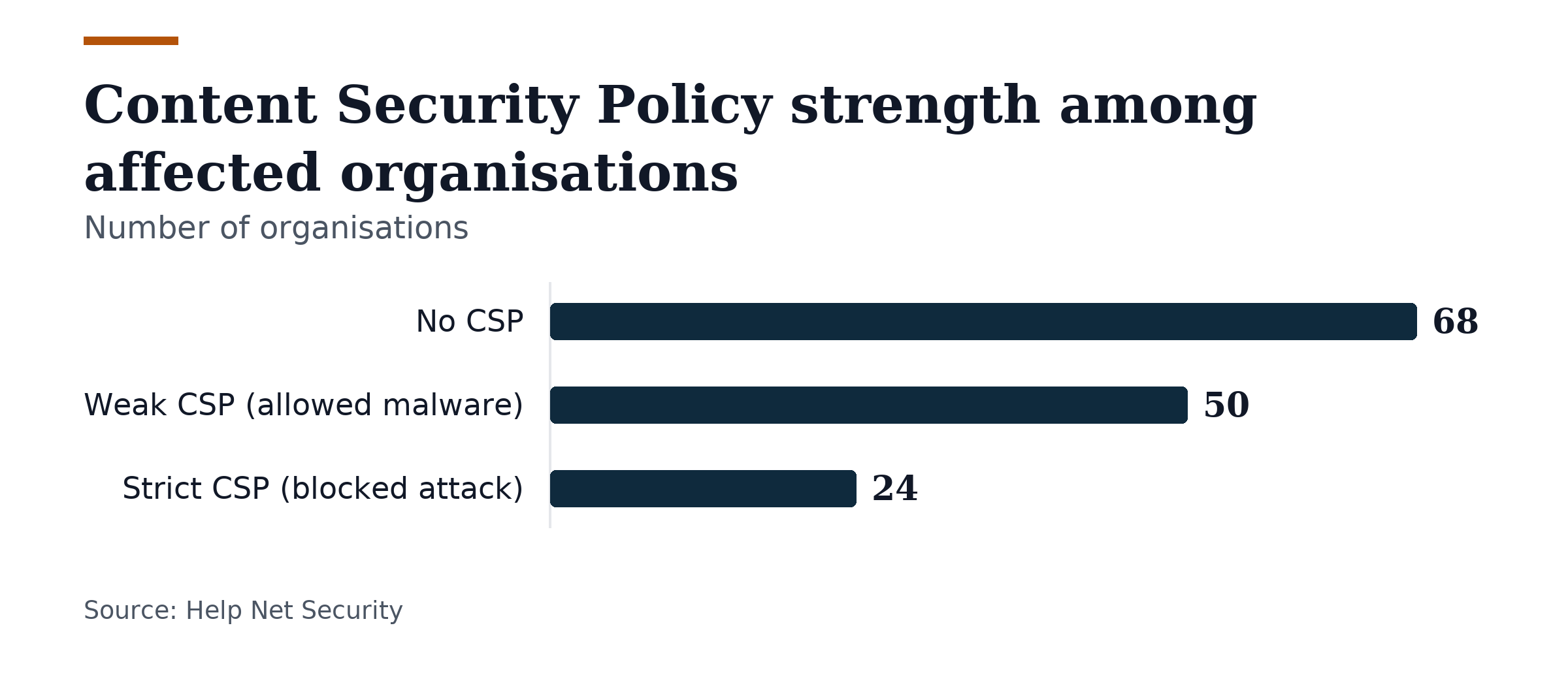
Only 24 affected organizations, or 15%, had a Content Security Policy, which sets rules for which scripts a browser may run, strict enough to block the attack. 68 affected organizations had no Content Security Policy at all. In 50 cases, the policy allowed the malware to run and send data back to the attacker. Listing Optimizely’s domain in a Content Security Policy gave no protection because the malware came from that domain.
Optimizely documentation recommends a setting allowing pages to execute code via JavaScript’s eval function, which runs code passed as text. That eval setting let a backup copy of the malicious code run on HSBC’s site.
Optimizely deployed a fix and blocked access to the vulnerable path. After removing the injected code, Optimizely reset access for affected user accounts, revoked tokens and ended active sessions, and the company said it added protections to stop unauthorized code delivery. Optimizely blocked any code delivery in Cloudflare. Optimizely notified all affected customers.

Salesforce said it was investigating unauthorized Optimizely changes and disabling scripts or components as a precaution, and would notify customers of any unauthorized data access. Equifax said it had stopped using Optimizely, and its own systems showed no evidence of a breach.
Visitors who entered payment information on affected sites on Monday were told to monitor card statements for unusual charges, and iPhone and iPad users were told to update their operating systems. Visitors to an affected site on Monday were told to update an iPhone or iPad, review crypto transfers and check card statements.
The incident follows the LiteLLM compromise weeks earlier and came a day after Google said attackers used AI to turn patches into exploits. Optimizely had disclosed a separate February breach in which voice phishing exposed basic business contact data. Helme concluded that trusted JavaScript does not always stay trustworthy and that attackers can breach a site via a third-party dependency even when the site’s own code and infrastructure are not compromised.
Join the discussion