

Key facts
- Debian describes this revision as a point release that changes individual packages without issuing a new Debian 13 version.
- The security advisories consolidated in this point release run from DSA-6408 through DSA-6629.
- Chromium received sixteen advisories in this release, more than any other packaged component.
- The update fixes a grub2 Secure Boot bypass identified as CVE-2026-97876.
The Debian project released Debian 13.8 on Nov. 21, 2026, as the eighth update to its stable distribution codenamed trixie.
This revision is a point release that changes individual packages without issuing a new Debian 13 version. The project announcement says, “The point release does not constitute a new version of Debian 13 but only updates some of the packages included.”
According to Help Net Security and Linux Compatible, the security advisories consolidated in this point release run from DSA-6408 through DSA-6629. Reports disagree on the total: Linux Compatible describes 139 distinct advisories across the range, or 150 entries if kernel architecture rows are counted individually, while DiarioBitcoin states 150 security updates. According to debian.org, the Security Team has already published an advisory for each security update included in the revision.
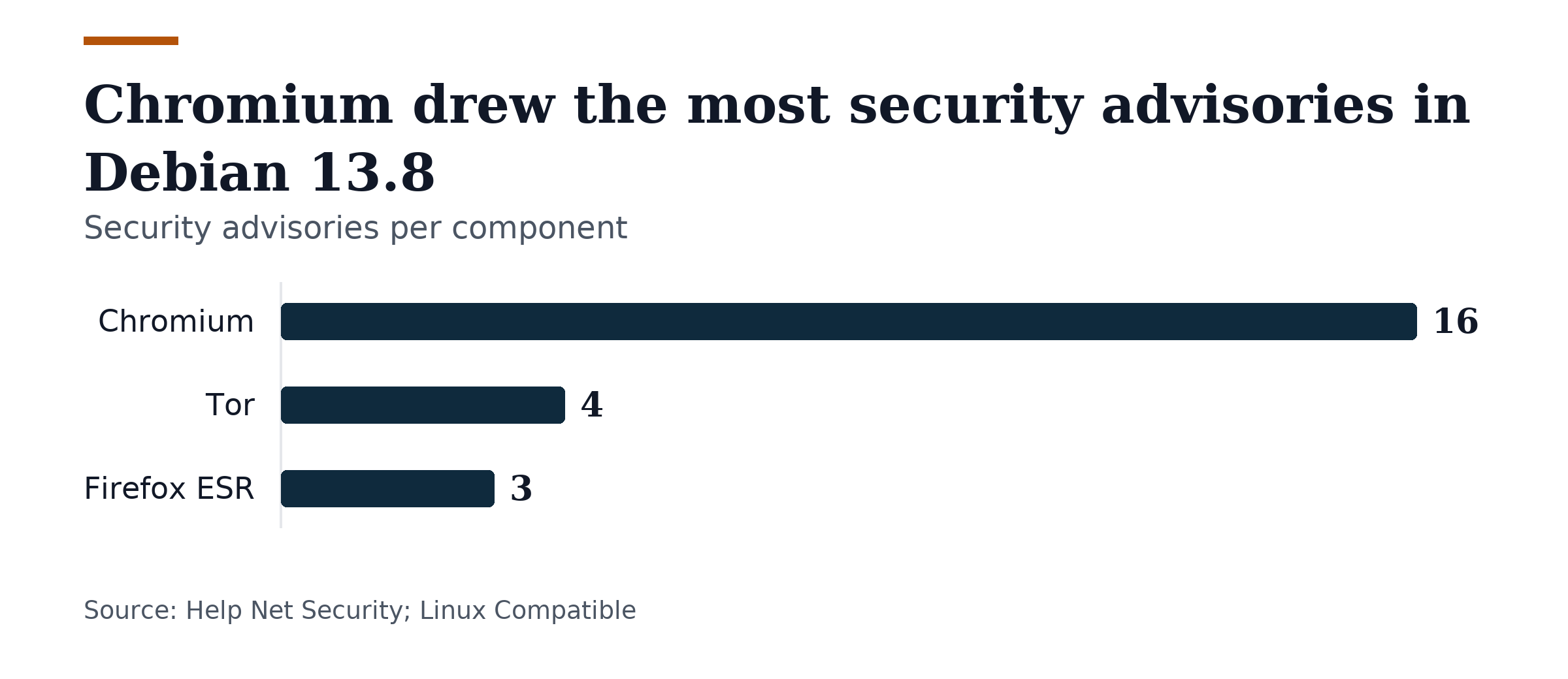
According to Help Net Security and Linux Compatible, Chromium received 16 advisories in this release, more than any other packaged component. According to Linuxiac and Linux Compatible, the update fixes a grub2 Secure Boot bypass identified as CVE-2026-97876. Secure Boot is a security standard that helps ensure a device boots only trusted software, and a CVE is a common vulnerability identifier.
According to Linuxiac and Linux Compatible, MariaDB receives a new upstream stable release correcting issues such as code execution risks, authorization bypass problems, path traversal defects, SQL injection flaws, and incomplete privilege checks. Intel microcode received a new upstream release containing security fixes for multiple processor vulnerabilities, including CVE-2025 and CVE-2026 entries. The sudo update corrects a security issue tied to manipulation of the TZ environment variable.
According to Help Net Security and Linuxiac, ClamAV switched to a new upstream stable release containing fixes for 13 CVEs. According to Linuxiac and DiarioBitcoin, OpenSSL received an updated upstream stable release as part of the point release. According to Linuxiac, glibc repairs in this release cover memory and stack issues such as buffer overflows and out-of-bounds writes, plus a UTF-32 conversion hang and Intel CPU feature detection improvements. According to Linux Compatible, the glibc update repairs buffer over-reads and out-of-bounds writes along with stack overflows, a wordexp state-preservation bug, a UTF-32 decode hang, and a race condition.
According to Linuxiac, the rsync update resolves a resource-exhaustion vulnerability that can be exploited without authentication. According to Linux Compatible, SSSD received fixes for several issues including privilege escalation. Firefox ESR received three advisories and Tor received four advisories in this release.
Linuxiac says updates to BIRD 2 and BIRD 3 address BGP timer calculations, authentication key handling, and FlowSpec validation. BGP is the Border Gateway Protocol for routing internet traffic, and FlowSpec is a BGP extension for filtering traffic. Linuxiac says additional components receiving corrections include ModSecurity, ProFTPD, and various OpenStack components. Components named in the security advisories also include OpenJDK 25, nginx, BIND 9, Dovecot, and PostgreSQL 17, according to Help Net Security.
Help Net Security, DiarioBitcoin, and Linux Compatible say a second set of 122 packages received corrections for serious non-security problems. According to Linuxiac, DiarioBitcoin, and Linux Compatible, the KWin window manager update resolves Wayland color management issues and crashes tied to monitor disconnection. Wayland is a display server protocol that manages graphical interfaces. Help Net Security says smaller repairs addressed build failures, compatibility for Thunderbird 153, and updated tzdata time zone data.
According to debian.org and Help Net Security, existing trixie installations can move to 13.8 by pointing package management at a Debian HTTP mirror. Users who regularly pull updates from security.debian.org will find few packages left to update because most fixes already appear in the point release. Old trixie installation media remains valid and does not need to be discarded.
According to Linux Compatible, trixie became stable on Aug. 9, 2025, with full support until Aug. 9, 2028, Long Term Support until June 30, 2030, and Extended LTS until June 30, 2035. The previous point release, 13.7, shipped on Sept. 12, 2026. The planned release date moved from Nov. 14 to Nov. 21, 2026.
According to Linux Compatible, Debian identifies 159 distinct CVEs in the security and misc-bugfix sections combined, affecting roughly 217 packages overall. According to Linuxiac, the Debian installer was rebuilt with the Linux 6.12.117+deb13 ABI, or application binary interface, to match updated kernel packages. Netinst ISO images for 13.8 support six architectures: amd64, arm64, armhf, ppc64el, riscv64, and s390x. Live images offer pre-installed desktop environments GNOME, KDE, LXDE, Xfce, Cinnamon, and MATE, available only for amd64.
Join the discussion