
Key facts
- The OPTIMJACK campaign exposed visitors to malicious code on at least 178 organizations' websites.
- Once loaded in a visitor's browser, the code swapped cryptocurrency wallet addresses, skimmed payment card details and delivered iOS exploit kits.
- On November 17, 2026, Optimizely fixed the flaw, deleted the injected code and secured the affected customer accounts.
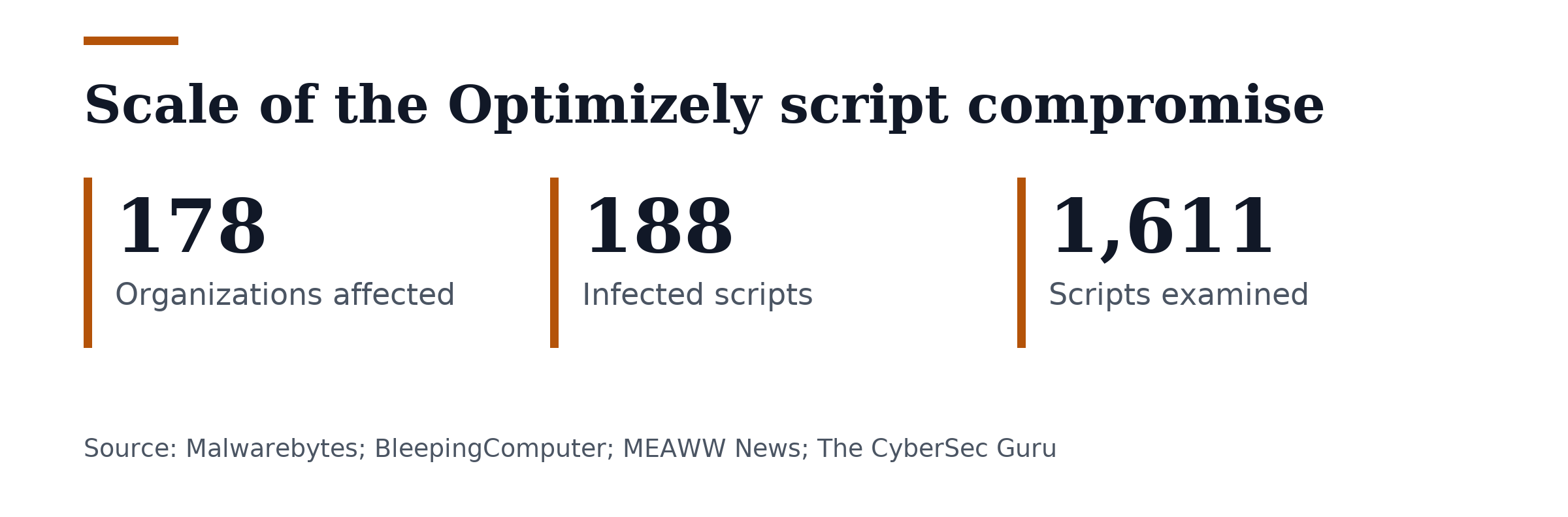
- Report URI's Scott Helme and his team found 188 infected Optimizely scripts across 178 organizations after examining 1,611 scripts.
An attacker exploited a flaw in Optimizely’s Experimentation account signup process on November 16, 2026, adding malicious JavaScript to customer projects that was served to visitors on at least 178 organizations’ websites.
Researchers documented 188 infected Optimizely scripts across 178 organizations after examining 1,611 scripts, while social media posts claimed an attacker hit at least 186 websites. The documented count may understate the true scope because researchers had not reviewed every Optimizely snippet. One social media post declared “BREAKING: 186+ WEBSITES HIT BY CYBERATTACK!” illustrating the early, conflicting scale reports. Optimizely’s own websites, including www.optimizely.com and login.optimizely.com, also served infected snippets.
The attacker inserted a loader into customer projects’ Project JavaScript field, and Optimizely’s pipeline compiled and served it as a routine configuration change. The code loaded a malicious script from https://1688360.cc/track.js, with some variants hiding the URL using Base64 encoding, a format that disguises text. The track.js payload was roughly 30 KB and was rebuilt 26 times during the day. One variant stashed the entire payload inside the snippet and executed it with eval(), a function that runs text as code, if the remote script could not load, wrapped in try/catch so a malformed injection would fail silently instead of breaking the customer’s snippet.
The BBC’s Optimizely snippet was clean at 02:21 UTC on November 16, 2026, was injected at 04:21 UTC and was loading the main malicious payload by 08:28 UTC. The payment card skimming module was added to the payload at 13:43 UTC that day. Certificates for the 1688360.cc domain were issued between 04:28 and 05:23, and the domain was registered at 05:23:08.
Because the tampered snippets came from Optimizely’s legitimate CDN, a content delivery network that distributes code to visitors, under its own certificate, at least 178 organizations unknowingly served malicious code to visitors. Vendor scripts with dynamic execution privileges are direct production code, and executing third-party scripts grants effectively the same privileges as the site’s own developers. Optimizely snippets execute early in the page head with the page’s own origin privileges before most first-party logic. The first observed injection happened early on November 16, 2026, but the exposure window and visitor count remain unclear.
Researchers said none of the affected organizations had their own servers breached; the malicious code arrived from cdn.optimizely.com over a valid TLS connection, the encryption used for secure web traffic. Organizations proxying Optimizely snippets through their own domains were equally affected because a first-party URL does not alter the upstream content. Consent management tools control when a script executes but not what it contains, so a poisoned tag runs once consent exists.
Once loaded in a visitor’s browser, the code swapped cryptocurrency wallet addresses, skimmed payment card details and delivered iOS exploit kits. The clipper validated each address using the real checksum for its blockchain before replacing it across Bitcoin, Ethereum and EVM networks, TRON, Solana, TON, Litecoin, Bitcoin Cash and Dogecoin. It re-scanned pages roughly every 50 milliseconds, gated on payment keywords, and rewrote addresses in text, form fields, attributes and QR codes.
The malicious code could steal browser cookies that hold sign-in information, and it also gathered webpage URLs and screenshots. Card data typed into a merchant’s own form fields was exposed, while cross-origin hosted fields such as Stripe Elements blocked the skimmer.
The payload sent iPhone, iPad and iPod visitors to Coruna and DarkSword exploit kits targeting older iOS versions. Visitors on iOS 18.6 or earlier received a hidden iframe, an embedded window within a page, and the page reloaded every 60 seconds to retry the exploit.
Coruna was disclosed on 3 March 2026 by Google Threat Intelligence Group and iVerify and covers iOS 13.0 through 17.2.1, with exploits for CVE-2023-32434 and CVE-2023-38606. Apple backported fixes to iOS 15.8.7 and 16.7.15 on 11 March 2026. DarkSword was reported by iVerify on 18 March 2026 and covers iOS 18.4 through 18.7, and its October P7 variant adds keychain and crypto-wallet theft with two-way command-and-control, servers that control infected devices.
Attackers registered .icu infrastructure domains on 28 October, 9 November and 16 November 2026, and one .icu domain was already serving exploit content on 12 November 2026, four days before the Optimizely campaign. The same injector was seen on 17 September on Turkish sites delivered through an SEO backlink panel script. The campaign’s TRON collection wallet was created on 18 March 2026.
Attacker wallets had received approximately $7,000 in cryptocurrency transactions as of November 16, 2026, though some wallets were active before the attack. One review put the total at roughly $7,040 at 19:25 UTC on November 16, 2026, while later reviews estimated the total closer to $6,600.
Salesforce said it is investigating malicious changes to Optimizely scripts on some of its websites and disabled Optimizely scripts across preview and production instances as a precaution. BleepingComputer confirmed the malicious script reached or attempted to load on Zoom, KLM, GitLab, BBC, Scheels, CNN, American Girl, ManageBuilding, Smartsheet, Stamps.com and Salesforce. Other affected organizations included Ledger, IKEA, Equifax and Peacock, and a November 16, 2026 report listed American Eagle and Hootsuite among the affected sites.
BleepingComputer reported that cleanup left only one infected Optimizely file among 188 compromised files by 21:52 UTC on November 16, 2026. The CyberSec Guru identified TalkTalk’s snippet as the last infected file still containing malicious code at that time. Report URI confirmed its monitored Optimizely files were free of infection by 23:11 UTC on November 16, 2026. The campaign ran from the first injection to the last observed infected snippet in about seventeen hours, while the stealer was live for roughly thirteen.
On November 17, 2026, Optimizely fixed the flaw, deleted the injected code and secured the affected customer accounts. Optimizely said it closed off the vulnerable path, released a fix and stripped the malicious code from affected customer projects. It also ended active sessions, revoked tokens, reset access for affected user accounts and stopped code delivery through Cloudflare, and it notified all affected customers.
Optimizely stated that “an unauthorized party exploited a vulnerability in the Experimentation account signup flow.”
Website technology tracker BuiltWith detects Optimizely on roughly 190,000 live websites, a figure reflecting usage rather than the number affected by this incident. Optimizely provides website testing and personalization software, and customers add a JavaScript snippet that loads Optimizely code into visitors’ browsers.
Security teams should apply strict segmentation, so a compromised vendor script cannot reach sensitive user inputs. Segmentation removes unnecessary tags from sensitive pages and puts payment handling inside hardened cross-origin iframes. Affected websites should audit project modifications from the malicious code period, double-check altered code and treat exposed payment card data as compromised. Website operators must track third-party script behavior and restrict the scripts and data connections those scripts can introduce.
A single compromised third-party tool can undermine heavy investments in hardening core web infrastructure. Threat actors consider third-party apps the easiest route into lucrative environments.
Join the discussion