

Key facts
- CVE-2026-123890 pairs an SRP session-key getter that works before authentication with an RPC context lookup that fails to check ownership, relying on predictable UUIDv1 context handles.
- An attacker with access to TCP 2012 and an existing SSO principal's name can grab a session key for an in-progress administrator login and finish it without a password.
- Suspected Chinese state-sponsored group Armory Castle, formerly UNC5221, exploited CVE-2026-123890 in early September 2026 using the Golang tool BONESAW, according to Mandiant and Google GTIG.
- The 8.0 U3m release includes the fixes, so customers on that version need no further update, while 9.1.x installations still require patching.
Rapid7 published a technical analysis of CVE-2026-123890 on Nov. 24, describing an unauthenticated VMware vCenter directory-service authentication bypass over DCE/RPC on TCP port 2012.
The company reproduced the bypass against vCenter Server Appliance 8.0.2.00400, build 23929136, running Photon OS 4.0, and reached root command execution. The tested appliance had SSH and Bash access initially disabled before the exploit chain enabled them. Rapid7 documented the starting configuration to show remote access services were off when the attack began and were turned on only after the forged administrator session was established.
The flaw pairs an SRP session-key getter that works before authentication with an RPC context lookup that fails to check ownership, relying on predictable UUIDv1 context handles. An attacker with access to TCP 2012 and an existing SSO principal’s name can grab a session key for an in-progress administrator login and finish it without a password.
Rapid7 found that the SRP key getter does not check whether the caller authenticated, owns the verifier, or supplied a valid password proof. The underlying key getter does not consult the authentication flag.
The RPC runtime searches a process-wide context table by UUID and returns the associated context without comparing the requesting connection or its authenticated identity. An attacker creates reference SRP verifiers immediately before and after a target login to bound the hidden verifier’s timestamp, then searches candidate UUIDv1 handles within that window.
Rapid7 confirmed the bypass using two anonymous RPC connections, one creating a verifier and the second retrieving its key before any password proof. The RPC executor does not enforce the SRP key-getter’s secure-interface flag and authentication callback on the tested TCP path.
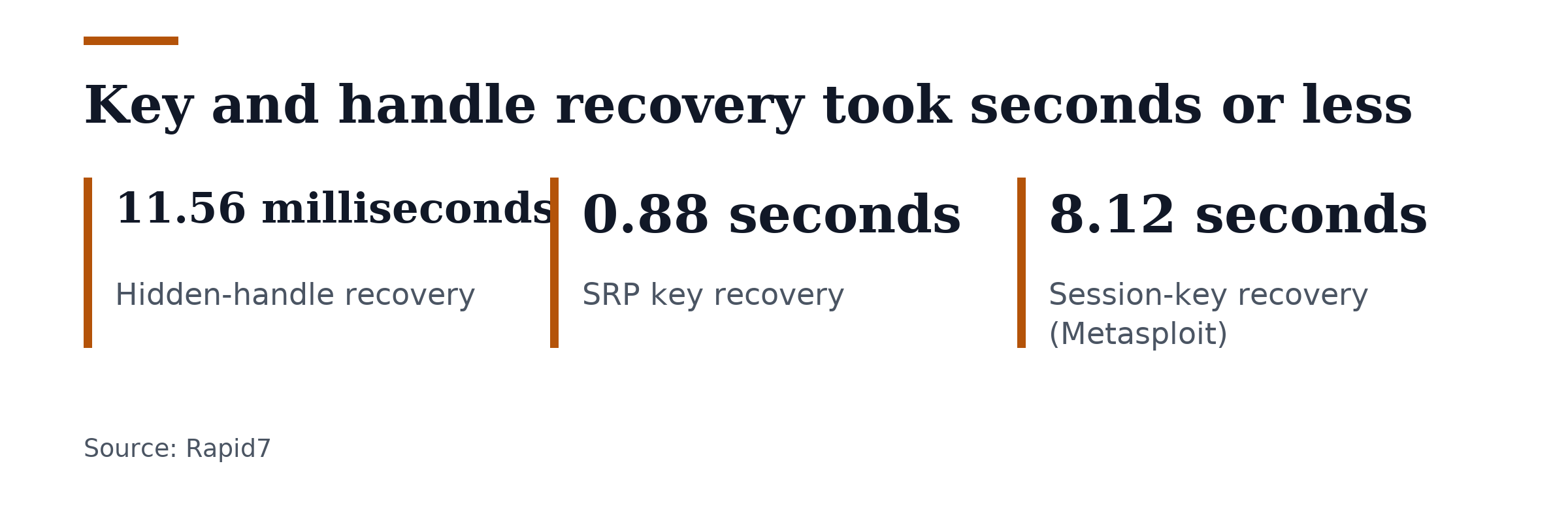
Rapid7’s Python test recovered the hidden handle after 5,083 queries using four workers over an interval of 115,610 UUID ticks, about 11.56 milliseconds, during a run on Nov. 19. With the disclosed 20-byte SRP session key, the client can calculate the SRP client proof and complete authentication without supplying a password. Rapid7 identifies the specific account its proof of concept targets and notes that deployments using another SSO domain must substitute the matching principal name.
Key recovery took approximately 0.88 seconds in one Rapid7 run on Nov. 19. A Metasploit run recovered a pending session key after 17,337 guesses in 8.12 seconds. The default UUID search advances in ten-tick increments, and the proof of concept includes a one-tick mode. Exhausting the search window does not prove a target is patched.
The authenticated connection can export the directory database through the database-copy interface, whose raw file contains the STS RSA private signing key. Rapid7 exported /storage/db/vmware-vmdir/data.mdb as a 16.22 MB live copy using 2,048-byte reads to fit one RPC fragment.
The TenantCredential-1 entry in data.mdb holds the STS RSA private key with its certificate chain, and Rapid7 confirmed the VMCA issuer. Rapid7 forged a SAML assertion with the recovered signing key to create a local superAdmin account, enable SSH and Bash, and run commands as root via sudo, needing TCP 443, TCP 22 and TCP 2012.
The attack chain does not use the current SSO password or the root password as an input. Rapid7’s proof of concept uses the default SSO administrator principal administrator@vsphere.local.
Since the attacker starts the login attempt, no prior authenticated connection or online administrator is required. Once the attacker has administrative RPC access, no second vulnerability is needed to reach root command execution.
Rapid7’s client uses public value A equals 2 in the normal 2048-bit SRP group, while reference verifiers use the cheaper 1024-bit group for timing bounds. In the tested build, the server sends back B at 276 bytes since CSRP writes k*v plus g^b without reducing the total modulo N.
The successful mechanism uses legacy SRP OID 1.2.840.113554.1.2.10 and SPNEGO bind and ALTER_CONTEXT messages with RPC packet privacy. PBKDF2-HMAC-SHA1 stretches the recovered SRP key to 64 bytes, taking the principal as salt and running 128 iterations to protect AES-CBC and HMAC-SHA1 packets.
Rapid7 tested the authenticated connection to 192.168.1.81 with RpcVmDirGetState; anonymous access returned ACCESS_DENIED and authenticated access returned state 3 Normal. Rapid7 gzip-compresses and Base64-encodes the assertion and posts it to /rest/com/vmware/cis/session with an Authorization: SIGN token header.
A successful response returns the API session ID carried in the vmware-api-session-id header. Account creation uses POST /rest/appliance/local-accounts/<username> with a config object supplying the generated password, roles: [”superAdmin”], and enabled: true.
The same API session enables SSH with PUT /rest/appliance/access/ssh {“enabled”:true} and Bash with PUT /rest/appliance/access/shell timeout 600. Rapid7’s Metasploit modules vcenter_offline_mdb_extract and vcenter_forge_saml_token provide the extraction and SAML-signing code that Rapid7 reused. The forged SAML assertion carries the administrator group claim SystemConfiguration.Administrators, uses the appliance’s STS identity, and has a short validity window.
Suspected Chinese state-sponsored group Armory Castle, formerly UNC5221, exploited CVE-2026-123890 in early September 2026 using the Golang tool BONESAW, according to Mandiant and Google GTIG. Mandiant says Armory Castle knew of the flaw before the July 29 disclosure of CVE-2026-59309, a vmdir daemon flaw reachable over TCP 389 or 636 via malformed LDAP authorization tokens.
CVE-2026-123890 is a vmdir DCE/RPC interface flaw over port 2012 exploiting predictable UUIDv1 timestamp generation, distinct from CVE-2026-59309. BONESAW ran in early September against a patched vCenter, and the recovered Go binary shows build timestamp July 13 at 09:21:24 UTC.
BONESAW gives complete control of vCenter Server 7.x and 8.x appliances via CVE-2026-123890, covering LMDB exfiltration, SAML STS hijacking, and creation of SSO administrator accounts. Armory Castle used BONESAW to add an SSO admin account, extract and parse the LMDB, obtain the private RSA signing key used by the STS SAML service, create a backdoor machine account through vmdir, and forge SAML 2.0 assertion tokens.
Following exploitation, the group deployed SAWSNAKE for Golden SAML attacks to forge authentication tokens, bypass MFA, and impersonate users, plus webshells and backdoors including CAGEMATCH, BEARBONES, and LAZYBONES. The group used the attacks to reach ESXi hosts and pull sensitive data from virtual machines, such as Windows Active Directory database files.
Armory Castle scanned internal VMware systems using nmap on ports including 443, 2012, 389, 5480 and 9080; port 2012 is the vCenter SSO control interface RPC.
CISA added CVE-2026-123890 to its Known Exploited Vulnerabilities catalog on Nov. 20, reporting it was exploited as a zero-day for months by a suspected China-nexus espionage group. Mandiant said, “Successful exploitation results in a remote authentication bypass which creates an authenticated session established as administrator@vsphere.local.”
Broadcom patched CVE-2026-123890 on Nov. 19 via VMSA-2026-0009, an advisory that also fixes four other flaws in VMware SDDC Manager and VMware Tools for Windows. Broadcom’s November 24 update addresses 23 vulnerabilities across VMware ESX, vCenter, Workstation, Fusion and Avi Load Balancer.
The update includes the distinct authentication bypass CVE-2026-123903 rated 9.8 on the CVSS scoring system. VMware states CVE-2026-123903 is a distinct issue and is not related to CVE-2026-123890. Broadcom credited sglab of QiAnXin, Qi Qin of depthfirst, and VulTeam and XGTP from ThreatBook for independently reporting CVE-2026-123903.
Fixed versions include VMware Cloud Foundation and VMware vSphere Foundation 9.1.x.x fixed in 9.1.2, 9.0.x.x fixed in 9.0.2.0300, VMware vCenter 8.0 fixed in 8.0 U3m, and VMware Cloud Foundation 5.x fixed in 5.2.5. VMware vCenter 7.0 requires contacting Broadcom Support for customers on an extended support contract. The 8.0 U3m release includes the fixes, so customers on that version need no further update, while 9.1.x installations still require patching.
Broadcom labels the vCenter flaw an emergency update and asks organizations to patch immediately; no official workarounds exist, but limiting network access and using firewalls can lower exposure. The vulnerability affects vCenter regardless of whether Enhanced Linked Mode is enabled.
Affected products include vCenter and SDDC Manager deployed standalone and as part of VMware Cloud Foundation, VMware vSphere Foundation, VMware Telco Cloud Platform, and VMware Telco Cloud Infrastructure, plus VMware Tools in Windows virtual machines. Google’s Mandiant and GTIG urged affected organizations to immediately install Broadcom’s security patches to remediate the vulnerability.
Join the discussion