

Key facts
- GL.iNet confirmed attackers pushed custom malware onto customers' routers and KVM devices by exploiting a flaw in its cloud remote management service.
- Some affected users reported backdoors and reverse shells granting remote access to infected devices.
- GL.iNet published a security advisory on November 20 confirming an unauthorized party exploited the cloud remote management vulnerability to reach devices and install malicious code.
- GL.iNet said the attack path is blocked, the cloud vulnerability is fixed, and the access used in the incident is blocked.
Attackers used a flaw in GL.iNet’s cloud remote-management service to place custom malware on customers’ routers and KVM devices, which let users access and control computers remotely, the company said in a security advisory published Nov. 20, 2026. BleepingComputer reported the confirmed exploitation on Nov. 22, 2026, drawing on the advisory and its own review of malicious code found on infected devices. Some affected users reported backdoors and reverse shells granting remote access to the infected devices.
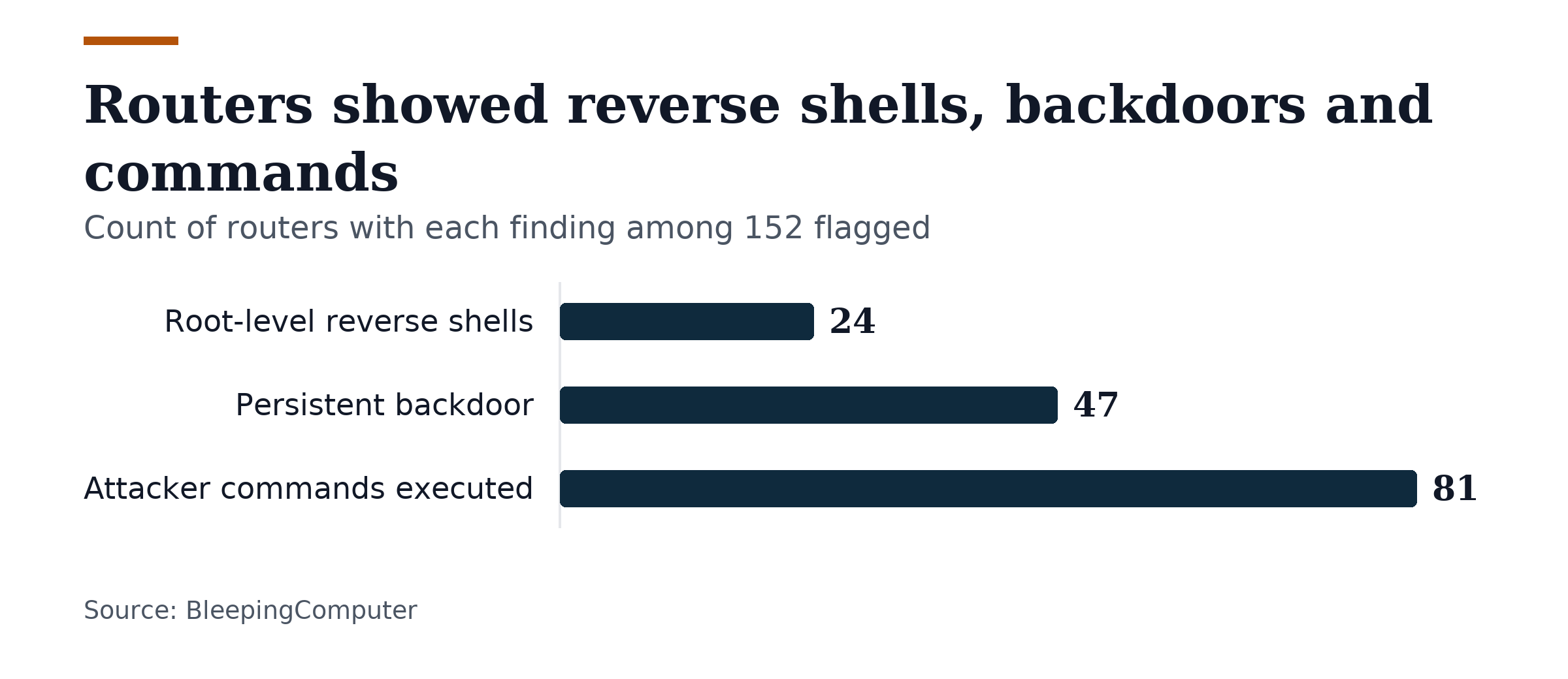
RemoteToHome Consulting looked at 183 routers it owns or manages and marked 152 as suspicious. Of those 152 routers, the researchers found root-level reverse shells on 24, an older persistent backdoor on 47, and evidence that attacker-supplied commands had executed on 81. The researchers said their findings might miss other customers and that older backdoor infections may have no link to the November attacks.
Security researchers and customers of the vendor shared evidence of custom malware built for its devices, including reverse shells at the root level that linked infected routers to IP address 170.39.226[.]219. Those shells relied on the Linux nc utility to open outbound connections, letting remote attackers run commands on infected devices. BleepingComputer examined a malicious ni.sh script and found code written for GL.iNet routers and KVM devices inside it.
The ni.sh script recognizes many GL.iNet device models and downloads malicious executables called gl-helper and gb from hardcoded servers. The script remains in place through startup scripts and scheduled tasks, so the malware restarts following a reboot or after its processes are halted. The installer disguises the malicious process as crond -i /tmp/.log, matching the vendor’s indicator of compromise, and replaces netstat with a fake script that hides connections to IP address 66.245.219[.]252.
It also adds SSH public keys for remote access, alters file timestamps, and regularly contacts a remote server to retrieve and execute commands. BleepingComputer traced attacker infrastructure to IP addresses 66.245.219[.]252 and 65.20.71[.]131, matching addresses in logs from a compromised GL-RM1 KVM owner. Logs showed the device retrieving the ni.sh script and other executable payloads from 66.245.219[.]252 on Nov. 19, 2026.
The owner said the device contacted about 1,800 residential IP addresses daily and repeatedly reached out to the TRON blockchain API, activity that suggests a peer-to-peer network. It is unclear why those connections happened, and no evidence confirms the devices acted as residential proxies or joined a larger botnet. The ni.sh script carries Chinese-language developer comments about persistence, reporting, and its use with GL.iNet’s cloud management software, suggesting the author may speak Chinese.
BleepingComputer additionally examined a separate malicious Lua payload pulled from a GL-MT2500 router. That Lua payload starts through a modified urandom_seed startup script and can collect device details, reach remote servers, and download and run additional programs. Malicious files pulled from GL.iNet devices carried timestamps from December 2025, suggesting some devices could have been compromised for months.
It is unclear whether the December 2025 infections involved the same attackers or tied into the November 20 incidents. RemoteToHome Consulting said a possible command injection flaw exists in the vendor’s GoodCloud client through a handler for AstroWarp/SD-WAN features. That handler passes cloud-supplied values into root-level shell commands without checking them first, and the vendor has not confirmed that the attacks used this specific vulnerability.
The vendor said it blocked the attack path, fixed the cloud vulnerability, and cut off the access used in the incident, meaning attackers can no longer infect devices through that path. However, the measures taken do not remove malware from devices already infected. The vendor has not disclosed the exploitation method for its cloud platform, how many customers were affected, or whether data was taken from compromised devices.
The vendor makes home and travel routers and KVM devices that let users access and control computers remotely. GoodCloud lets customers manage supported devices from afar and reach computers and servers tied to its KVM products. The vendor is investigating whether computers tied to infected KVM devices were also compromised, and said the malware might have let attackers reach computers controlled through a compromised KVM, so those machines should also be checked.
The vendor directed customers to a community-made detection and cleanup tool included in official support guides for routers and KVM devices. The scanner checks for modified system utilities and suspicious processes, along with known malware files and persistence changes to configuration files. The tool can collect forensic evidence and, if requested, remove known malware components, though its creators warn it may miss some infections.
The developers say infected devices might require a fresh firmware install that erases saved settings because malicious files held in configuration folders can survive a routine upgrade. Customers who suspect a compromise should preserve evidence before resetting their devices, avoid restoring configurations that might be infected, and rotate credentials and access keys that might have been exposed. The vendor asked scanner users to upload the anonymous report when prompted so developers can determine how many and which devices were affected.
The vendor’s first guidance told customers to look for a process called crond -i /tmp/.log, which it flagged as an indicator of compromise. The vendor recommended that customers check devices for infection signs and install the newest security firmware even if no malware is detected.
Stable firmware updates with additional security fixes for routers and KVM devices are scheduled for release on Nov. 22, 2026. For KVM devices, the vendor recommends firmware version 1.10.3 or later on RM10, RM1, RM1V2, RM1PE, and RM4PE, version 1.10.3 beta or later on RM10RC, and version 1.8.7 or later on RMQ1. Router owners should install the newest security firmware for their model as soon as it becomes available, and the vendor plans to notify identified affected customers through the e-mail addresses tied to their cloud accounts.
Join the discussion