

Key facts
- CrowdStrike will combine its endpoint security with Zscaler's cloud-delivered zero-trust network security platform.
- The deal expands CrowdStrike's presence in network security.
- CrowdStrike's fiscal 2028 second half is when closing of the deal is expected.
- Jay Chaudhry, founder and CEO of Zscaler, will remain in charge of the Zscaler business and take a seat on CrowdStrike's board once the deal closes.
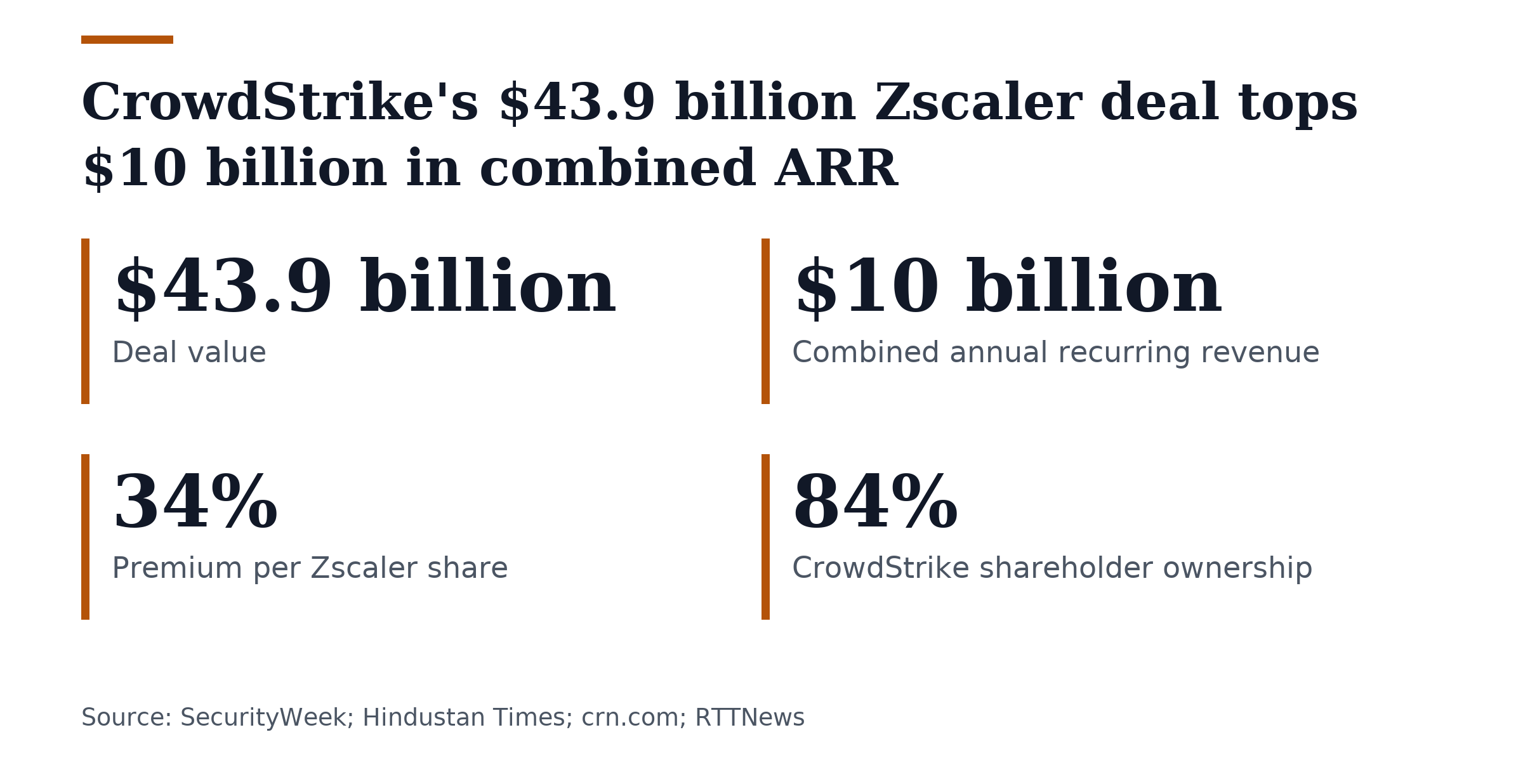
CrowdStrike agreed on Nov. 23, 2026, to acquire Zscaler for about $43.9 billion in an all-stock transaction.
The exchange ratio determines how many CrowdStrike shares Zscaler investors receive. Zscaler shareholders will receive 1.135 CrowdStrike shares for each Zscaler share. Based on Friday’s closing prices, the exchange ratio valued each Zscaler share at $260.41, a premium of roughly 34 percent.
The deal gives CrowdStrike investors a controlling stake in the combined business. After closing, CrowdStrike shareholders will own approximately 84 percent of the combined company, while Zscaler shareholders hold the remaining 15.9 percent.
The parties set a closing window tied to CrowdStrike’s fiscal calendar. CrowdStrike expects the deal to close in the second half of fiscal 2028. That fiscal period runs from Aug. 1, 2027, to Jan. 31, 2028.
CrowdStrike and Zscaler would together surpass a significant revenue threshold. The combined company is expected to exceed $10 billion in annual recurring revenue at closing. Annual recurring revenue measures the yearly value of subscription contracts.
The deal preserves separate leadership for the Zscaler business under the combined company. George Kurtz, CrowdStrike’s chief executive and co-founder, will lead the combined company after the acquisition completes. Jay Chaudhry, Zscaler’s founder and chief executive, will remain in charge of the Zscaler business and take a seat on CrowdStrike’s board once the deal closes.
The transaction combines CrowdStrike’s endpoint security with Zscaler’s cloud-delivered zero-trust network security platform. CrowdStrike protects the endpoint, workload, identity and data, while Zscaler protects the connections between them. CrowdStrike said the deal lets it enter network security.
Zero-trust network security assumes no user or device is trusted by default. The deal expands CrowdStrike’s presence in network security.
After closing, CrowdStrike intends to combine endpoint security and Zero Trust SASE into a single unified cybersecurity platform. Zero Trust SASE blends network security with zero-trust access principles. The companies plan to unite the products on one platform that uses a shared data layer and a single customer contract.
CrowdStrike framed network security as a major growth market. CrowdStrike expects the acquisition to add more than $185 billion to its total addressable market by 2029. The company described network security as the largest single addressable market in cybersecurity.
CrowdStrike outlined two synergy streams tied to the closing date. CrowdStrike expects about $1 billion in annualized revenue synergies within 30 months of closing. It also expects about $500 million in annualized cost synergies within 18 to 24 months.
Channel partners are a shared strength for both companies. The transaction ranks among the largest cybersecurity acquisitions on record. The combination could create broader channel partner opportunities, including cybersecurity platform consolidation. Both companies share many of the same channel partners.
Palo Alto Networks stands as a common rival to both parties. CrowdStrike and Zscaler are two leading competitors of Palo Alto Networks. Buying Zscaler adds network security capabilities CrowdStrike has not prioritized, positioning it to compete more directly with Palo Alto Networks. The transaction intensifies competition with Palo Alto Networks.
The partnership predates the acquisition plan. CrowdStrike and Zscaler jointly serve more than 2,000 customers and maintain 16 product integrations. In September, the companies said they would broaden their partnership to let Falcon continuously evaluate user risk and feed data into Zscaler’s access controls.
Daniel Bernard, CrowdStrike’s chief business officer, previously described the CrowdStrike-Zscaler partnership as the industry’s most successful partnership in a CRN interview. Melissa Nacerino, Zscaler’s vice president for global partner marketing, said in September 2025 that the companies share many joint partners and the ecosystem offers a tremendous opportunity.

Zscaler has made several acquisitions in recent years. Zscaler acquired SquareX in February 2026. SquareX provides a browser extension for enforcing security policies on unmanaged devices. Unmanaged devices are endpoints not directly administered by corporate IT. Zscaler bought SPLX in November 2025. SPLX offers tools that discover AI models, applications and agents and test and protect them. AI agents are autonomous systems that can act on behalf of users.
Earlier Zscaler deals added detection, data and segmentation capabilities. Zscaler completed its acquisition of Red Canary, a managed detection and response provider, in August 2025. A managed detection and response provider monitors and responds to threats on a customer’s behalf. Zscaler bought Avalor for $350 million in 2024 for security data merging and risk ranking. It also bought Airgap Networks for network segmentation. Network segmentation divides a network into smaller parts to limit the spread of a breach.
CrowdStrike’s third-quarter total revenue reached $1.58 billion, up 28 percent from $1.23 billion a year earlier. Subscription revenue totaled $1.50 billion, a 29 percent increase over the prior year. Annual recurring revenue grew 27 percent to $6.26 billion.
Adjusted net income reached $354.9 million or $0.34 per share, up from $245.4 million or $0.24 per share a year earlier. Attributable net income was $24.86 million or $0.02 per share, versus a $26.78 million or $0.03 per share loss a year earlier.
Total revenue is projected between $1.638 billion and $1.644 billion, and adjusted net income is projected between $380.3 million and $383.0 million in CrowdStrike’s fourth-quarter outlook. The forecast exceeds the average analyst sales estimate of $1.62 billion compiled by LSEG. CrowdStrike projects fourth-quarter adjusted earnings of 36 cents per share, matching analyst estimates.
CrowdStrike updated its full-year financial outlook alongside quarterly results. CrowdStrike raised its full-year 2027 adjusted net income guidance to $1.342 billion to $1.344 billion or $1.28 per share. The prior outlook was $1.302 billion to $1.311 billion or $1.25 to $1.26 per share. It raised full-year 2027 revenue guidance to $6.078 billion to $6.084 billion from $5.991 billion to $6.011 billion.
Zscaler posted first-quarter results showing revenue growth. Zscaler reported first-quarter revenue of $949.33 million, a 20 percent increase from $788.11 million a year earlier. Annual recurring revenue increased 21 percent to $3.882 billion from $3.204 billion a year earlier. Adjusted net income totaled $208.4 million or $1.23 per share, up from $159.5 million or $0.96 per share last year.
Zscaler’s first-quarter results showed mixed profitability trends. Zscaler’s first-quarter net loss widened to $27.44 million from $11.62 million a year earlier because of higher tax expense. The first-quarter loss per share came to $0.17, versus $0.07 a year earlier. Loss before income taxes narrowed to $1.66 million from $8.37 million a year ago. The operating loss was $33.24 million, an improvement from the prior-year loss of $36.36 million.
Zscaler topped Wall Street estimates in its latest quarter. Zscaler’s first-quarter revenue surpassed the analyst estimate of $938 million reported by CNBC. Adjusted earnings came to $1.23 per share, above the analyst estimate of $1.16 per share.
Investors reacted to the deal in premarket trading on Nov. 23, 2026. Zscaler shares rose more than 13 percent in premarket trading on Nov. 23, 2026, after the announcement. CrowdStrike shares dropped more than 8 percent during premarket trading that day. In premarket Nasdaq trading, Zscaler shares rose 20.45 percent to $234.68 while CrowdStrike shares lost 8.02 percent to $211.04.
The acquisition landed against a backdrop of rising security concerns. Bloomberg first reported the potential deal discussions on Friday, Nov. 20, 2026. AI tools help hackers find software weaknesses and exploit them faster, so growing AI use is raising cybersecurity risks. Business concerns about system safety have risen because of recent outages and security flaws in Java and PHP software that is widely used.
Both companies built their reputations on distinct security categories before expanding. CrowdStrike originally pioneered endpoint detection and response, while Zscaler pioneered zero-trust network security. Endpoint detection and response monitors devices for threats. Both vendors have expanded beyond their original focus into security operations, cloud security, and AI and agentic protection. Agentic protection refers to defenses built for autonomous AI systems.
The proposed merger of two channel-focused powerhouses might change the cybersecurity competitive landscape. CrowdStrike’s chief executive has tied the company’s strategy to the rise of autonomous AI. George Kurtz said in a March CRN interview that CrowdStrike is emphasizing foundational AI and security capabilities for the agentic wave. He said, “Security used to be about keeping the adversary out. Today, safety is required to let AI in.”
Join the discussion