

Key facts
- DShield sensors at SANS Internet Storm Center detected persistent scanning from subnet 109.160.32.0/24.
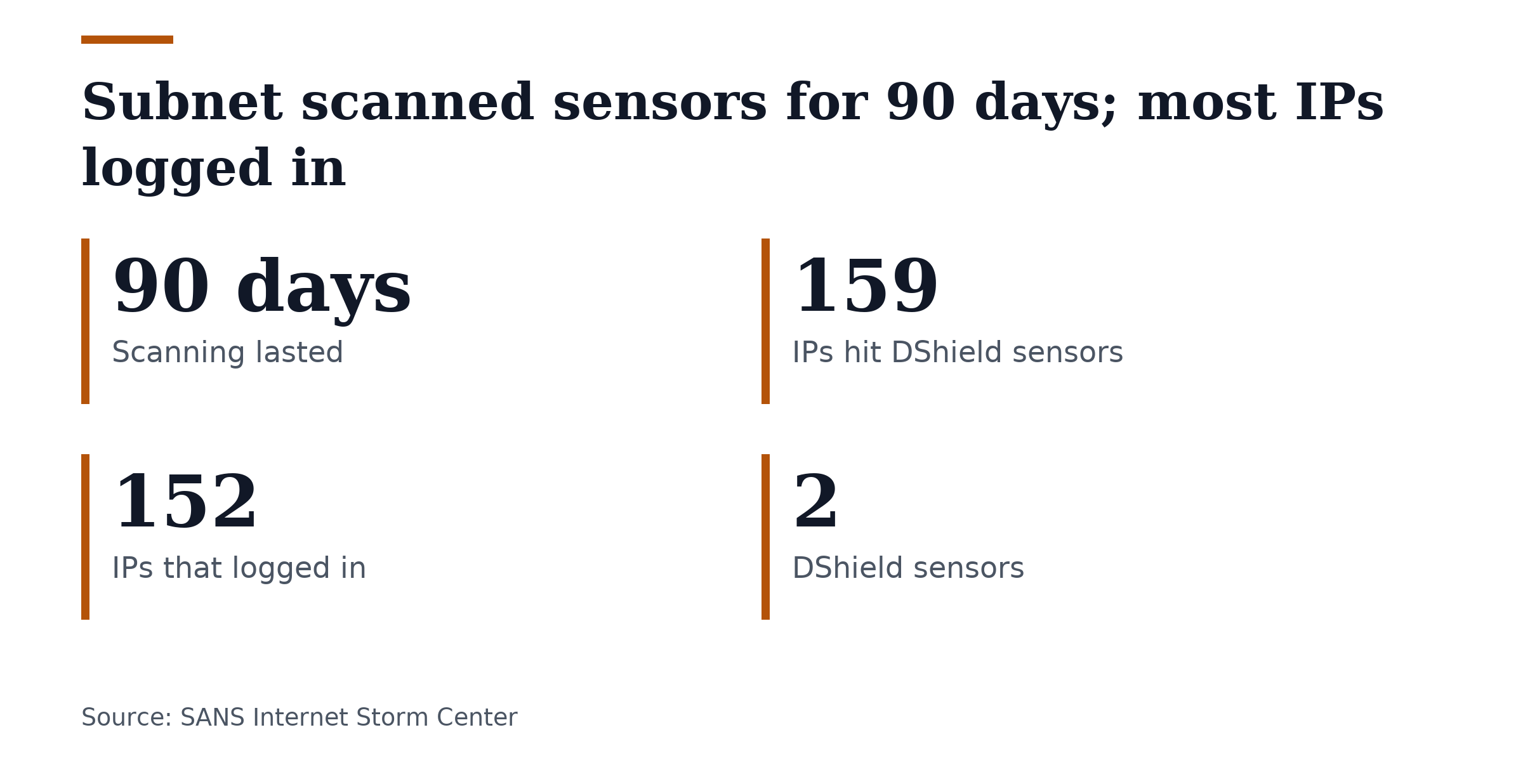
- Almost all, 152 out of 159 IPs, succeeded in logging in using standard usernames such as root, ubuntu and admin.
- After logging in, the actors ran uname -s -v -n -r -m once and disconnected immediately.
- One sensor recorded 127 unique IPs and the other recorded 134 unique IPs.
SANS Internet Storm Center’s DShield sensors spotted ongoing scanning coming from subnet 109.160.32.0/24, and the activity was still active on Nov. 24.s1
BANATSYNC SRL, based in Timisoara, Romania, owns the block and provides web hosting and virtual private servers on AS198364, SANS Internet Storm Center said. The scanning ran for about 90 days. Its analysis of the subnet started on Sept. 5.s1
SANS Internet Storm Center said 159 addresses in the block reached its sensors at least once starting Sept. 1, with most of the activity aimed at the SSH service. Two separate DShield sensors captured the activity regularly, recording 127 unique IPs on one sensor and 134 on the other.
According to SANS Internet Storm Center, firewall and Cowrie logs show each address tried to log in to the SSH service; Cowrie is an SSH honeypot. Almost all succeeded: 152 out of 159 logged in using common names such as root, ubuntu and admin, and some needed several tries on those ports. Once inside, the actors executed uname -s -v -n -r -m one time and then cut the connection.
The inbound traffic carried SYN, SYN-ACK and RST packets aimed at ports such as TCP/2323, TCP/22 and TCP/2222, SANS Internet Storm Center said. Firewall logs showed TTL values mostly from 45 to 52, though some exceptions fell between 232 and 243. Packet capture data showed 69 addresses beginning with a static IP identification value of 54321, and all of them used TTL between 232 and 243.
For the 69 flagged addresses, the opening packet always used TTL above 230 before later packets switched to normal Linux TTL, the center said. When researchers replayed the first packet from 109.160.32.146 on Nov. 13, it opened with TTL 239, dropped to 50 after a reset, and then used TTL 50.s1
VirusTotal reports on four sampled addresses showed the same SSH brute-force pattern, with commands run before disconnection when SSH was open, according to SANS Internet Storm Center. Shodan checks showed that some addresses in the block expose only SSH while others reveal no open ports.
When SSH answered, it ran Ubuntu 24.04 LTS or Ubuntu 26.04 LTS, SANS Internet Storm Center said. Shodan listed SSH-2.0-OpenSSH_10.2p1 Ubuntu-2ubuntu3.2 on 109.160.32.34 and 109.160.32.200, both Ubuntu 26.04 LTS, and SSH-2.0-OpenSSH_9.6p1 Ubuntu-3ubuntu13 on 109.160.32.141, 109.160.32.147 and 109.160.32.150, all Ubuntu 24.04 LTS. Shodan showed no open ports for 109.160.32.12, 109.160.32.66, 109.160.32.80 and 109.160.32.88. Guy Bruneau of IPSS Inc. wrote the diary entry.
Join the discussion