

Key facts
- The Sheriff's Office withdrew a proposed $288,000 sole-source contract with Clearview AI from the November 19, 2026 commissioners' agenda before a vote.
- The contract would have run from November 19, 2026 through November 18, 2027 and included four optional one-year renewal options.
- Funding would come from the county's current General Fund, and the request identified no need for additional money for the initial $288,000 cost.
- The purchasing request, Harris County File No. 26-7668, named the county's Purchasing Department as primary and the Sheriff's Office as secondary.
The Harris County Sheriff’s Office removed a proposed $288,000 sole-source contract with Clearview AI from the Harris County Commissioners Court agenda for November 19, 2026 before commissioners voted, so the purchase was never approved.
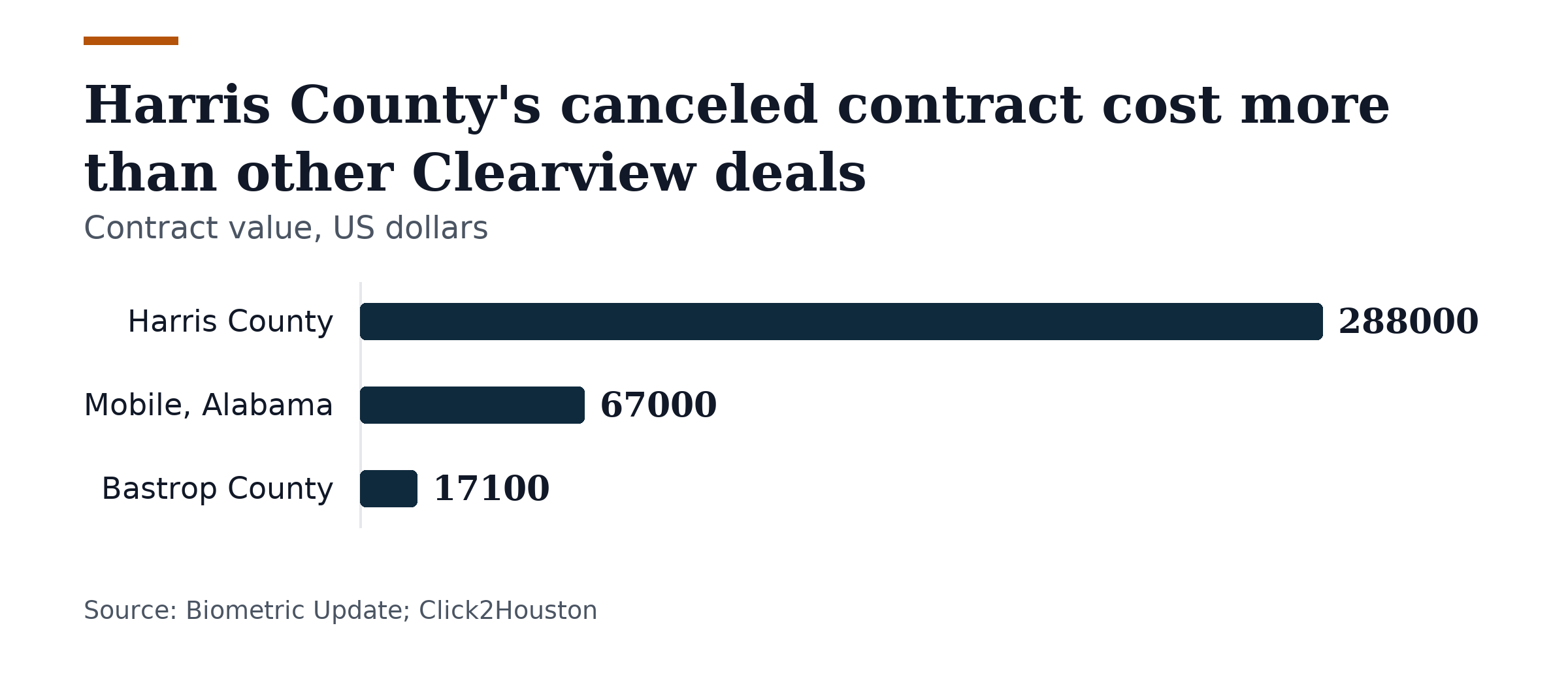
The county sought a sole-source exemption from competitive bidding so it could buy directly from Clearview AI, and the request appeared as Item 100 on the agenda. The contract would have run from November 19, 2026 through November 18, 2027 with four optional one-year renewals. The county planned to pay the initial $288,000 from its current General Fund, requesting no additional money for that cost. The purchasing request, Harris County File No. 26-7668, named the Purchasing Department as primary and the Sheriff’s Office as secondary.
The Sheriff’s Office said investigators could use the tool to identify suspects in cases with no prior leads, and linked the purchase to making the county safer and reducing violent crime. Investigators could upload a face image to receive potential matches as leads, and the proposal covered searches of images involving suspects, victims and people of interest. There would be no cameras across Houston or continuous street-level scanning of people.
County paperwork listed NA under Alternative Options without saying if any other vendors or products had been considered, gave no estimate of how many additional cases investigators expected to solve with the platform, and included no details on safeguards, access restrictions or auditing requirements.
The Sheriff’s Office said the item was not ready for consideration and would not say whether the proposal would come back later. Nothing in the purchasing documents explains why the item was pulled. Whether the county has abandoned the purchase altogether or will come back later with a revised agreement is still unclear.
Clearview AI says its database contains more than 100 billion images gathered from public online sources like social media and mugshot sites. Harris County’s purchasing documents describe the database as holding more than 70 billion images posted online.
Houston sits in Harris County, one of the United States’ largest cities. Bastrop County near Austin approved a $17,100 contract for Clearview’s technology in March 2026, paid for with asset forfeitures, according to Community Impact. In Mobile, Alabama, the City Council is considering whether to renew a $67,000 Clearview AI contract, NBC 15 reports, and the Mobile Police Department has declined to release its policies on facial recognition or its annual search count.
A Tennessee resident has sued over an arrest following a Clearview AI-assisted investigation in North Dakota, alleging a mistaken identification and six months in custody.
Chris Bronk, professor of public affairs at the University of Houston’s Hobby School of Public Affairs, called Clearview concerning yet useful. He said oversight questions arise when investigators gain access to ever-larger collections of personal information, and that officials should judge whether the tool produces measurable public-safety benefits by looking at how often it is used, how well searches perform and how results are measured. “The question I always ask with these systems is when it goes bad, when it fails, what happens?” Bronk said.
Bronk warned that staff members with access could run searches for non-work reasons, and said agencies should conduct audits of who searched and why, looking for repeat searches and unusual patterns. He also said agencies must think through what happens when the systems fail, and cautioned against over-reliance on automated results, noting that a match is a lead for investigators, not proof of guilt.
Bronk said a person’s photo can appear online when a friend, relative, organization or someone else posts it without that person’s knowledge, which prompts questions about how those images are collected, accessed and used. A mistaken match could point to someone who merely looks like the subject, and the danger increases when investigators trust the result without independent checks. A match alone does not prove a person’s identity or involvement in a crime.
KPRC 2 said it plans to keep asking why the item was removed. The outlet also wants to know whether the Sheriff’s Office will try again for the technology and what rules would apply to its use. No determination exists on whether the county will move forward with Clearview AI or on what terms. The outlet frames the central issue as a balance between investigative benefits, financial cost, privacy concerns and oversight needs.
Join the discussion