

Key facts
- The New York City Department of Investigation's Office of the Inspector General for the NYPD released a report on facial recognition use.
- The report found the department mostly follows the city's Public Oversight of Surveillance Technology Act.
- The report also found the department broke some internal policies and missed certain legal obligations.
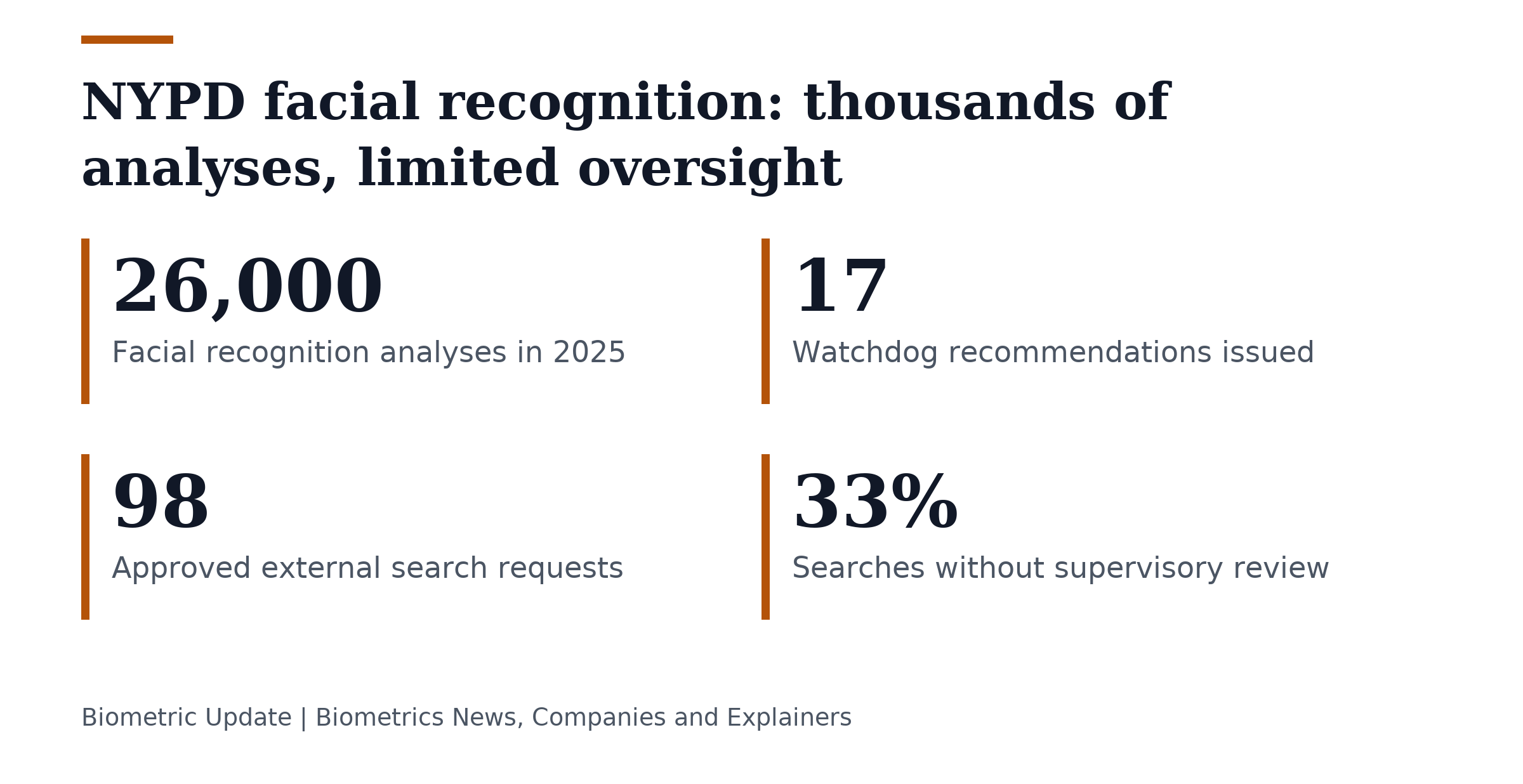
- Investigators issued 17 recommendations.
The New York City Department of Investigation’s Office of the Inspector General for the NYPD released a report on facial recognition use, finding that the department’s Facial Identification Section carried out roughly 26,000 analyses in 2025, that the department mostly follows the city’s Public Oversight of Surveillance Technology Act, and that it broke some internal policies and missed certain legal obligations.
The investigation began after a Legal Aid Society complaint in Aug. 2025 accusing NYPD staff of bypassing limits through outside agencies. NYPD logs showed 98 approved requests from Oct. 2023 to Oct. 2025 for facial recognition searches outside department databases.
All 98 requests came from the Intelligence and Counterterrorism Bureau and went to Customs and Border Protection. Investigators determined the approvals violated the departmental policy in effect at the time.
The records showed no denied requests and offered little reasoning for the authorizations.
The report does not name the Customs and Border Protection platforms or image repositories involved, so it is unknown whether NYPD photographs were compared with federal law enforcement, immigration, border security or commercial databases. Customs and Border Protection has incorporated Clearview AI into intelligence work, though the watchdog report does not prove Clearview AI was used in any of the 98 NYPD referrals.
In one instance, an NYPD investigator asked a New York City Fire Department official to run a Clearview AI search tied to a pro-Palestinian demonstrator. A judge later ruled the search clearly violated official NYPD policy. The watchdog urged formal authorization steps and auditable records for searches run through outside agencies.
NYPD policy treats matches as investigative leads, not independent grounds for arrest. NYPD policy demands human peer review and supervisory sign-off before facial recognition candidates go to investigators. About 33 percent of Intelligence Division searches logged in 2024 and 2025 were marked without supervisory review.
The watchdog cited unclear written requirements and urged uniform supervisory approval of possible matches. Investigators found that authorized units did not record peer reviews, so compliance is hard to verify. Distinct record keeping systems raised the chance of duplicate searches and conflicting outcomes.
The department relies on three facial recognition tools: DataWorks Face Plus, DataWorks+ PhotoManager, and Idemia’s FaceExpert. DataWorks Face Plus checks arrest photographs from New York and New Jersey. DataWorks+ PhotoManager checks NYPD arrest photographs, including pictures of juveniles. Idemia’s FaceExpert checks adult NYPD arrest photographs.
The department’s public Facial Recognition Impact and Use document names vendors but not their specific products, violating POST Act disclosure rules. Investigators found NYPD facial recognition products include image-editing tools beyond what current policy allows, including a paintbrush feature and an option to export photos for editing outside the system. Officials said some former Facial Identification Section investigators used heavy image-editing methods, while current staff do not.
The NYPD has moved Intelligence Division searches into its Regional Intelligence Support Center and shifted requests to a centralized case management system. The City Council passed Local Law 55 of 2025, mandating logs of image changes, retention of original and edited photos, and annual facial recognition audits. The NYPD previously turned down comparable watchdog recommendations in 2022. The NYPD states that it does not run facial recognition in real time, and that a match alone cannot justify an arrest.
The report found no regular process for reviewing new National Institute of Standards and Technology algorithm assessments after vendor updates. The report noted that vendor updates can alter accuracy and demographic performance. The Surveillance Technology Oversight Project repeated its demand for a prohibition on police facial recognition, pointing to search volume and Customs and Border Protection cooperation.
Join the discussion