
Key facts
- The Phoenix no-cost agreement never went before the Phoenix City Council.
- Phoenix Police chose not to renew the Flock agreement in summer 2026, but officers kept searching for months after it expired until Flock removed access.
- The department already had Motorola Solutions cameras and access to the Vigilant national lookup tool.
- Yavapai County, the Maricopa County Attorney's Office and Pinetop-Lakeside police signed no-cost agreements granting five years of search privileges.
Over roughly four years, Arizona law enforcement agencies conducted more than 110,000 license plate searches using Flock Safety’s system without purchasing cameras or signing paid agreements, and Attorney General Kris Mayes is investigating the state’s use of license plate readers.
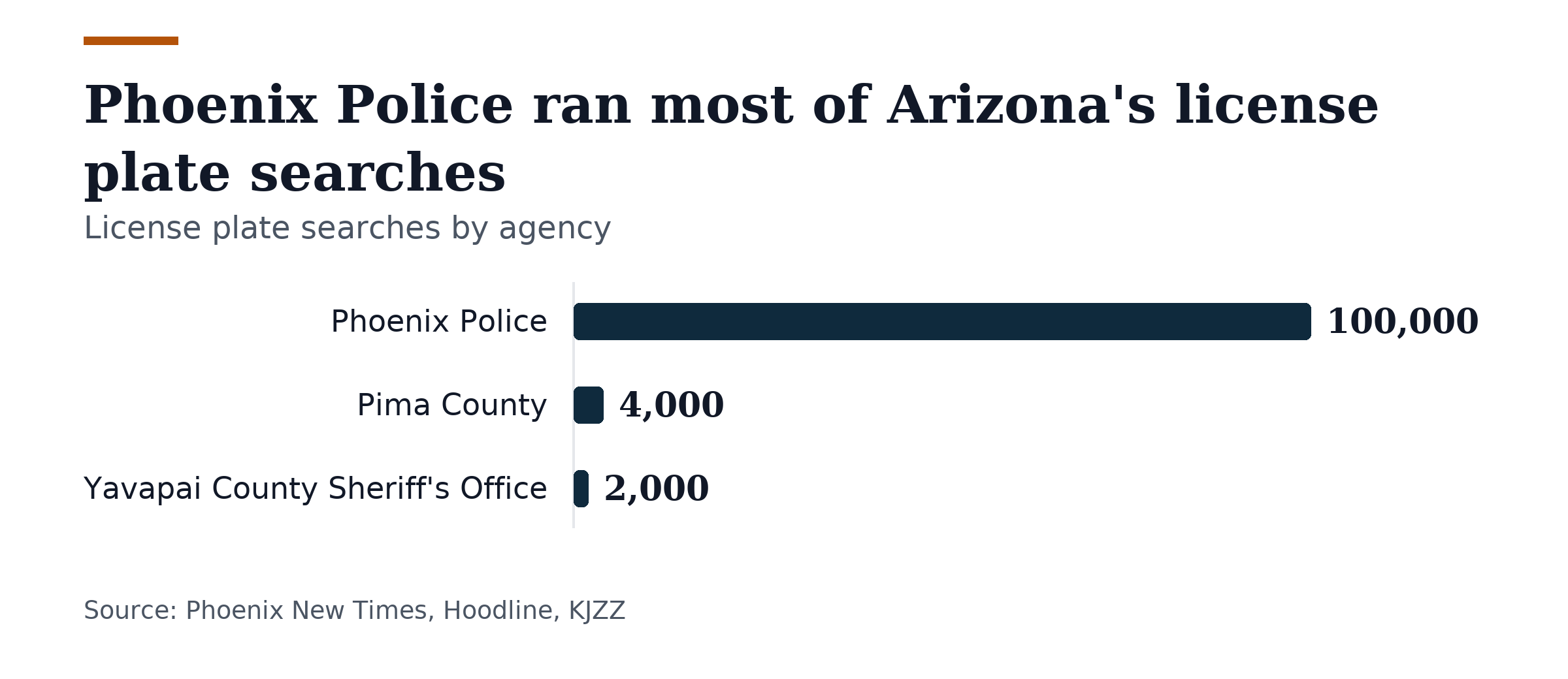
Phoenix Police carried out more than 100,000 of the statewide searches, and an estimated 200-plus officers used the no-cost arrangement, which the Phoenix City Council never voted on. On June 21, 2021, Phoenix Police Chief Jeri Williams signed the department’s Flock memorandum of understanding. Phoenix already had Motorola Solutions cameras and access to the Vigilant national lookup tool. The department declined to renew the agreement in summer 2026, yet officers continued searching for months after expiration until Flock cut off access.
At least eight Arizona law enforcement agencies, including the Yavapai County and Pima County sheriff’s offices, accessed Flock’s network through no-cost deals or other agencies. Yavapai County, the Maricopa County Attorney’s Office and Pinetop-Lakeside police signed no-cost deals that gave them five years of search privileges. In 2022, the Yavapai County Board of Supervisors approved its no-cost memorandum on a consent agenda with no public discussion.
The Yavapai County Sheriff’s Office ran more than 2,000 searches, capturing plate sightings from Cobb County, Georgia, and West Seneca, New York. In 2022, Pinetop-Lakeside police signed a Flock agreement after a private subdivision put up cameras. The department ran hundreds of searches between September 2023 and April 2025. Pinetop-Lakeside Police Chief Dan Barnes said the agency signed an agreement with the subdivision’s approval after Flock notified it about cameras installed by a private subdivision, granting access to those cameras and Flock’s national database.
Flock revoked Pinetop-Lakeside’s national lookup privileges under a new policy requiring paying customers, though the department still has access to its subdivision cameras. Why some Arizona agencies kept national lookup access after Flock ended Pinetop-Lakeside’s privileges under a policy requiring paying customers is unclear. In 2023, the Maricopa County Attorney’s Office signed its Flock memorandum after requesting camera access from Tempe Police, and the office said internal audits found no misuse.
Pima County ran at least 4,000 searches after receiving free database access from Flock with no memorandum, despite declining Flock cameras at high-traffic intersections. In 2024, Flock approached the Pima County Sheriff’s Office about installing cameras at high-traffic intersections. The county declined the cameras, but detectives kept using Flock’s database. Pima County also accessed Motorola Solutions license plate reader information through other agencies.
Four other Arizona agencies besides those with agreements searched Flock’s database without their own agreements. Marana, Globe and Superior used other agencies’ Flock access over a handful of days, most recently in 2024. Marana and Globe require searches to be tied to a case number and a legitimate law enforcement purpose, and both reported no misuse in audits. Superior Police Chief Joaquin Manuel said his agency did not use Flock while he was chief, though a detective may have partnered with a county.
Flock Safety runs more than 120,000 license plate cameras. Some cameras are owned by private businesses and community groups, which share data with law enforcement. Officers can use Flock’s national database to search vehicle records well beyond their own jurisdictions, expanding their ability to track people’s movements.
At least 11 agencies across Arizona have canceled Flock contracts. Tempe ended its Flock contract, becoming Arizona’s first city to ban license plate reader cameras. The ban makes an exception for multijurisdictional task forces that use another agency’s plate data without requesting a system query. Cave Creek, Flagstaff, Payson, Sierra Vista, South Tucson and Surprise also canceled Flock contracts earlier in 2026.
The Fountain Hills Town Council approved a 5-2 ordinance that permanently prohibits the town from acquiring, funding, installing or operating license plate readers. The ordinance also prevents Fountain Hills from buying reader data or search services from vendors outside the town.
At least 30 localities nationwide have deactivated Flock cameras or canceled contracts since the beginning of 2025. Flagstaff pulled its data out of Flock’s national and statewide lookup networks, limited sharing to two local agencies and cut retention from 30 days to 14.
Flock estimated that its cameras helped with more than 1 million law enforcement investigations in 2025. Pew Research Center said agencies disclosing camera data sharing reported a median of 217 other organizations, mostly law enforcement.
Lake Havasu Police shared Flock data with 137 agencies, and 58 were in-state. Hotlists from the Maricopa County Sheriff’s Office went to 77 agencies, including federal bodies such as Customs and Border Protection and the Secret Service.
A city spokesperson said Flock cameras assist Phoenix police with missing persons cases and violent crimes such as murders, and officers use them to identify suspects in shootings outside city limits. Phoenix Mayor Kate Gallego and Phoenix City Council members did not respond to repeated requests for comment, and Flock Safety also did not respond to repeated requests for comment.
State Sen. Lauren Kuby, a Democrat representing parts of Maricopa County and greater Phoenix, said: “Any agreement that lets an agency track where people go should require open public debate and a vote by elected leaders – period”. State Sen. Jake Hoffman, a Republican representing parts of Maricopa and Pinal counties, said the Fourth Amendment should not be treated as a suggestion or an invitation to bypass warrant requirements.
Dave Maass, head of investigations at the Electronic Frontier Foundation, said: “(Law enforcement) can backdoor a whole surveillance network”. He urged eliminating automated license plate reader access across the board instead of removing only a few cameras. Chad Marlow, who serves as senior policy counsel at the American Civil Liberties Union, said he had never seen arrangements like these and questioned whether Flock was providing people’s data for free to build customer relationships.
Because of these arrangements, communities struggle to identify which agencies can access license plate reader data and cannot easily oversee its use. Reporting indicates that officers have misused Flock’s system to stalk strangers and track romantic partners.
After the Town of Oro Valley denied her request, Leah Christopher sought data on five vehicles registered in her name. Oro Valley wants the case dismissed, while Christopher asks a judge to order the records’ release.
According to a Senate Bill 1111 fact sheet, agencies operating automated license plate readers should be responsible for collecting and retaining data and images. Whether the Senate Bill 1111 provision became law is not established by available evidence.
The Arizona Center for Investigative Reporting drew its tally from roughly four years of Flock audit logs obtained through Have I Been Flocked. The tally is likely an undercount since the logs cover just a fraction of agencies using Flock’s system.
AZCIR matched records based on five fields: the time of the search, the searching agency and officer, the stated reason, and the number of camera networks searched. Testers confirmed that no counted search involved two different license plates or appeared twice under two officers within a single agency’s log. A single search could appear a dozen times or once in each agency’s log that searched those cameras.
Alexandra Markovich of the Arizona Center for Investigative Reporting said: “Ooo, they declined to – well, they didn’t even decline to comment; they just didn’t respond, which is common for Flock.” Markovich said Flock can grant agencies free no-cost database access through a back door, and that the access comes when Flock approaches agencies or agencies approach Flock, potentially leaving departments with indefinite access. Markovich said legislators on both sides see the transparency gap as a concern, but action is uncertain with Arizona’s newly blue Legislature.
The Arizona Barbering and Cosmetology Board has sent investigators into the field with license plate reader cameras for routine inspections and when investigating specific complaints. Court documents argue that police access to the Flock database for a specific law enforcement reason creates a public record; otherwise no public record is created.
Join the discussion