

Key facts
- The EU Cyber Resilience Act sets mandatory cybersecurity rules for products with digital elements, covering items like smartwatches, cameras, internet-connected baby monitors, toys and cloud-enabled goods.
- CRA reporting duties have applied since September 2026, and Article 14 requires a 24-hour early warning beginning September 11, 2026.
- The complete CRA rules, including CE marking, begin to apply on Dec. 11, 2027, for connected goods placed on the EU market.
- BS EN 40000-1-1 sets out shared cybersecurity terms and definitions for the standards series.
BSI, the U.K. national standards body, released the first two standards backing the European Union’s Cyber Resilience Act during the week of Nov. 27, 2026. The standards give manufacturers a common framework for assessing and managing cybersecurity risk in connected products sold on the EU market.
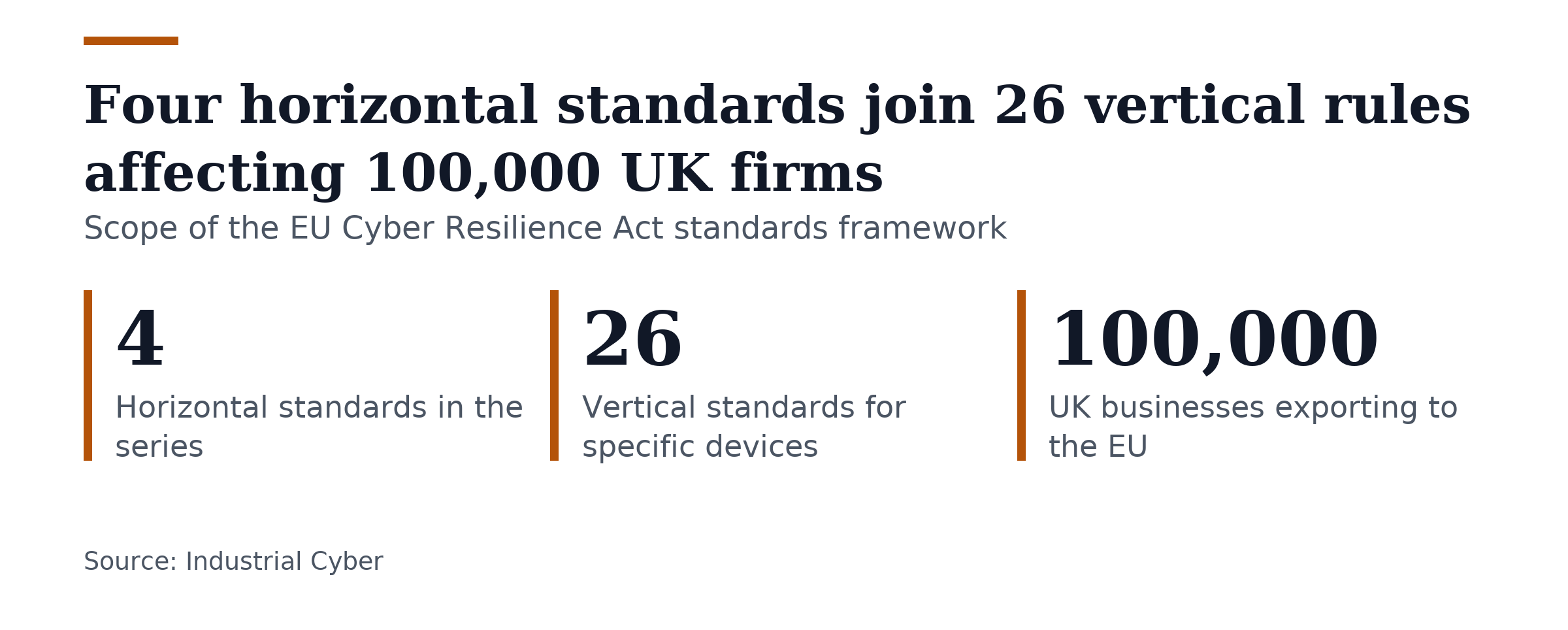
The first standard, BS EN 40000-1-1, defines shared cybersecurity terms for the series. BS EN 40000-1-2 covers product risk management principles and lifecycle work, offering manufacturers a consensus-based method for product risk assessment. The pair begins a four-standard horizontal series that covers every product with digital elements.
A third standard covering vulnerability handling, BS EN 40000-1-3, is expected in early 2027. A fourth standard for generic security requirements, BS EN 40000-1-4, is expected later in 2027. ETSI and CEN/CENELEC will add roughly 26 vertical standards with rules for routers, smart home devices, browsers and virtual private networks.
The EU Cyber Resilience Act imposes mandatory cybersecurity rules on products with digital elements. Covered items include smartwatches, cameras, internet-connected baby monitors, toys and cloud-enabled goods. The CRA covers products with digital elements sold in the EU market, regardless of where the maker is based or where goods are produced.
Medical devices and civil aviation equipment fall outside the CRA because they already have their own EU safety regimes. Open-source software made entirely outside business contexts is excluded from the CRA. Companies that sell or maintain open-source parts in a product generally count as manufacturers under the regulation. About 100,000 U.K. businesses that export to the EU or supply EU manufacturers are covered by the rules.
The Cyber Resilience Act entered into force under Regulation EU 2024/2847 on December 10, 2024. Reporting duties under the CRA have applied since September 2026. Article 14 requires a 24-hour early warning beginning September 11, 2026. Connected goods placed on the EU market must comply with CE marking and the rest of the CRA rules beginning Dec. 11, 2027.
Products placed on the EU market after Dec. 11, 2027, that lack CE marking showing CRA compliance may not legally remain on sale.
June 11, 2026 was an early CRA milestone: national authorities had to designate conformity assessment bodies under Chapter IV by that date. A delegated act adopted on December 11, 2025 sets rules for delaying how member states share notices under Article 14(9).
Manufacturers send vulnerability notices through the ENISA Single Reporting Platform. It sends them to the home country’s computer security incident response team (CSIRT) and to ENISA. Manufacturers file a single notice, and the platform forwards it to CSIRTs in every member state where the product is available.
Companies based outside the EU must appoint an authorized EU representative to handle national CSIRTs and the ENISA Single Reporting Platform. Every covered product must have a software bill of materials under the CRA. Those materials must use machine-readable formats such as CycloneDX or SPDX.
Manufacturers must issue an early warning within 24 hours after learning of active exploitation. Full notification is due within 72 hours, followed by a 14-day final report and 30 days for severe incidents. Manufacturers start the 24-hour clock when they become aware of active exploitation, not after confirmation or completed triage. The reporting platform will be ready by September 11, 2026, ENISA said.
There will be no API at launch, so early reports must be filed manually through the web portal. Guidance for signing up, training sessions and practice runs would be available during June 2026, according to ENISA.
Tech Times reported that penalties for serious CRA violations can reach €15 million or 2.5% of worldwide yearly revenue, whichever is larger. Serious violations can also force removal of products from the EU’s single market.
BSI told manufacturers to begin product cybersecurity risk assessments before the Dec. 11, 2027 deadline. Laura May Bishop, Sector Lead, AI and Cybersecurity at BSI, said AI is making the problem worse as cyber criminals grow more sophisticated, so makers of connected products must stay alert.
She said the first standards give firms a common language and a consensus-based method for assessing product cybersecurity risk, which makes the requirements easier to understand. Bishop said: “We know cyber criminals are getting ever more sophisticated in their methods, and AI is only exacerbating that.”
British experts helped shape the standards. Publication gives U.K. manufacturers a domestic path to guidance they need to keep selling in the EU market. BSI research on AI failure costs found that 31% of respondents view cybersecurity as their top current risk while AI changes operations, and 48% expect it to matter more in the coming year.
Awareness is low, according to the OpenSSF and Linux Foundation Research 2026 CRA Awareness and Readiness Report: 66% of respondents do not know the CRA, up from 62% in 2025. Most European smaller businesses do not know that the regulation applies to them. In July 2026, the European Commission published its first non-binding implementation guidance for the CRA. It targets manufacturers, software developers and businesses preparing for the CRA.
The CRA works alongside the NIS2 Directive rather than replacing it. NIS2 covers network and information systems for essential service operators, not products.
GDPR requires a separate 72-hour notice to data protection authorities when personal data is involved in a vulnerability or incident. That notice runs alongside CRA reporting. It does not replace CRA reporting. Britain’s Product Security and Telecommunications Infrastructure Act took effect in Britain in 2024.
In October 2023, a coalition including Google, the Electronic Frontier Foundation, ESET, Rapid7, Bugcrowd, Trend Micro, the CyberPeace Institute and European Digital Rights wrote to EU officials. The letter said requiring disclosure of unpatched vulnerabilities within 24 hours is counterproductive.
Katie Moussouris, CEO of Luta Security, said governments cannot build patches themselves. She said early required reporting would disrupt coordinated remediation, a process that usually takes weeks or months. The Electronic Frontier Foundation said the delay mechanism is an improvement. The group said governments could still use gathered unpatched vulnerability information for spying or offensive use.
Routers and switches carry nearly 32 vulnerabilities on average, according to Forescout’s 2026 Riskiest Connected Devices research. Routers and switches account for roughly a third of the most critical flaws in corporate networks.
The Aisuru botnet, observed from late 2024 through 2025, launched denial-of-service attacks above 29.7 terabits per second. The attacks came from roughly 300,000 to 700,000 compromised routers, recorders and cameras. The European Vulnerability Database was launched by ENISA in May 2025 under the NIS2 Directive.
Join the discussion