

This is a new development in a story we reported earlier: Drupal warns original installer patch left sites open to takeover.
Key facts
- CVE-2026-136716 is described as improper checking for unusual conditions or exceptional conditions, and the CVE List says it allows forceful browsing. key: true.
- CVE-2026-136716 exposes Drupal core versions from 0.0.0 to 10.6.23, from 11.0.0 to 11.3.23, and from 11.4.0 to 11.4.14. key: true.
- Drupal says installing the latest updates addresses CVE-2026-136716, and the fixed releases are Drupal 11.4.14, Drupal 11.3.23 and Drupal 10.6.23. key: true.
- Active exploitation of CVE-2026-136716 has been observed since November 19, 2026. key: true.
Drupal warned that CVE-2026-136716, a highly critical flaw in Drupal core, is under active exploitation, with attacks observed since Nov. 19, 2026 — a new development in the Fail2Install installer story that can lead to remote code execution or a site takeover.
The flaw relates to CVE-2026-132165, or Fail2Install, which Drupal patched on Nov. 18, 2026. Fail2Install permits remote code execution. CVE-2026-136716 covers remaining vulnerable installation states, so attackers can still abuse those states to take over sites despite the earlier fix. The earlier advisory, SA-CORE-2026-017, patched installer flaws, but sites stuck in unusual or incomplete setup states remain exposed, including production sites.
The vulnerability amounts to improper checking of unusual or exceptional conditions, and the CVE List describes it as allowing forceful browsing, in which an attacker reaches pages directly instead of following the intended flow.
Versions 0.0.0 through 10.6.23, 11.0.0 through 11.3.23 and 11.4.0 through 11.4.14 are exposed. Each range tops out at a fixed release: 10.6.23, 11.3.23 and 11.4.14 respectively. The end-of-life branches – Drupal 11.0.x to 11.2.x and Drupal 10.5.x and below – will not get a fix for CVE-2026-136716, and Drupal says the CVSS score is not available.
Drupal says applying the latest updates addresses CVE-2026-136716. The fixed releases are Drupal 11.4.14, Drupal 11.3.23 and Drupal 10.6.23. After updating to current versions, administrators should run update.php to repair existing production sites and lock down the Drupal installer everywhere. Owners who already locked down the installer, install.php, are not affected by CVE-2026-136716.
Drupal 11.4.13, 11.3.22 and 10.6.22 include patches for the earlier Fail2Install flaw, while end-of-life branches will not receive one.
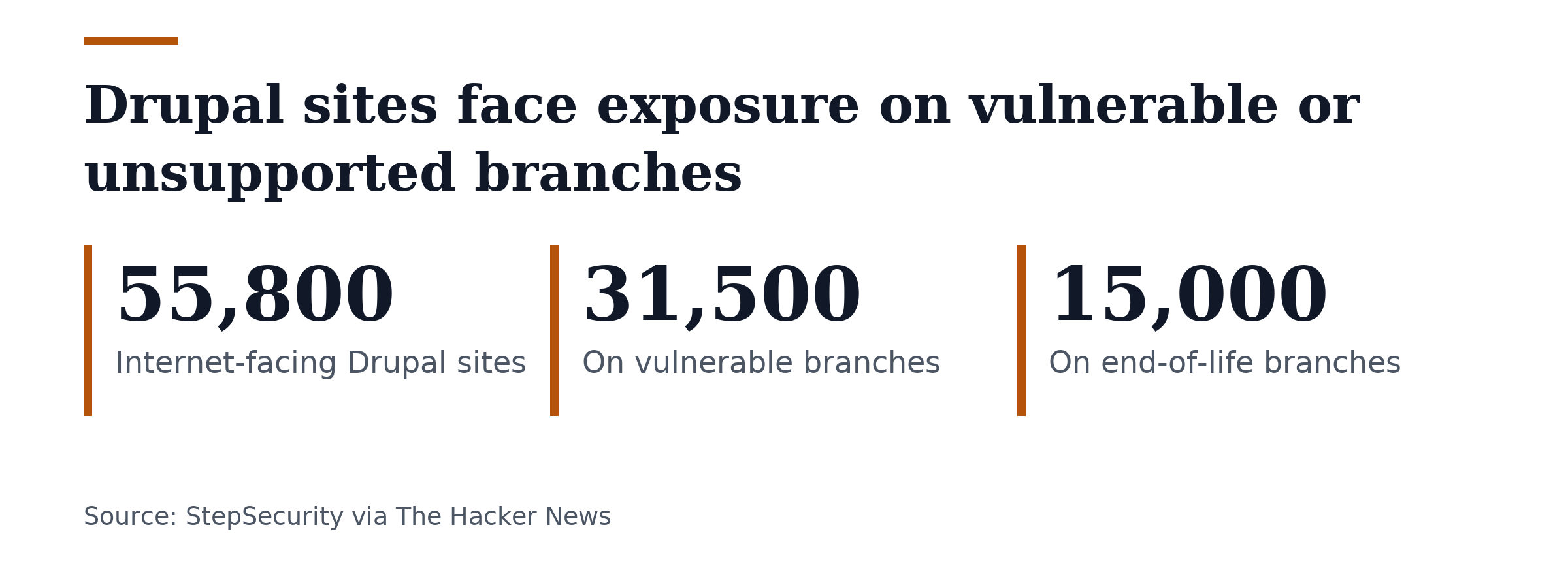
StepSecurity put the number of internet-facing Drupal sites at about 55,800 as of Nov. 26, 2026, with 31,500 on branches exposed to CVE-2026-132165 and about 15,000 on the end-of-life Drupal 8 and 9 branches. Drupal, a content management system, is commonly used by large organizations such as government entities, major research universities and high-profile enterprise and media organizations, and a takeover means attackers control the site’s content and hold data about its users and subscribers.
Administrators cannot tell from the user interface whether a site is in the vulnerable state, and compromised sites may no longer show that state. Drupal warns that sites with installers reachable from the internet after the CVE-2026-132165 fix may have been compromised.
Drupal says attackers abused Fail2Install on live websites starting Nov. 19, 2026, at 19:00 UTC. CISA added CVE-2026-132165 to its Known Exploited Vulnerabilities list on Nov. 24, 2026, telling federal agencies to fix it by Nov. 27, 2026.
Drupal calls it the third of its flaws abused in live attacks in 2026, after CVE-2026-118539 in late October and CVE-2026-9082 in May, and going back to November 2021, CISA has counted five Drupal flaws among those abused in active attacks, with two also used by ransomware cartels. After learning of the attacks, Drupal rated Fail2Install highly critical and gave it a CMSS score of 20/25.
If an update is not possible right away, administrators should block access to /core/install.php at the web server level or through the .htaccess file in the website root. Some exploit paths are blocked if the server cannot write to settings.php or change its permissions, the Drupal Security Team says.
Sites behind the paid Drupal Steward Web Application Firewall are shielded from known attack vectors, though administrators should still upgrade. The team tells administrators to examine site logs for signs of unauthorized access and unexpected changes around the user 1 account, to confirm the administrator controls the user 1 e-mail address and to consider resetting the password for the user 1 account.
Join the discussion