

Key facts
- SOCRadar attributes a previously undocumented espionage operation called WeaveLotus to a suspected Vietnam-sponsored hacking group.
- The campaign included five confirmed intrusions against targets in Thailand and the Philippines, along with reconnaissance against Indonesian government organizations.
- SOCRadar observed the sustained RedOps campaign between August and September 2026.
- SOCRadar said evidence backs treating WeaveLotus as a separate activity cluster while falling short of proving state sponsorship.
The Hacker News reported that SOCRadar attributes a previously undocumented espionage operation called WeaveLotus to a suspected Vietnam-sponsored hacking group behind five confirmed intrusions in Thailand and the Philippines and reconnaissance against Indonesian government organizations between August and September 2026. The group targeted military, government, and legislative organizations in Southeast Asia to collect intelligence on South China Sea defense and military agreements.
SOCRadar observed the sustained RedOps campaign between August and September 2026. The firm said evidence tying the actor to Vietnam includes Vietnamese-language code comments, activity during UTC+07:00 working hours, regional strategic targeting, and custom scripting. SOCRadar said evidence backs treating WeaveLotus as a separate activity cluster while falling short of proving state sponsorship.
Following OSINT, the operators listed government, military, and legislative organizations in the Philippines, Thailand, and Indonesia, SOCRadar said. The firm said RedOps appears aimed at exfiltrating internal records and documents from Southeast Asian governments, and SOCRadar said the exfiltration supports Vietnam’s foreign policy and military intelligence priorities. SOCRadar said this pattern is consistent with state-directed intelligence collection.
In August 2026, Hunt.io disclosed a separate suspected Chinese cyber espionage campaign that targeted a nuclear research organization as well as a marine engineering and shipbuilding company. Hunt.io said the suspected Chinese actor stole sensitive documents after entering through known security vulnerabilities.
SOCRadar said in a Thursday, Nov. 26, 2026 analysis that intruders entered mainly through flaws and default logins in open-source tools. The firm listed GeoServer, JasperReports, osTicket, and exposed Laravel debug mode settings among the open-source tools used for initial access.
Operators began with passive reconnaissance, harvesting Certificate Transparency logs through CertSpotter and crt.sh. The activity progressed to active Nmap port scans and IMAP or POP3 banner grabbing across more than 30 organizations. Operators fingerprinted VPN services including Palo Alto GlobalProtect, Ivanti Connect Secure or Pulse Secure, Cisco ASA, and Fortinet FortiGate.
The actor ran automated Bing search scripts to collect news and documents about military agreements among the Philippines, China, and the United States, with emphasis on the South China Sea. SOCRadar said WeaveLotus conducted broad reconnaissance against Indonesian government agencies between August and September 2026, and SOCRadar said reconnaissance against Indonesian targets stopped short of compromise.
“The threat actor established persistent internal network access using reverse SSH tunnels and moved laterally into downstream networks and applications,” SOCRadar said. The firm said the campaign shows a suspected Vietnam-linked espionage operation used exposed applications, weak authentication measures, and persistent network connections.
In the Thai military organization intrusion, the actor likely exploited GeoServer flaw CVE-2024-36401 with CVSS score 9.8. The actor deployed a SOCKS5 proxy and opened a reverse SSH tunnel. The actor accessed Directus CMS API endpoints for file collection and asset downloads without authentication to enumerate and download records. The actor used optical character recognition to pull English and Thai text from PNG images in the collected data.
The actor unsuccessfully attempted to access surveillance video feeds hosted on Wowza for possible real-time visibility into military operations. At a Thai legislative organization, the actor used default credentials jasperadmin:jasperadmin on an exposed JasperReports server to upload a malicious report that ran SQL scripts on a Microsoft SQL Server backend. The actor deleted the report, then used xp_cmdshell to open a reverse SSH SOCKS proxy tunnel over port 443 to WeaveLotus infrastructure at 172.235.245[.]49. The actor deployed a lightweight Python command and control server to automate post-exploitation.
The actor launched password spraying attacks against a third-party document management system, pairing real employee names with National ID numbers. After authentication, the actor collected the full system configuration and the complete application user directory of 1,502 records. The actor also gathered system audit logs. The actor took 5,000 ZIP archives containing sensitive data.
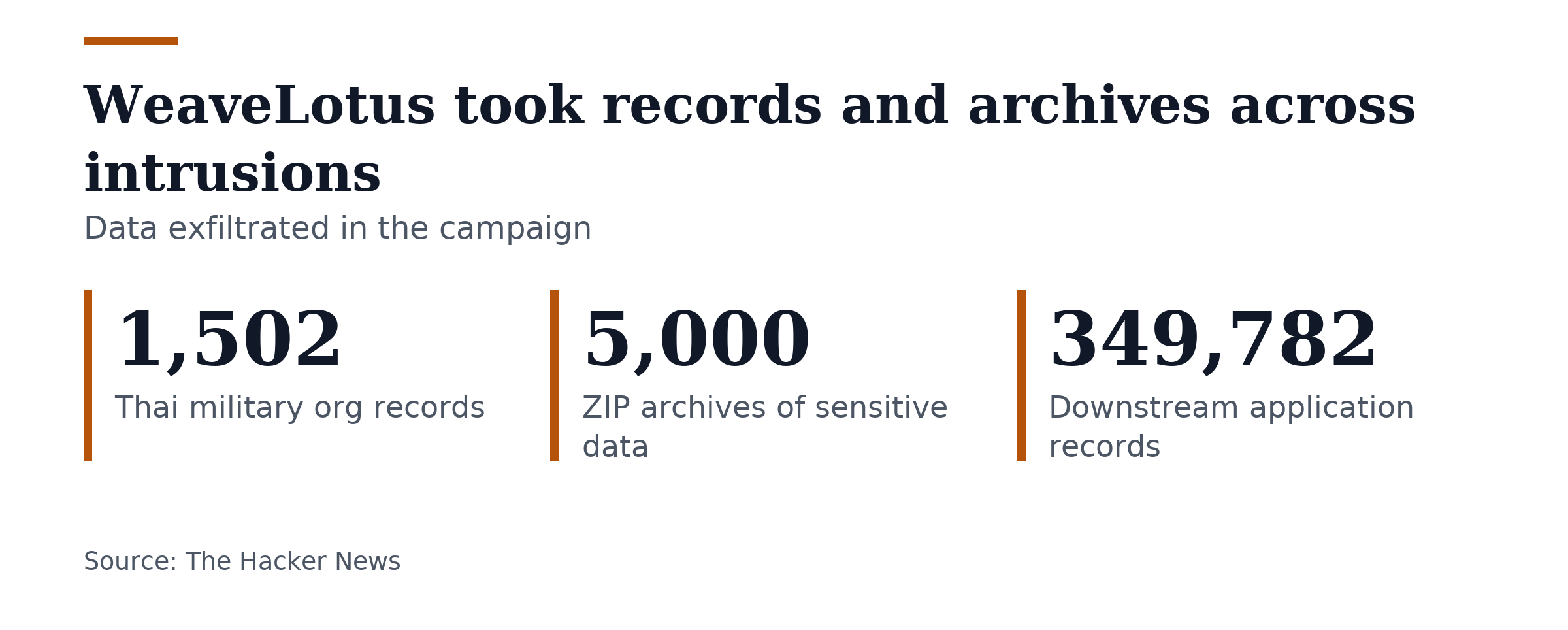
At a Thai government organization, the actor gained root SSH access to a Keycloak 3.4 server and dumped its credential database. The actor cracked PBKDF2-SHA256 hashes offline using wordlists built around Thai Buddhist Era years and validated them in real time against the Resource Owner Password Credentials token endpoint. Users from various Thai ministries and agencies held the valid accounts, and two of them granted administrative privileges. Using valid credentials, the actor retrieved 349,782 records from a downstream application containing five-year fiscal plans, sustainable development goals, masterplan targets, reform directives and national strategy alignment.
At Philippine government organization A, the actor exploited unauthenticated SQL injection flaw osTicket CVE-2021-42235 with CVSS score 9.8 to extract database schemas. The actor dumped usernames and e-mail addresses. The actor dumped bcrypt password hashes for registered staff accounts.
At Philippine government organization B, the actor probed a Laravel web application to get server paths and pieces of application source code. The probe uncovered directories connected to an internal project-management and budgeting system.
The RedOps campaign focused only on government, military, and legislative bodies in the Philippines, Thailand, and Indonesia. SOCRadar said no evidence shows private-sector entities were targeted. SOCRadar said recovered tooling and operational artifacts give insight into the actor’s methods.
Join the discussion