

Key facts
- CISA flagged a critical stack buffer overflow, CVE-2026-129713, scored 9.8 under CVSS v3, in Danfoss AK-SM 8xxA Series devices on version 5.4.0 or earlier.
- Specially crafted HTTP/S POST requests from remote attackers can corrupt memory, restart the webserver, and potentially execute arbitrary code with webserver privileges without authentication.
- The flaw hits critical manufacturing, energy, and commercial facilities around the world and is a use-after-free issue, CWE-416, tracked as CVE-2026-119055 with a CVSS v3 score of 5.3.
- CISA published its Schneider Electric advisory, ICSA-26-328-02, on Nov. 24, 2026; the advisory's initial release date was Nov. 10, 2026.
CISA issued three industrial-control-system advisories during the week of Nov. 23-27, 2026, covering Danfoss refrigeration controllers, Schneider Electric power-design software, and AutomationDirect programming software deployed across global critical infrastructure.
The agency identified a critical stack buffer overflow in Danfoss AK-SM 8xxA Series controllers on version 5.4.0 and older, scoring 9.8 on the CVSS v3 scale (a common severity scale for software vulnerabilities) and tracked as CVE-2026-129713. The vulnerability resides in an unauthenticated CGI handler on the controller. Remote attackers can send specially crafted HTTP/S POST requests that corrupt memory, force a web server restart, and potentially run arbitrary code with web server privileges, all without needing authentication. CISA said, “Successful exploitation of this vulnerability could allow an attacker to execute arbitrary code with webserver privileges,” and Carlo Meijer of Midnight Blue reported the flaw to CISA; the agency says it has not received reports of public exploitation against these vulnerabilities so far.
In a Nov. 20, 2026 advisory, Danfoss said the flaw would not receive an immediate fix and would instead arrive in upcoming software version 5.5.x. No patch exists yet for CVE-2026-129713. Danfoss plans to address the issue in a future AK-SM 800A Series release, version 5.5.x, and will eventually remove the ability to disable Strict Mode. CISA noted the flaw “allows remote attackers to send specially crafted HTTP/S POST requests, leading to memory corruption, webserver restart”.
Until a patch arrives, Danfoss says affected devices should not be exposed directly to the internet or given public IP addresses. The company also recommends limiting remote access to affected devices using a secure VPN or another protected network design. Danfoss advises running affected devices in Strict Mode for enhanced security protections. It also says every user account and administrative access needs strong, unique passwords.
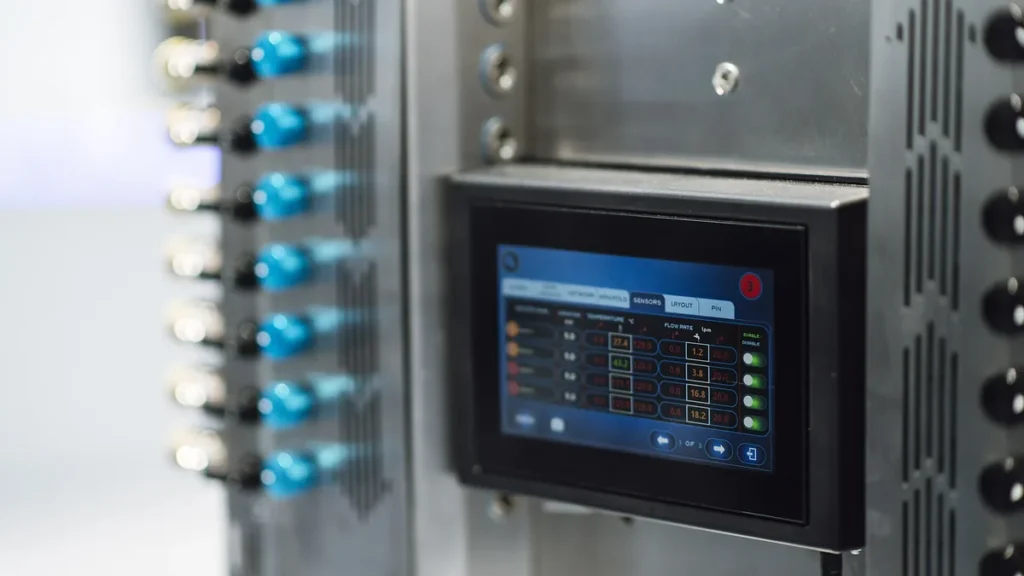
Danfoss calls the product line the AK-SM 800A Series, which includes the 820A, 850A, and 880A models. Depending on the model, the controllers can also manage store lighting and HVAC. These controllers handle commercial refrigeration, HVAC, and lighting for food retailers. CISA says the controllers are installed around the world, but the exact number remains unknown.
These products serve water and wastewater systems, commercial facilities, energy, and critical manufacturing across the globe.
On Oct. 11-12, 2026, attackers broke into Danfoss controllers at up to 700 mostly French supermarket locations, including Intermarche, Coopérative U, Carrefour Market, Monoprix, Leclerc, and Super U. They raised temperatures to spoil food and sometimes start fires. A second wave on Nov. 1-2, 2026 followed the same playbook against retailers in at least 12 European countries and reportedly struck blood banks in France. On Nov. 2, 2026, remote access shut down or changed refrigeration settings at least 115 supermarkets across Belgium, the Netherlands, Sweden, Luxembourg, Ireland, Romania, and Estonia.
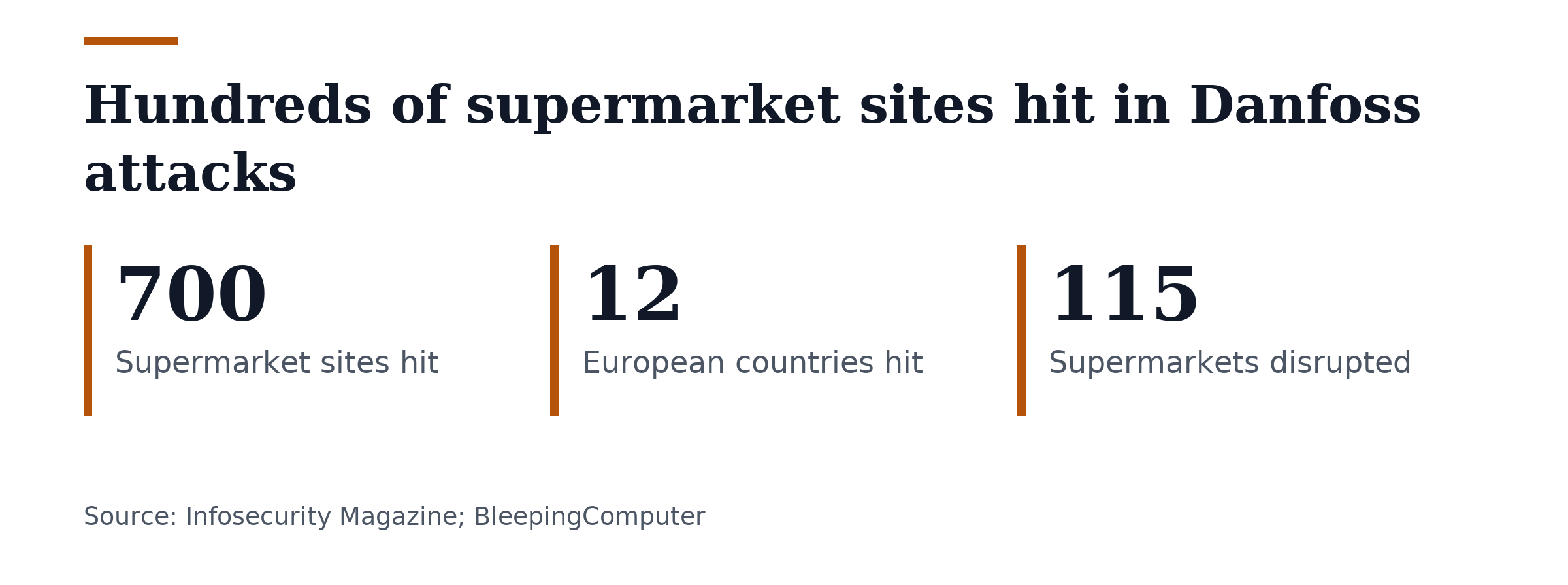
Attackers suspected of links to the same campaign also altered cold-storage settings at three facilities supplying the French national blood service. Retailers in the UK were mostly unaffected, since Danfoss controllers are less common there.
French authorities linked the October attacks to Shahid Kaveh, which they describe as an Iran-connected cyber unit tied to the Islamic Revolutionary Guard Corps. Responsibility for the November attacks across Europe has not been conclusively established. Sabcobel, a supplier, said attackers reused the vulnerability from the October France attacks, suggesting Danfoss systems were involved again. Some reports put nationwide losses at tens of millions of euros in a single day.
CISA added three Danfoss flaws – CVE-2023-25914, CVE-2023-25915, and CVE-2025-41450 – affecting AK-SM 800A and AK-SM 8xxA systems to its Known Exploited Vulnerabilities catalog. CVE-2023-25914 is a path traversal flaw affecting Danfoss AK-SM 800A software earlier than version 3.3; the fix arrived in version 3.3. CVE-2023-25915 involves improper input validation in Danfoss AK-SM 800A software prior to version 3.3, and version 3.3 contains the patch. CVE-2025-41450 is an improper authentication flaw affecting Danfoss AK-SM 8xxA software earlier than version 4.2, identified by Claroty’s Team82 researchers and patched in version 4.2.
Investigators have not confirmed that the supermarket operations involved any of those three flaws.
Ireland’s National Cyber Security Centre issued an advisory in November 2026 citing Midnight Blue research on six pre-authentication remote code execution flaws. The flaws affected Danfoss AK-SM 800A controllers running firmware through version 5.3.2. When that advisory was issued, no CVE identifiers or patches existed for the flaws, and researchers warned that intruders could keep persistence through factory resets and firmware updates. Controllers affected in the recent attacks included older Danfoss models no longer receiving security updates, specifically AK-SM800 and AK-SC355, along with newer models running outdated firmware such as AK-SM800A.
CISA’s Schneider Electric advisory, ICSA-26-328-02, came out on Nov. 24, 2026, though it was initially released on Nov. 10, 2026. The flaw affects critical manufacturing, energy, and commercial facilities worldwide and is a use-after-free issue, CWE-416, tracked as CVE-2026-119055 and scored 5.3 under CVSS v3. EcoStruxure Power Build Rapsody lets users enter or import single-line diagrams and produce a switchboard bill of materials for hardware, connections, and mounting parts. The vulnerability was reported to CISA by Schneider Electric CPCERT.
A local attacker can exploit it by tricking a user into opening a specially crafted malicious SSD file, which could lead to arbitrary code execution. Left unfixed, the issue can corrupt memory and trigger heap or stack buffer overflows. Fixes were released by Schneider Electric through its website. The patched builds include French 2.9.12.0101, Spanish 2.9.5.0000, Portuguese 2.9.7.0000, Belgian French 2.9.8.0000, Belgian English 2.9.3.0000, International English 2.9.4.0000, International French 2.9.6.0000, and Dutch 2.9.6.0000.
The affected software covers eight language-specific builds. French versions 2.9.1.0 and earlier are affected, as are Spanish versions 2.8.5.0301 and earlier. Portuguese versions 2.8.7.0101 and earlier and Belgian French versions 2.8.8.0201 and earlier are also affected. Belgian English versions 2.8.3.0201 and earlier and International English versions 2.8.4.0401 and earlier are affected.
International French versions 2.8.6.0000 and earlier and Dutch versions 2.8.2.0000 and earlier round out the list.
CISA identified a heap-based buffer overflow in AutomationDirect C-More EA9 Programming Software. The issue carries CVE-2026-127280, a CVSS v3 score of 7.8, and affects version 6.80 and earlier. Version 6.80 uses project file data within heap memory operations, and the validation is not adequate. When opened, a malicious project file can trigger a heap buffer overrun.
That corrupts heap memory and can destabilize or crash the application. An attacker exploits the flaw by convincing a user to open a malicious project file delivered through e-mail, file sharing, or removable media. Exploitation could corrupt application memory, crash the application, and potentially allow arbitrary code execution. The vulnerability was reported to CISA by rgod of TrendAI Zero Day Initiative.
AutomationDirect released a vendor fix. The company advises updating to version 6.81 through its software downloads page.
CISA recommends reducing network exposure so that control system devices and systems are not reachable from the internet. Control system networks and remote devices should sit behind firewalls and remain isolated from business networks. When remote access cannot be avoided, CISA says it should use updated Virtual Private Networks. The agency warns that a VPN’s security depends on the devices connected through it.
Before deploying defensive measures, organizations should conduct an impact analysis and a risk assessment. CISA says organizations that see suspected malicious activity should follow internal procedures. They should also report findings for tracking and correlation against other incidents.
CISA refers organizations to ICS webpage resources such as Improving Industrial Control Systems Cybersecurity with Defense-in-Depth Strategies. It also points to technical information paper ICS-TIP-12-146-01B, Targeted Cyber Intrusion Detection and Mitigation Strategies.
When remote access is necessary, organizations should deploy a hardened jump host with multifactor authentication, least-privilege access, and authorized time-bound sessions. Device traffic should run over trusted, dedicated OT networks. Higher-criticality systems may require dedicated or physically separated infrastructure. Organizations using logical segmentation should configure, secure, and monitor those controls properly.
Physical and logical access should be limited to authorized personnel. Least-privilege principles should apply across administrative, engineering, maintenance, and service access.
Where supported, organizations should set up application allowlisting. This lets only trusted, pre-approved applications run while blocking unauthorized software. Antivirus or endpoint detection and response tools should be used where supported and compatible. Host-based and network firewalls should be configured to allow only required communications.
Unneeded services, ports, protocols, and pathways should be turned off. If a service or protocol must stay on for operations, access should be limited to trusted systems and authorized users. System, security, and network logs should stay enabled and be reviewed regularly. Communications with affected systems should be watched for unexpected connections or changes in network behavior.
Organizations should keep secure, tested, preferably offline copies of PLC programs, device configurations, engineering workstation settings, and other restoration data. Restoration should be confirmed periodically. Critical OT functions should continue running without unnecessary reliance on external networks, cloud services, remote-access services, corporate IT, or other nonessential systems. Removable media used to move files into isolated or restricted environments should be controlled and trusted, and scanned for malicious content before use.
These organizations should continually evaluate the risk of running vulnerable or outdated firmware and software. Compensating controls should be adjusted as conditions change, and vendor updates should be prioritized after safe testing and deployment.
Users should avoid links and attachments in unexpected e-mail, CISA says. The agency also points to guidance on recognizing e-mail scams, phishing, and social engineering.
Join the discussion