
Key facts
- Bot Auto launched Capacity Grid, a freight platform linking shipper demand with driverless trucking capacity under agreements for 200 million miles.
- Shippers and freight brokers can reserve driverless trucking ahead of time with set prices, routes and operating schedules through the platform.
- One deal commits 50 million miles to FreightVana, a Phoenix-based logistics firm focused on power-only freight transportation.
- Bot Auto has not set a completion timetable for the full 200 million miles under the announced agreements.
Bot Auto has launched Capacity Grid, a freight platform matching shipper demand with driverless trucks under agreements covering 200 million miles.
One announced deal puts 50 million miles with FreightVana, based in Phoenix and focused on power-only freight transportation. Bot Auto has not set a completion timetable for the full volume.
Capacity Grid moves operations away from individual autonomous trucks toward a managed network that serves customers across many routes and schedules. Shippers and freight brokers can book driverless trucking ahead of time at set prices, with fixed routes and operating schedules. They buy autonomous freight transportation by the mile and arrange capacity to match their requirements.
Instead of handling each driverless truck alone, the platform matches trucks, routes, schedules and trailers to what customers need. Buyers can reserve space on fixed routes and time windows at set prices, so Bot Auto can plan its fleet around expected freight volumes.
Bot Auto owns and runs its own vehicles and sells transportation directly to customers, instead of selling driving systems to fleet operators. Customers do not need to purchase autonomous trucks, keep them running or manage the technology behind them.
The approach will lift vehicle utilization, lower operating costs and give customers more predictability when planning logistics, Bot Auto says. Its model keeps vehicles running often so fixed costs can be spread across more miles that produce revenue. According to Bot Auto, keeping utilization high matters because commercial viability for autonomous trucking depends on it. “Pair that with humanless trucks, and the economics on both sides improve substantially,” said Brett Suma.
On Apr. 29, 2026, a Bot Auto truck completed a driverless commercial run between northeast Houston and Hutchins near Dallas, with nobody aboard. It departed at 1:16 a.m. and arrived at 4:57 a.m. on the 231-mile run for freight broker Ryan Transportation. At Fort Hood in Texas, Bot Auto runs a pilot program using autonomous trucks to move goods between warehouses. Its purpose is to test self-driving technology for civilian use on a military base.
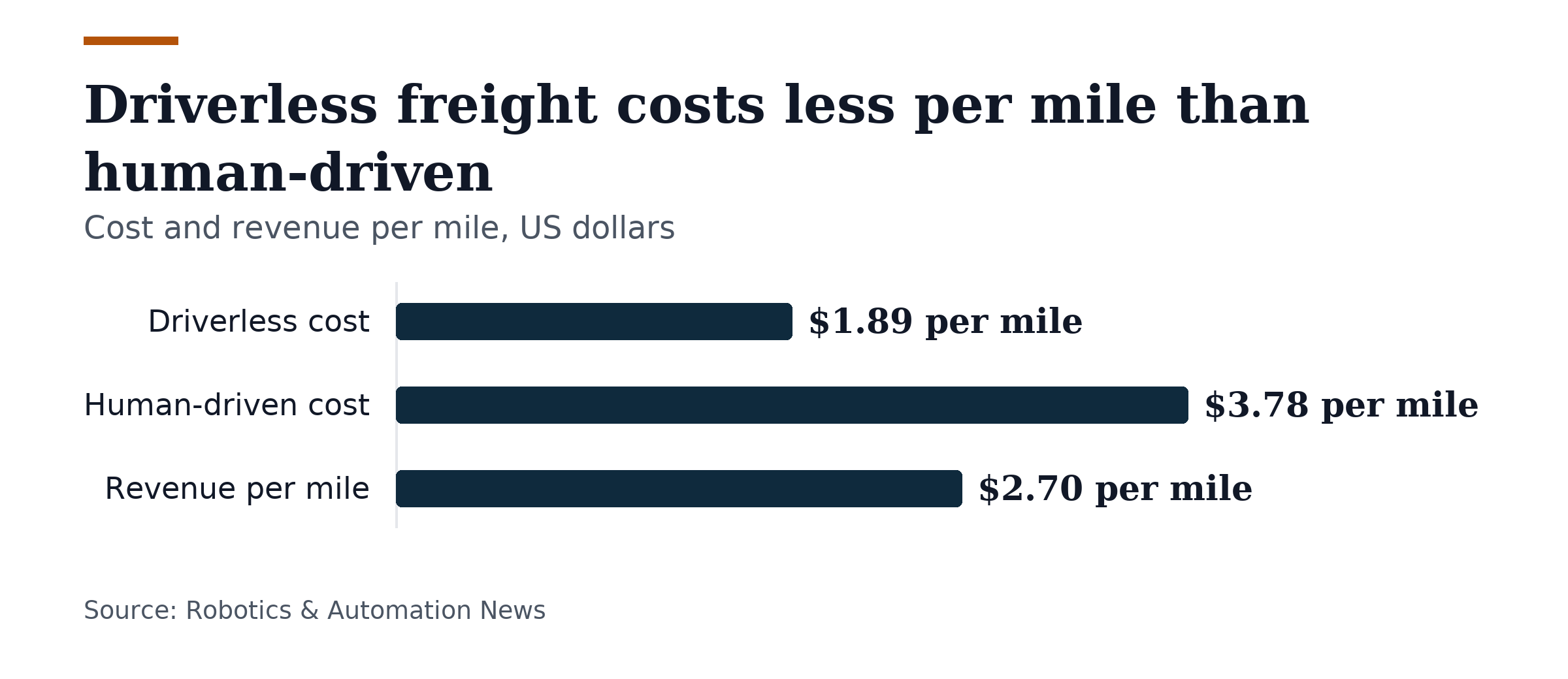
Company-reported figures put the driverless trip at $1.89 per mile, against $3.78 per mile for a comparable human-driven run. The shipment earned revenue of $2.70 per mile. Those figures do not, by themselves, show profitability across a bigger fleet, since vehicles also have to be bought, maintained, insured, managed and supported with infrastructure.
Bot Auto says J.B. Hunt, Ryan Transportation and Steves & Sons are among the customers already using its autonomous trucking services. During April, Bot Auto ran 12 trucks over two routes and served more than 25 customers. The company hauls roughly 350 loads each month, and revenue rose 270% from May through August 2026, according to Yahoo! Finance.
Yahoo! Finance reported that Lenovo’s AD1 domain controller, which is built on NVIDIA Hyperion, serves as the production compute platform Bot Auto uses for its Class 8 heavy-duty trucks. Bot Auto will begin integrating the AD1 into its trucks in Q1 2027.
Lenovo rates the AD1 for continuous operation from -40°C to 85°C, and the unit is built to handle Class 8 trucking shock and vibration. Through this deployment, Bot Auto joins the autonomous trucking customers on Lenovo’s US list.
Bot Auto’s autonomous-driving system, including compute and sensors, carries an expected hardware bill of materials of $50,000 per truck. A January 2026 estimate from Heavy Duty Journal puts the price of a full truck at $350,000 to $600,000. That points to an autonomy system cost of $150,000 to $400,000, or three to eight times what Bot Auto quotes.
As capacity grows across Texas and the Southwest, deployment will expand toward a billion autonomous miles by 2031. Taking driverless trucking beyond limited commercial routes will demand more spending on vehicles, maintenance facilities, operational oversight and infrastructure. Capacity Grid is meant to line up customer demand before fleet capacity is added, giving the expansion a commercial framework, and Bot Auto aims to move past proving that driverless freight works and create a repeatable business model for large-scale commercial operations.
The strategy addresses pressure facing the US trucking industry, including operating costs, driver availability and shifting freight capacity. The company believes autonomous vehicles can help with some challenges through steadier operations on established highway routes and overnight services. US federal hours-of-service rules limit most property-carrying truck drivers to 11 driving hours after 10 straight hours off duty. Driver rest rules do not bind autonomous trucks, so they could run longer, though maintenance, refueling and other constraints still apply.
Join the discussion