
Key facts
- New partnerships announced at GTC Berlin are expanding autonomous driving programs at European automakers and mobility companies such as Mercedes-Benz, Volkswagen, Volvo Cars, Bolt and Einride.
- Mercedes-Benz agreed to integrate Hyperion, the Alpamayo Stack and Halos into MB.OS, its vehicle operating system.
- Mercedes-Benz is expanding its work with Nvidia to cover Level 3 and Level 4 driving capabilities.
- Einride, a Swedish autonomous trucking company, is building its next-generation Einride Driver system with Hyperion, Alpamayo and Cosmos AI models.
Nvidia announced new autonomous driving partnerships at GTC Berlin, which ran Oct. 20-22 with Jensen Huang’s keynote on Oct. 21, bringing European automakers and mobility companies such as Mercedes-Benz, Volkswagen, Volvo Cars, Bolt and Einride into its platform ecosystem.
Mercedes-Benz agreed to put Hyperion, Alpamayo software and Halos into MB.OS, its vehicle operating system, and is expanding cooperation with Nvidia to cover Level 3 automated driving and Level 4 autonomous vehicles. Level 4 describes vehicles that can operate without driver input. The automaker expects approval in Germany for MB.DRIVE ASSIST PRO, a system for urban point-to-point driver assistance, and is placing Nvidia chips in its MO360 factory network. The deal targets a Level 4 robolimousine and followed Nvidia’s separate Volvo expansion by two days.
Volvo Cars will include Hyperion and Alpamayo software in future vehicles. The automaker confirmed that Hyperion, Halos OS and the Alpamayo Stack will be folded into upcoming models, with the technology debuting in a next-generation vehicle.
Volkswagen Commercial Vehicles is developing an autonomous version of the ID. Buzz built on Hyperion for various autonomous driving systems and commercial transportation uses. Einride, a Swedish autonomous trucking company, is building its next-generation driver system using Hyperion, Alpamayo and Cosmos AI models.
Bolt chose Nvidia’s Alpamayo software for its European robotaxi program, starting with future Lucid vehicles that use Hyperion. The company plans to begin collecting real-world driving information in Madrid in 2027 if regulators approve, and envisions a European fleet of no fewer than 25,000 Lucid vehicles with Level 4 capability. Bolt also counts Germany as a priority market for its robotaxi program and aims to put 100,000 autonomous vehicles on European and UNECE roads by 2035.
Open-loop evaluation pairs AutoE2E with Autoware, while closed-loop testing in real vehicles continues to assess interactive driving. Additional on-road trials are planned for 2027. L4 driverless mobility remains a development goal rather than a current capability, though the project aims for L2++ hands-free driving assistance and eventual L4 mobility.
TIER IV and the Technical University of Munich plan to use Hyperion for developing and testing autonomous public transportation in Germany. Automotive suppliers Aptiv, Valeo and Schaeffler are building computing platforms meant for future autonomous vehicles.
Through the collaborations, Nvidia’s Hyperion platform and related AI software support Level 4 autonomy, Level 3 automation and advanced driver assistance. Nvidia announced an AI model for perception and motion planning inside vehicles.
TIER IV said that on November 11, 2026, it created five AI models for end-to-end autonomous driving in Autoware and released them as open source. The lineup comprises NVIDIA Alpamayo 2 Edge, AutoE2E, METEOR, OnePlanner and LatentDrive, which TIER IV calls concrete results for Autoware 2.0, an architecture it detailed on November 2, 2026.
The company applies agentic AI and CoMET, the automated labeling platform inside Co-MLOps, to automate labeling and training for METEOR. Automakers and component suppliers can adapt the open-source METEOR model to suit their own vehicle specifications and performance requirements. TIER IV’s next steps cover further performance improvements, vehicle optimization, commercial rollout with automakers and partners using Autoware, and expansion to additional vehicle types and applications. Shinpei Kato, Founder and CEO of TIER IV, said companies can “internalize technologies according to their applications and performance requirements, without depending on a particular AI model or semiconductor platform.”
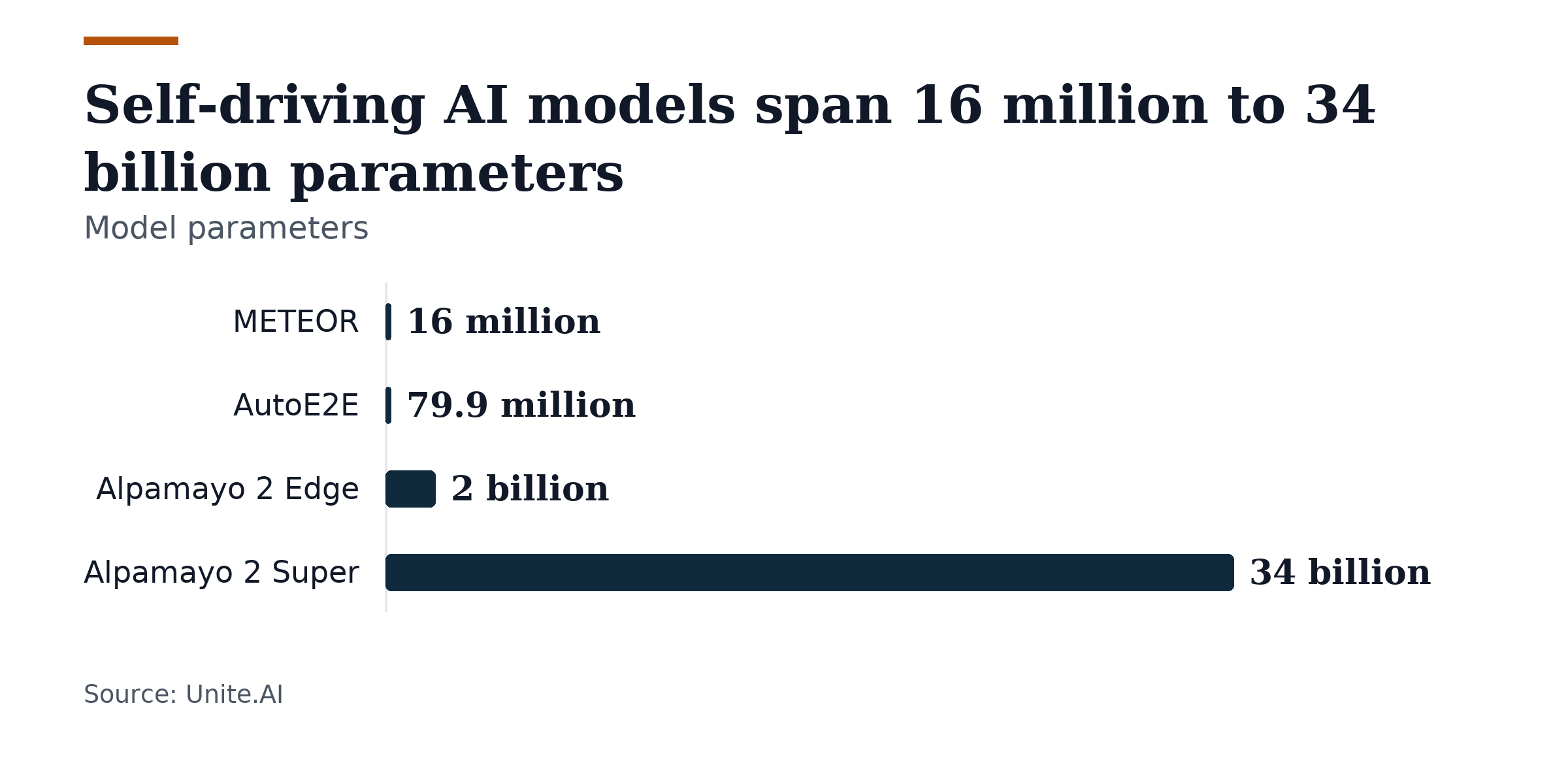
Privately owned passenger cars are the target for METEOR, which uses 16 million parameters. The model builds its bird’s-eye-view representation from a convolutional neural network and generates perception and trajectory output without HD maps (high-definition maps). It accepts one to eight camera inputs, runs on NVIDIA and Renesas platforms, and can add LiDAR and radar.
Alpamayo 2 Edge runs on 2 billion parameters, compared with 34 billion for Alpamayo 2 Super, and produces driving trajectories using only camera images and reasoning. AutoE2E has 79.9 million parameters and runs on hardware other than Nvidia’s, while setups go from camera-only systems to ones with LiDAR and radar.
OnePlanner combines perception and motion planning for six-second trajectories, drawing on route information and traffic-signal states along with vehicle motion states and HD maps. Using V-JEPA self-supervised learning, LatentDrive turns camera video features into latent-space representations and builds trajectories with no intermediate object detection or tracking. It skips the HD map and produces four-second trajectories using route information along with video and vehicle motion states, accepts one or three cameras, and continues Autoware integration and in-vehicle validation.
The November 11, 2026, release carries the Apache 2.0 license for research and commercial use and ships trained checkpoints (saved snapshots of a model’s learned parameters). The AutoE2E Reactive Model runs at 10 Hz, merges six camera views into a bird’s-eye representation and plots 6.4 seconds of acceleration and steering. Against recorded data, the fine-tuned model showed an average displacement error of 0.744 meters over three seconds and placed second among eight open-weight configurations.
Germany was planning AI cooperation with Nvidia that might involve investments of hundreds of millions of euros, but the reported plans were not binding, in reporting dated Oct. 16, 2026. Jensen Huang spoke at a Stockholm company event centered on Sweden’s AI ecosystem. Sferical One is a joint supercomputer effort on Nvidia systems, backed by a consortium with AstraZeneca, Ericsson, Saab, SEB and Wallenberg Investments among its core members.
Nvidia committed a five-year computing donation valued at $250 million for British work on agentic AI safety. Reuters said Nvidia agreed to take minority stakes in Doctolib and Genesis AI, but neither the holding size nor the Doctolib deal value was disclosed.
Join the discussion