

Key facts
- Ransomware and breach trends both point to health care as a leading target in 2026.
- Beazley Security said reported ransomware incidents climbed 38% from the prior quarter.
- NCC Group counted 2,865 victim claims in Q3 2026 compared with 2,325 in the prior quarter.
- Beazley Security measured health care at 21% of investigated ransomware cases in Q3 2026, the largest sector share.
NCC Group published its Cyber Threat Intelligence Report Review of Q3 2026 on Nov. 2, 2026. Beazley Security and NCC Group both reported more ransomware activity in Q3 2026 than in Q2 2026, with Beazley Security publishing its Q3 2026 Quarterly Threat Report on Nov. 19, 2026, from West Hartford, Conn.
Beazley Security said reported ransomware incidents climbed 38% from the prior quarter. NCC Group counted 2,865 victim claims in Q3 2026, up from 2,325 in the previous quarter, which the firm described as a 23% increase in global ransomware activity.
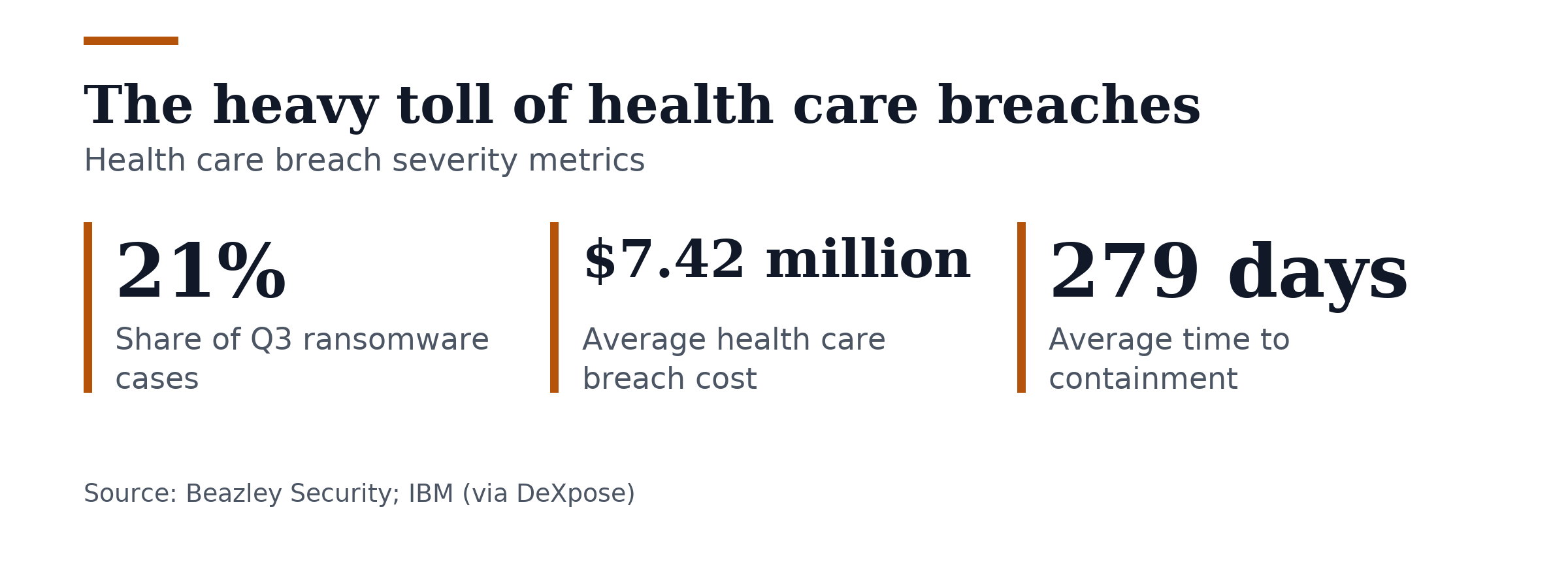
Ransomware and breach trends both point to health care as a leading target in 2026. Beazley Security measured health care at 21% of investigated ransomware cases in Q3 2026, the largest sector share. DeXpose said health care breaches affected more Americans than any other industry from 2024 through 2026.
Health care’s sensitive records, low tolerance for downtime, legacy systems, and extensive vendor web make it a persistent ransomware target, as stated by DeXpose. Patient records cannot be reissued and support long-term medical fraud, insurance fraud and identity theft. Hospitals also face life-critical uptime pressure and sprawling third-party vendor relationships that raise their attack appeal.
IBM’s 2025 findings put health care’s average breach at 279 days from compromise to containment, longer than any other industry. IBM’s 2025 report put the average U.S. health care breach cost at $7.42 million, the highest of any industry for 15 straight years. Because many organizations require months to spot and report incidents, breach totals may increase long after an intrusion occurs.
The share of ransomware cases starting with an exploited vulnerability doubled to 28% in Q3 2026 from 14% in Q2. Published vulnerabilities rose almost 80% to nearly 37,000 in Q3 2026. Malware caused 19% of initial access cases in Q3 2026, up from 14%, driven mainly by ClickFix, a malware initial-access method. Ransomware or extortion generally followed a ClickFix intrusion by two to three weeks, leaving time to isolate systems and rotate credentials.
In an intrusion carried out mostly by AI agents, attackers entered through a flaw in a custom .NET application, took a service account credential, moved laterally and stole data. The AI harness ran across three servers, tried about a dozen known exploits on patched systems, and had credential attacks blocked by multifactor authentication. Attackers also took cloud access keys from compromised servers and moved deeper, sometimes deploying ransomware through the victim’s own cloud tools; attacker notes showed multi-agent coordination, and MFA and patching blocked early attempts. Attackers often exploited self-hosted internet-facing tools like build servers, analytics platforms and collaboration software, which receive less security attention than operating systems.
Alton Kizziah, CEO of Beazley Security, said, “At today’s volume, security teams simply cannot treat every vulnerability as equally urgent.” Patch volumes from major technology companies including Microsoft and Oracle are soaring as vendors remediate weaknesses.
NCC Group said September 2026 attacks fell 26% from the prior month to 821. North America logged 390 September 2026 attacks, ahead of Europe with 211. Organizations in North America and Europe accounted for the largest proportion of Q3 2026 ransomware attacks; the industrial sector represented 29% of Q3 2026 attacks. Sources do not state a Q4 2026 forecast.
The Gentlemen recorded 356 victims and INC Ransom ranked third with 109 in Q3 2026. Gunra, a ransomware-as-a-service operation, had hit 53 victims across several industries by Q3 2026. Storm said it had 78 victims by the end of September 2026, and Deadlock was an emerging ransomware cartel active in Q3 2026.
Gunra entered corporate networks through CVE-2024-55591 and CVE-2025-24472 in internet-facing Fortinet devices. After entering, Gunra shifted between systems using stolen logins, session hijacking and admin tools before ransomware deployment. More than 40 exploited-vulnerability entries covering management platforms, e-mail gateways, VPN appliances and enterprise applications entered CISA’s catalog in Q3 2026. Brokers sold access to VPNs, remote desktop and SSH services, plus cloud identities, code repositories and security platforms.
A July attack on a small UK power generation facility stopped operations for about four days; methods resembled Iranian-affiliated campaigns but the UK government made no formal attribution. BraZetsu, an AI-enhanced Windows malware framework, became a specialized initial access toolkit that automates victim profiling and identifies valuable corporate systems. The framework hunts for corporate software, financial data, certificates, and cloud credentials, so operators can sell access.
The review flagged prompt injection, excessive permissions, and unintended external access as risks of legitimate AI agents, citing U.S. and Australian government systems. Legitimate AI agent incidents may lack malicious intent yet still produce consequences like conventional cyber intrusions.
The February 2024 Change Healthcare ransomware attack ultimately affected an estimated 190 million people after UnitedHealth nearly doubled its original impact figure in early 2025. The attack disrupted claims processing and pharmacy operations across the country for weeks. ALPHV/BlackCat stole names, Social Security numbers, insurance details, and clinical and billing information; UnitedHealth reportedly paid $22 million, and attackers posted the stolen data after a dispute among themselves. The Change Healthcare incident remains the benchmark case whenever Congress or regulators talk about cybersecurity risk in health care.
An intruder with stolen credentials reached legacy Cerner servers as early as January 22, 2025. Oracle Health found the intrusion on February 20, 2025, and the intrusion may have affected as many as 80 hospitals. Authorities asked Oracle Health and hospital clients to postpone patient notifications while the investigation continued. Becker’s Hospital Review reported that the intrusion could affect up to 80 hospitals, with breach letters continuing into 2026.
Ascension disclosed a May 2024 ransomware attack exposing 5.6 million patient records. A separate December 2024 Ascension incident affected 437,329 patients and was linked to Cl0p’s exploitation of a Cleo software flaw.
Unauthorized access at Cognizant TriZetto dated back to November 2024, and the company revealed in early 2026 that it affected over 3.4 million individuals. A UnitedHealth Group subsidiary disclosed a medical coding vendor breach at Episource in early 2025.
Australia’s Office of the Australian Information Commissioner reported 532 data breach notifications from January to June 2025, with health at 18%. Australian regulators counted health sector breaches as the largest single share of notifications in the first half of 2025, ahead of finance and government.
DC Health Link confirmed in March 2023 that enrollees’ personal information was accessed and posted publicly, affecting up to 170,000 individuals. The breach exposed data broadly, including information tied to members of Congress and their families. The marketplace settled a class action for $1.45 million in early 2025, paying members by September 2025.
Because PHI covers vendors such as billing companies and claims processors, a breach there triggers the same HIPAA notification duties as a hospital breach. Third-party vendor compromises became the dominant breach pattern in 2025 and 2026, since one vendor breach can force notifications from many unrelated providers. Breach reporting obligations under HIPAA apply equally to business associates and vendors handling PHI.
HHS inflation-adjusted HIPAA penalties run from $145 per violation to $2,190,294 per violation category annually for uncorrected willful neglect under the four-tier civil penalty structure. Office for Civil Rights settlements in 2025 ran from $25,000 at small providers to $3 million at large organizations with major breaches and weak prior risk assessments.
In 2025, phishing became the top initial access vector across industries, passing stolen credentials; it figured in roughly 16% of breaches with an average cost of $4.8 million. IBM found more organizations refused ransoms in 2025 (63% versus 59% the prior year) while average demands stayed near $5.08 million.
McKesson discovered a cybersecurity incident on August 25, 2026, involving third-party applications and data theft, and called its investigation early-stage. The company disclosed the incident in a Form 8-K SEC filing and had not determined it was material. McKesson said customers may experience intermittent service degradation related to the attack, though it did not proactively disconnect systems. McKesson has not said which third-party apps intruders breached, how intruders entered, or what data intruders stole.
ShinyHunters claimed it stole about 284 million patient-related data records from McKesson’s Snowflake environment, removing roughly one terabyte between August 21 and August 25, 2026. ShinyHunters said the 284 million figure counts data records or lines rather than unique people, and it does not know how many distinct individuals the figure includes.
The group said it compromised employee Okta single sign-on accounts through voice phishing and used them to enter Salesforce and Snowflake. The group demanded $55,236,150 and gave McKesson 72 hours to respond after the August 25 theft, saying McKesson neither replied nor negotiated.
The group asserted it took full control of McKesson’s Salesforce platform and its support cases. The group claimed the stolen Snowflake data contains patient names, addresses, birth dates, Social Security numbers, and medical identifiers. ShinyHunters claimed the data also covers deceased and terminally ill patients, prescriptions, invoices, employee information, Salesforce records, and internal communications.
The McKesson incident fits a wave of healthcare data-theft attacks attributed to ShinyHunters, also targeting Medtronic, DentaQuest, iRhythm, OneMedical, and AdaptHealth. Health-ISAC warned health care organizations about growing ShinyHunters social-engineering attacks designed to steal corporate accounts and reach cloud and SaaS platforms.
ReliaQuest said, “ReliaQuest is tracking a widespread ShinyHunters campaign using domains that follow the company[.]claims pattern.” BleepingComputer could not confirm ShinyHunters’ claims, and McKesson has not said what data intruders stole.
Join the discussion