
Key facts
- Ambulances were diverted in 26 attacks.
- A median of 15 days was the downtime for clinical systems across 23 attacks that reported restoration dates.
- The longest outage ran 41 days, and five outages continued for at least a month.
- The Department of Health and Human Services breach registry tracks exposed patient data, covering at least 500 people, but does not record canceled treatments, closed clinics, or diverted ambulances.
The Health Management Academy counted at least 65 cyber attacks that disrupted patient care at hospitals and health systems across the United States between January 2022 and September 2026.
“Ambulances were diverted to other hospitals in 26 of the 65 attacks, or 40%,” said Andrew Reed, associate director at the academy. Canceled or postponed surgeries, treatments and appointments occurred in 28 attacks, and staff switched to paper records in 58 attacks.
A median of 15 days was the downtime for clinical systems across 23 attacks that reported restoration dates, and 14 of those 23 outages lasted at least two weeks. The longest outage ran 41 days, and five outages continued for at least a month.
On Feb. 19, 2026, a ransomware attack took the Epic electronic health records system, the digital software clinicians use to chart patient care and orders, offline at the University of Mississippi Medical Center, forcing all 35 statewide clinics to close until March 2 and canceling elective procedures. Andrew Reed, associate director at The Health Management Academy, said the Mississippi attack was one of the care-disrupting attacks in the academy’s log.
Brockton Hospital in Massachusetts stopped accepting ambulances on April 6, 2026, after a cyber attack, and Brockton Hospital canceled chemotherapy infusions there on April 7, 2026. Hospitals hold highly sensitive data, including medical records, identity information and insurance details, said Ricardo Amper, founder and CEO of Incode Technologies. The Anubis ransomware cartel claimed on April 9, 2026, that it had stolen two terabytes of patient data from Brockton Hospital. Brockton Hospital lifted its code black emergency status on April 15, 2026.
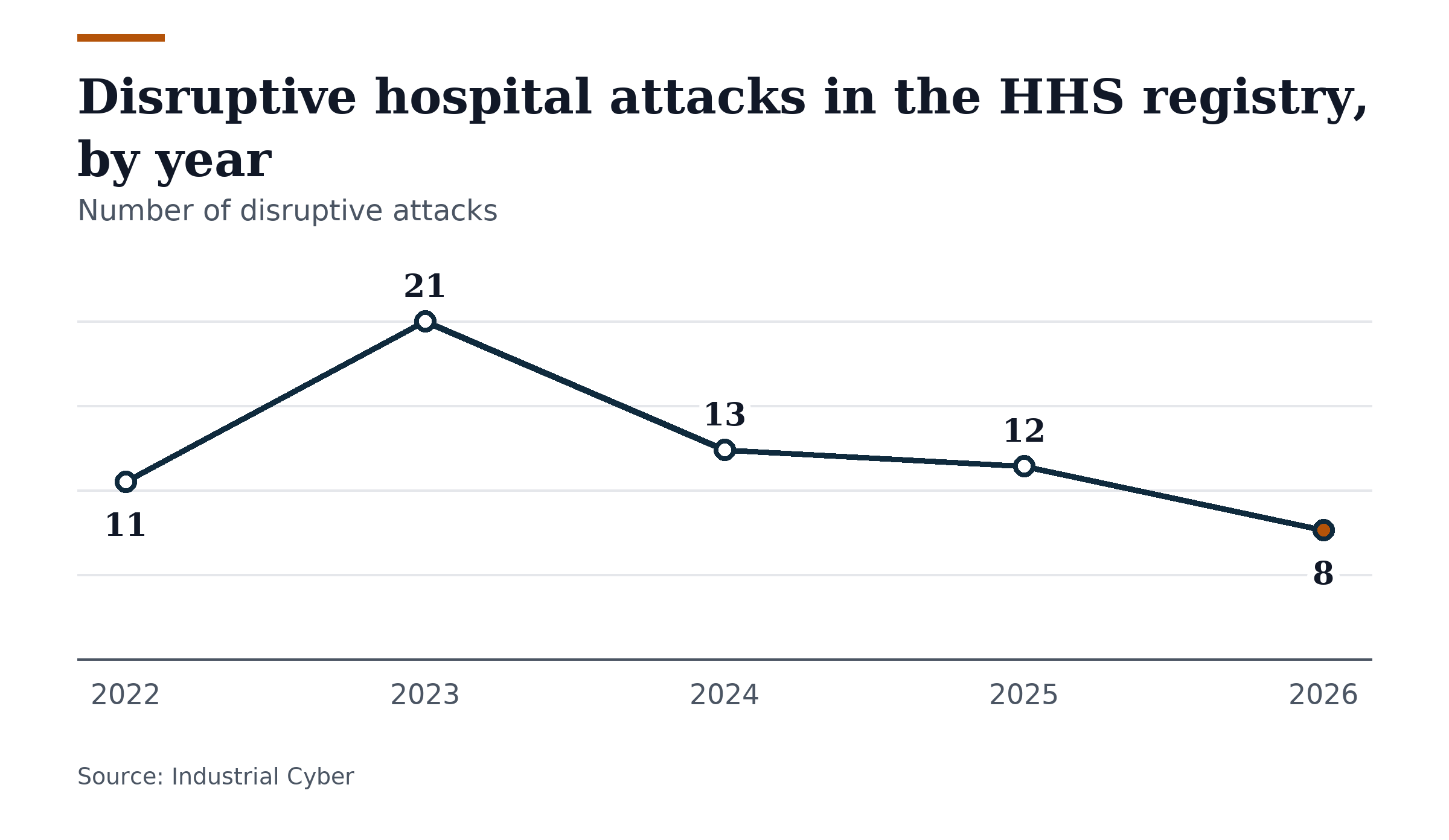
Federal breach records do not capture every kind of care disruption. The Department of Health and Human Services breach registry tracks exposed patient data covering at least 500 people, but it does not record canceled treatments, closed clinics or diverted ambulances. The registry listed 11 disruptive attacks in 2022, 21 in 2023, 13 in 2024, 12 in 2025 and eight in 2026 through September. 12 of 55 analysis attacks starting at least a year earlier had no related registry filing, or 22 percent.
Regulators received a record 776 healthcare data breach reports in 2025, and hacking represented 81 percent of the 2,878 breaches reported from 2022 through 2025. Emsisoft’s count of hospital systems hit by ransomware was 46 in 2023 and rose to 85 in 2024. Comparitech counted 445 ransomware attacks on hospitals and clinics in 2025, marking a new peak. Medicare data analyzed in 2026 showed a 38 percent higher death risk for hospitalized patients during a ransomware attack.
Texas recorded seven attacks, more than any other state, followed by California, Idaho, Illinois and New York with five each. Florida, Georgia, Maryland and Massachusetts each recorded four attacks. Kentucky, Maine, Michigan, New Jersey, Oklahoma and Wisconsin each recorded three attacks. Attacks hit two or more hospitals at once in 21 cases.
Three of Texas’s seven attacks involved health systems spanning state lines. Kansas and Tennessee recorded only attacks involving multi-state systems. New York recorded five attacks, none involving a multi-state system. Most remaining jurisdictions, including Alabama, Arizona, Kansas, Mississippi, Missouri, South Carolina, Tennessee and the U.S. Virgin Islands, recorded one or two attacks.
10 jurisdictions with one attack each, including Connecticut, the District of Columbia, Indiana, Iowa, Nebraska, New Hampshire, New Mexico, Pennsylvania, Rhode Island and Washington, experienced the disruption through a multi-state system. Arizona, Colorado, Guam, Louisiana, Mississippi, Missouri, Ohio, the U.S. Virgin Islands, West Virginia and Wyoming recorded no attacks involving multi-state systems.
University of Minnesota researchers found that in-hospital mortality rose 34 to 38 percent for patients admitted before an attack began, and that hospital volume fell 17 to 24 percent in the first week after an attack. A May 2024 ransomware attack on a national hospital system took electronic health records offline across roughly 140 hospitals.
Researchers from the University of California San Diego reported that survival with good brain function after cardiac arrest outside a hospital dropped from 40.0 percent to 4.5 percent at two emergency departments during a nearby hospital system’s outage, and said a cyber attack reduced cardiac arrest survival odds without severe brain damage by nearly 90 percent at nearby hospitals. A JAMA Network Open study found that after a 2021 ransomware attack at the same hospitals, ambulance arrivals climbed from 1,741 to 2,354 while stroke code activations climbed from 59 to 102.
Proofpoint and Ponemon Institute found that 97 percent of organizations reported at least one cyber attack in the past year, and 74 percent reported disruption to patient care. Attack frequency averaged 51 per organization, up from 43 in 2025. The costliest cyber attack averaged $4.2 million, up nearly 8 percent, downtime and recovery averaged $1.39 million, the single largest cost category, and idle time and lost productivity averaged $1.05 million.
Patient-care disruption was reported by 90 percent of organizations hit by supply chain attacks, up from 87 percent in 2025, and by 72 percent of organizations hit by ransomware, up from 67 percent in 2025. “When a cyberattack delays a procedure, extends a hospital stay, or forces patients to another facility, cyber risk becomes patient risk,” said Ryan Kalember.
24 percent of respondents cited AI agents operating without guardrails as a leading cause of data loss. 45 percent of organizations have embedded AI in cybersecurity or patient care, 30 percent plan to adopt it, and 60 percent lack controls covering sensitive data used by AI systems. Over two years, organizations averaged 21 incidents involving sensitive healthcare information and data loss or exfiltration. 54 percent of organizations said data loss incidents disrupted patient care, and 56 percent of that group reported increased mortality rates.
Andrew Reed called on health systems to plan for outages lasting weeks rather than days. Downtime plans should cover order sets, medication records, lab and imaging requests that work without electronic records, printed supplies and trained staff.
Recovery plans need to cover paper workflows, manual billing and claims handling, and the backlog created by postponed procedures. Organizations could benchmark readiness and recovery against peers using shared measures such as days of clinical downtime, hours spent on diversion and postponed procedures. The academy’s Catalyst and Convening programs bring health system and industry leaders together to share data and practices.
The Rural Health Transformation Program is a $50 billion package distributed across all 50 states. New York and Connecticut passed bills during 2025 and 2026 requiring hospitals to create specific cybersecurity plans. Senators Bill Cassidy and Mark Warner introduced a health care cybersecurity bill in December 2025.
Join the discussion