
Key facts
- Qilin, active for years, claimed 131 attacks in October 2026, ranking third.
- In Q3 2026, Qilin topped ransomware groups for a sixth straight quarter with 365 victims.
- The Gentlemen had 356 victims in Q3 2026, ranking second.
- NCC Group reported a 23% increase in claimed ransomware incidents in October 2026 versus September, reaching 1049 incidents.
NCC Group reported a 23% increase in claimed ransomware incidents in October 2026 from September, reaching 1,049 incidents, after a record quarterly total from July through September 2026, and published its report on November 25, 2026, with North America accounting for 46% of October attacks.
The company’s Q3 2026 review counted 2,865 ransomware victim claims, up from 2,325 in the prior quarter. Ransomware attacks fell 26% month over month in September 2026 to 821. North America recorded 390 attacks in September 2026, followed by Europe with 211.
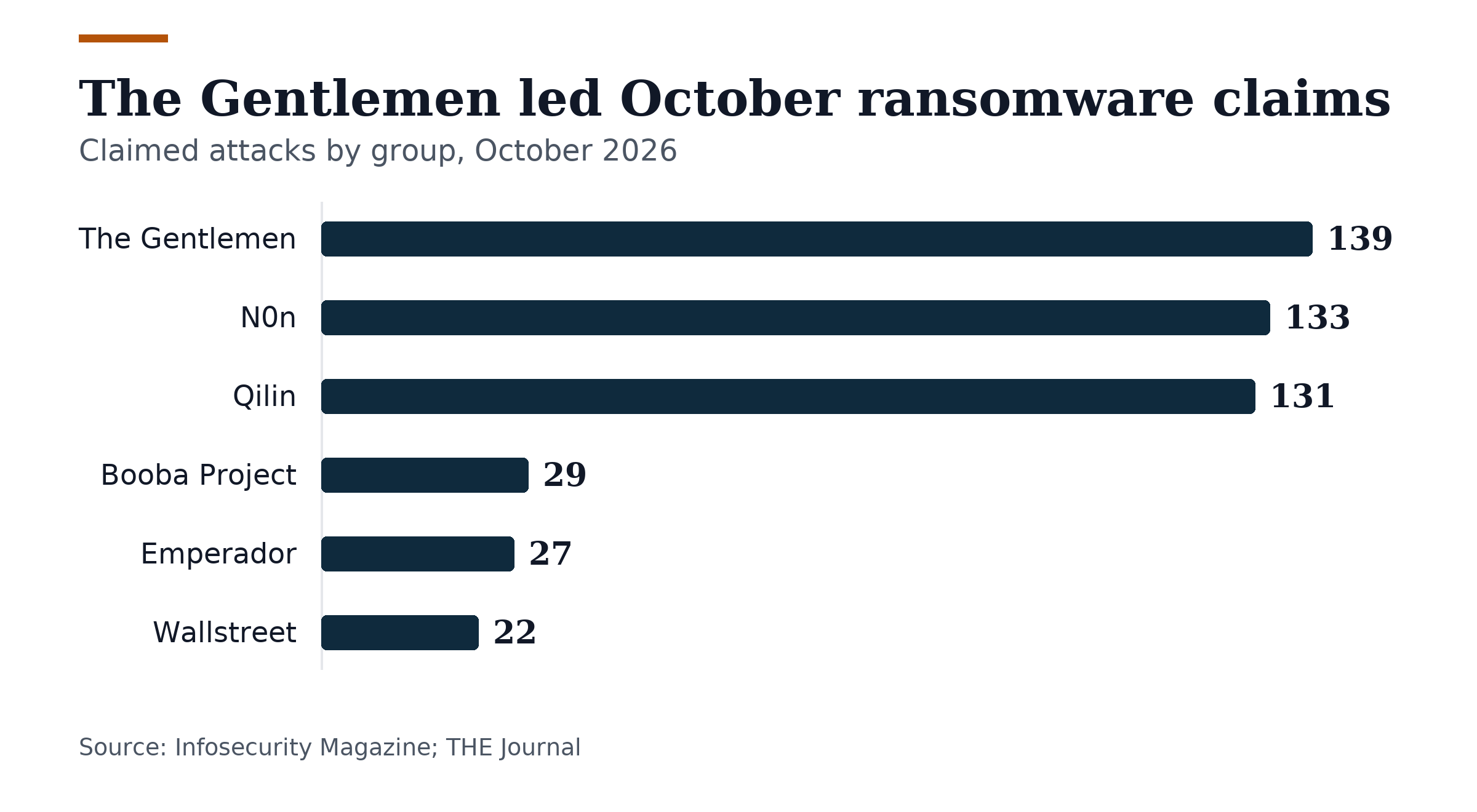
The Gentlemen ransomware cartel claimed the most victims in October 2026 with 139, representing 13% of claimed incidents. Qilin, active for years, claimed 131 attacks in October 2026, ranking third. N0n, first observed in September 2026, claimed 133 victims in October 2026. Booba Project claimed 29 attacks in October 2026, Emperador claimed 27, and Wallstreet claimed 22.
In Q3 2026, Qilin topped ransomware cartels for a sixth straight quarter with 365 victims. The Gentlemen had 356 victims in Q3 2026, ranking second. INC Ransom ranked third in Q3 2026 with 109 victims. Deadlock and Storm were emerging ransomware cartels in Q3 2026, and Storm claimed 78 victims by the end of September 2026.
NCC Group researchers said the origins of newer actors are unknown and none are conclusively linked to a country or predecessor. Researchers described newer operations as emerging brands rather than completely new threat actors. These brands may include experienced affiliates, access brokers or developers from other cybercriminal groups, and the rapid increase shows it is easy to launch a new extortion brand in the ransomware ecosystem. In November 2026, N0n claimed responsibility for data breaches at JPMorgan, Mastercard and Visa.
Industrials was the most targeted sector in October 2026, making up 31% of claimed attacks. Consumer discretionary accounted for 19% of October 2026 claimed attacks, healthcare for 12%, and IT for 10%. Europe accounted for 23% of October 2026 attacks, Asia for 15%, and South America for 8%.
NCC Group said serious vulnerabilities are discovered and weaponized more rapidly.
The report warned of dangers from genuine AI agents such as prompt injection, overbroad permissions and access beyond intended scope. U.S. and Australian government system incidents illustrated agents reaching resources outside intended scope. Researchers said AI agent incidents may lack malicious intent but can still produce effects resembling conventional cyber intrusions.
BraZetsu, an AI-enhanced Windows malware framework, developed into a specialized initial access toolkit. The framework uses artificial intelligence models to profile victims, examine compromised environments and find valuable corporate systems. The toolkit looks for enterprise software, financial data, certificates and cloud credentials, so operators can sell access to other cybercriminals.
Brokers sold access to compromised VPNs, RDP and SSH, along with cloud identities, source code repositories and security management platforms. Gunra, a ransomware-as-a-service operation (affiliates pay to use the group’s malware and infrastructure), had hit 53 victims across multiple industries by Q3 2026. Gunra used CVE-2024-55591 and CVE-2025-24472 against internet-facing Fortinet devices to enter corporate networks. The group also moved between systems using stolen credentials, session hijacking and administrative tools before deploying ransomware.
A July 2026 cyber attack against a small UK power generation facility halted operations for about four days without affecting the national grid. Researchers said the UK power facility attack matched techniques tied to Iranian-affiliated campaigns, including strikes on internet-exposed industrial controllers. The UK government has not formally attributed the July facility attack and the techniques remain unconfirmed.
NCC Group recommended network segmentation, stronger privileged-access controls and continuous monitoring of operational technology environments.
Join the discussion