
Key facts
- Claroty reported that researchers found tens of thousands of consumer devices on hospital, factory and commercial networks meant for operational technology.
- Most game consoles sat on production networks near medical and industrial equipment.
- Researchers put 13,939 hospital game consoles on production networks.
- Researchers rated 691 hospital game consoles as high risk.
Claroty researchers found tens of thousands of consumer gadgets on hospital, factory and commercial networks built for operational technology, the company said in its report Nov. 19, 2026.
Help Net Security reported the research. Operational technology means the systems that run physical equipment such as medical devices and factory machinery, and the consumer gadgets turned up on networks built for it at those sites. The researchers looked at more than 45 million devices across more than 30,000 critical infrastructure sites on Nov. 19, 2026. Researchers found most game consoles on production networks close to medical and industrial equipment.
Claroty found that hospitals had 14,624 game consoles on Nov. 19, 2026, concentrated in children’s hospitals. Researchers placed 13,939 of them on production networks. They gave 691 hospital game consoles a high-risk rating. Claroty called the consoles in children’s hospitals a legitimate use and said the hospitals probably bought them.
Claroty researchers found that industrial sites had 963 game consoles on Nov. 19, 2026. Researchers put 89.5% of them on production networks near industrial equipment and gave Thirty a high-risk rating.
Researchers found that most Roku sticks and smart watches rode guest networks on Nov. 19, 2026. A guest network is a separate segment set aside for visitors and personal devices. Staff phones and tablets decide where Sonos speakers show up on the network, and just a small portion of Sonos speakers sat on guest networks. Researchers said Roku sticks serve no business purpose on these networks, although the sticks were better segmented than hospital consoles.
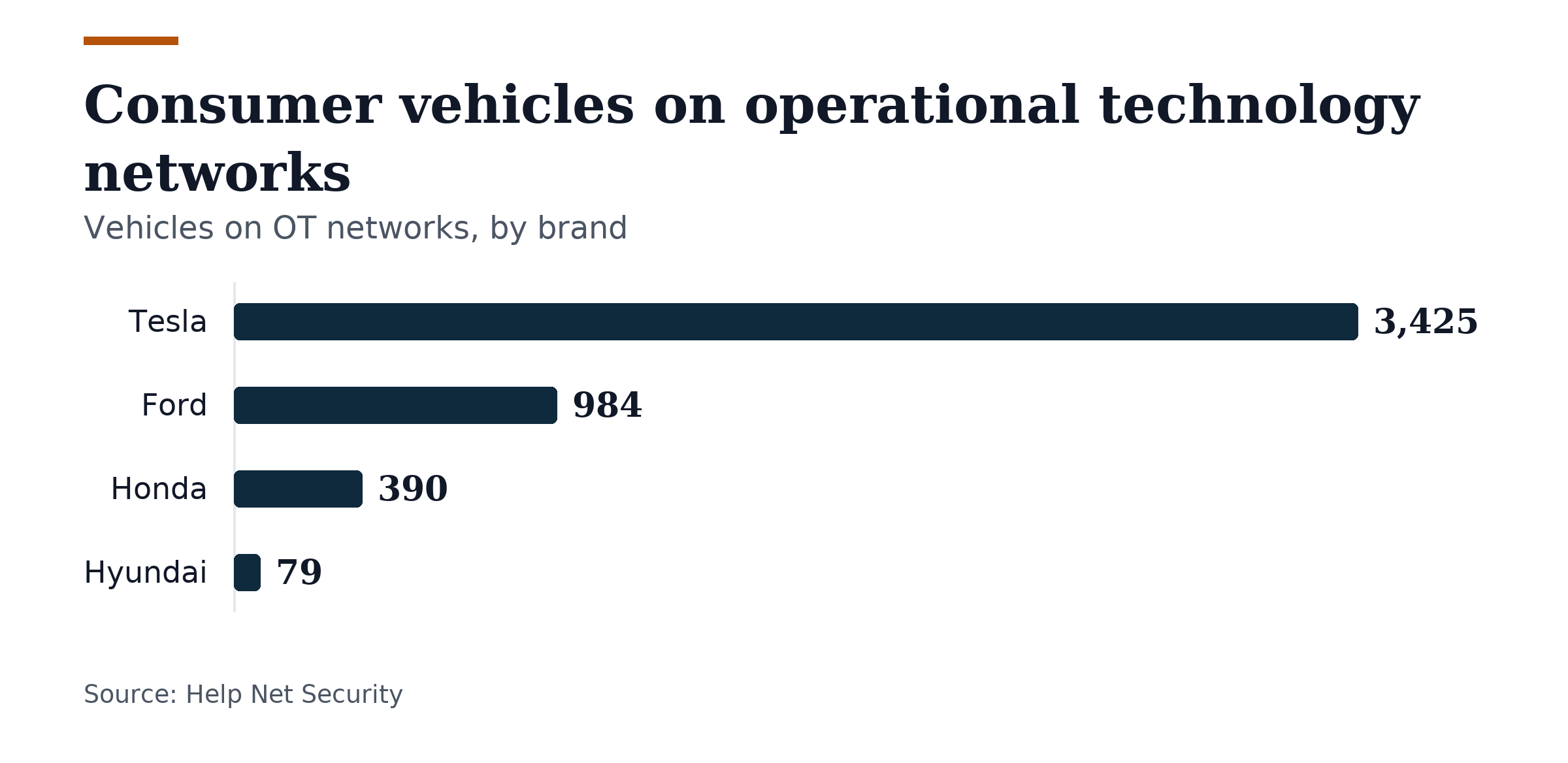
Claroty’s count on Nov. 19, 2026 included 3,425 Teslas, 984 Fords, 390 Hondas and 79 Hyundais on the networks, and the scan turned up 775 devices from Texas Instruments. Virtually all vehicles stayed off guest networks. Workers link cars to the company network after their commutes, since the vehicles need Wi-Fi to get software updates.
On Nov. 19, 2026, Claroty disclosed six critical CVEs affecting Tesla Model 3s, including flaws that allow remote code execution, and 121 security issues linked to Ford F-150 trucks, with no CVE numbers listed. A CVE is a publicly disclosed security flaw tracked in a public catalog. A remote code execution flaw lets an attacker run code on a target machine.
On Nov. 19, 2026, Claroty researchers said an attacker who compromises a streaming stick or car can search for reachable controllers. From there, the attacker may go after medical devices and building systems, take credentials, and move closer to critical equipment. Reachable controllers are the systems that direct machinery and equipment.
Sean Tufts, the Field CTO at Claroty, said consumer devices on OT networks point to ongoing deficiencies in network governance and segmentation on Nov. 19, 2026.
Join the discussion