

Key facts
- NIST updated its Face Analysis Technology Evaluation Age Estimation and Verification results on November 6, 2026, adding new submissions from Innovatrics, Paravision and Shufti.
- Across up to 61 algorithms in four evaluations, the top algorithm changes by the age assessed, user demographics, image resolution and the legal age being enforced.
- ROC leads general accuracy in NIST's broadest test.
- Innovatrics leads teenage assessments and shows the smallest demographic differences in directional errors.
NIST updated its Face Analysis Technology Evaluation Age Estimation and Verification results on Nov. 6, 2026, adding new submissions from Innovatrics, Paravision and Shufti to a benchmark covering up to 61 algorithms across four evaluations.
FATE operates as a government benchmarking effort for face analysis work beyond recognition, with an ongoing Age Estimation and Verification track run by NIST for algorithms that inspect face photos and produce age estimates. The track is open to worldwide developers under a standardized submission process, and NIST publishes accuracy and computational efficiency results. NIST notes that facial age verification is mandated in legislation in several jurisdictions, typically to protect minors.
The broadest test draws on roughly 6.2 million Mexican visa photos covering people aged 0 to 90. Across up to 61 algorithms in four evaluations, the top algorithm changes by the age assessed, user demographics, image resolution and the legal age being enforced. ROC leads general accuracy in NIST’s broadest test.
Across all ages in the broadest test, ROC’s roc-003 ranks first at 2.3 years mean absolute error, with 71 percent of estimates within three years. Idemia’s idemia-003 ranks second at 2.4 years mean absolute error, with 69 percent within three years. Regula’s regula-000 ranks third at 2.6 years mean absolute error, with 67 percent within three years.
ROC announced on September 30, 2026, that its roc-003 algorithm ranked number one globally in age estimation across three primary datasets in NIST’s Face Analysis Technology Evaluation Age Estimation and Verification track. The company kept its number one global position in the Child Online Safety evaluation for ages 13 to 16, and roc-003 achieved the lowest Mean Absolute Error across the Visa, Application and Mugshots datasets for adults ages 18 to 30, ranking first on three of four primary datasets. ROC added Visa and Application to its number one rankings in Mugshots and Child Online Safety, and the company is headquartered in Denver, Colo., with additional hubs in Grand Rapids, Mich., and Morgantown, W.Va.
Among children 12 and under, Rigrai’s rigrai-000 leads at 0.91 years mean absolute error, ahead of regula-000 at 0.93 years and roc-003 at 0.94 years. Rigrai is a UK-based video investigation platform provider making its FATE debut. For teenagers aged 13 to 17, Innovatrics’ innovatrics-004 ranks first at 1.45 years, ahead of idemia-003 at 1.47 years and rigrai-000 in third at 1.59 years.
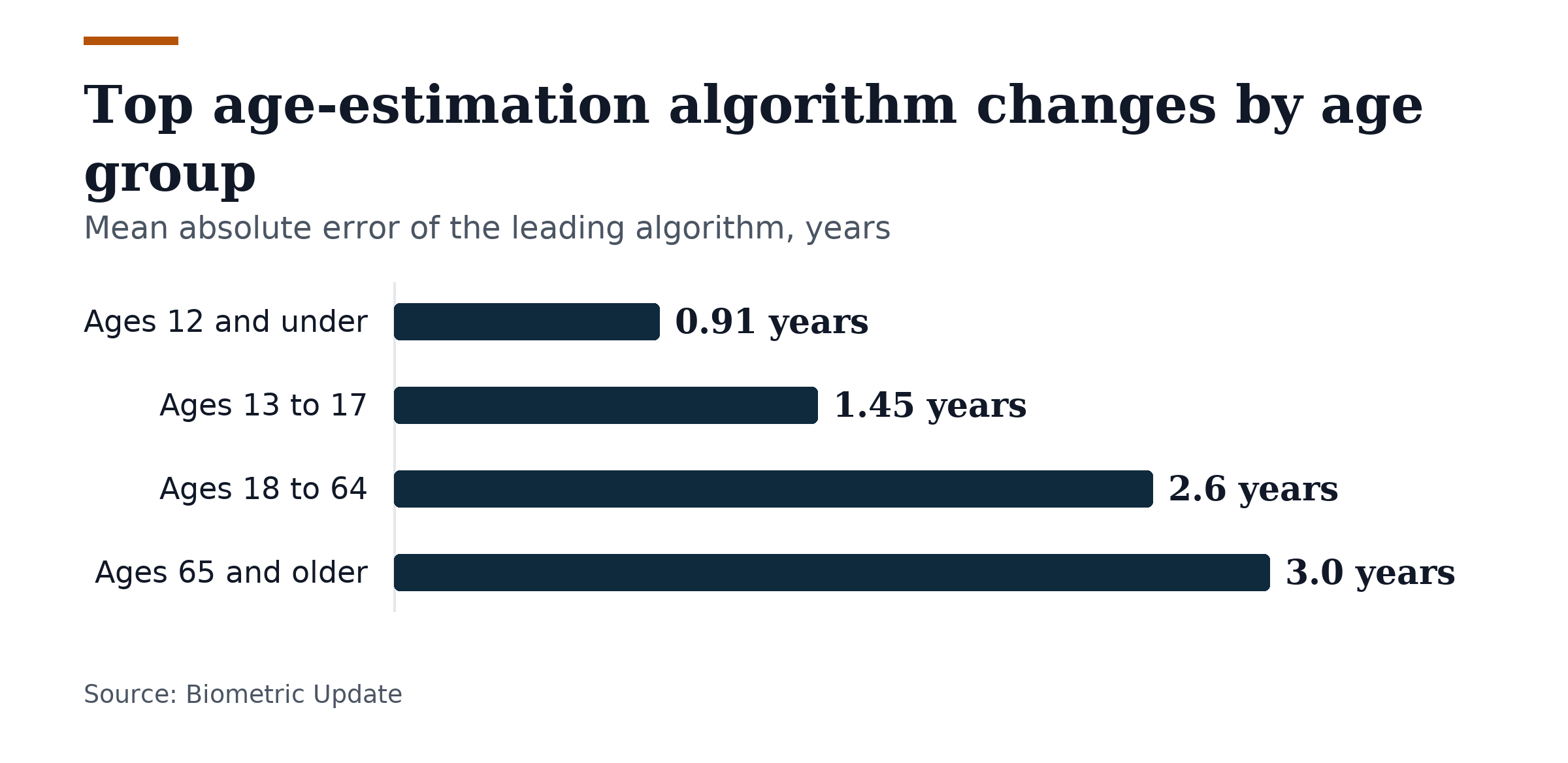
For adults aged 18 to 64, roc-003 posts the lowest error at 2.6 years, ahead of idemia-003 at 2.9 years and cognitec-000 from Cognitec at 3.0 years. For adults aged 65 and older, Onfido’s onfido-000 ranks first at 3.0 years, then Incode’s incode-001 at 3.2 years and regula-000 at 3.3 years.
innovatrics-004 rose from 24th place with innovatrics-003 to first among teenagers, while overall and adult results barely changed. paravision-001 reduced overall error from 4.5 years to 3.0 years, chiefly among adults. shufti-001 overall error rose from 4.0 years to 5.7 years, while error for children rose from 2.9 years to 11.9 years.
A second NIST evaluation looks at 12 groups of women and men aged 14 to 52 from six world regions, with application-style photos that resemble passport images. Innovatrics leads teenage assessments and shows the smallest demographic differences in directional errors. Idemia’s idemia-002 records the lowest average bias, 0.5 years, paired with a 2.1-year spread, while innovatrics-004 ranks second for bias at 0.6 years and holds the smallest spread of any algorithm at 2.0 years. Cognitec’s cognitec-001 ranks third at 0.7 years bias and 2.4 years spread.
Each of the three new submissions cut average bias, but shufti-001’s spread grew wider, moving from 2.5 years to 3.3 years. innovatrics-004 estimates ages about 0.3 years younger than actual, while paravision-001 estimates older by about 0.8 years and shufti-001 by about 1.2 years. Systematic overestimation raises underage acceptance risk, while systematic underestimation raises unnecessary referrals for identification.
A third NIST evaluation measures accuracy changes by pixels between the eyes using booking photos of white men aged 18 to 30. Yoti’s yoti-005 leads the resolution test at 1.7 years, followed by idemia-003 and roc-003 at 1.8 years each. paravision-001’s gap between best and worst resolution categories shrank from 1.0 year to 0.1 year.
Yoti’s November 2026 white paper says typical live checks show about 150 pixels between the eyes, inside NIST’s 120-to-199-pixel range where yoti-005 ranks first. Robin Tombs, CEO of Yoti, said independent testing should measure performance on phone-captured selfie images, while NIST’s resolution test uses booking photos.
"When it comes to age assurance, accuracy matters," said Robin Tombs, CEO of Yoti.
Robin Tombs, Biometric Update | Biometrics News, Companies and Explainers
The UK minimum legal age to purchase alcohol is 18, and retailers commonly apply Challenge 25 policies to customers appearing younger than 25. NIST’s L18/T25 configuration measures how often an algorithm estimates an underage person as at least 25; the comparable U.S. setting for age 21 is L21/T28. On Yoti’s selfie test images, lifting an 18-plus threshold from 21 to 25 reduces 14-to-17-year-olds judged old enough from 1.10 percent to 0.04 percent.
False positive rate counts underage people the system would admit, drawn from NIST’s border dataset of airport photos showing varied lighting, head angles and eyewear. Intellicheck’s intellicheck-000 posted the lowest false positive rate across all four groups: men at 0.2 percent, women at 0.3 percent, under both thresholds. At the UK threshold, runners-up were innovatrics-004 at 0.3 percent for men and paravision-000 at 0.6 percent for women.
Behind Intellicheck at the U.S. threshold came innovatrics-003 at 0.6 percent for men and idemia-003 at 0.8 percent for women. innovatrics-004 cut UK false positive rates to 0.3 percent for men from 0.5 percent and to 0.8 percent for women from 1.8 percent. paravision-001’s UK women’s rate rose from 0.6 percent to 1.0 percent, even as its U.S. women’s average error fell from 4.0 years to 2.2 years.
shufti-001’s men’s rates dropped by over half to 2.9 percent and 3.0 percent, while women’s rates climbed to 13.8 percent and 10.4 percent. Of 61 algorithms, only idemia-003 stays under a below-1 percent false positive ceiling across both sexes, both thresholds and all photo types, peaking at 0.8 percent. Lifting the ceiling to 1.5 percent expands the shortlist to five: idemia-003, innovatrics-004, paravision-001, paravision-000 and idemia-001.
Intellicheck-000, the airport-photo leader, meets neither ceiling once application and mugshot photos are included, where its rates reach 4.9 percent. On border photos, women’s false positive rates were higher than men’s in four out of every five combinations of algorithm and threshold.
Buyers should test qualifying vendors on their own images and users after building a shortlist from NIST results. Each new submission improved on its predecessor in some areas and not others, so newer versions warrant separate evaluation against the same requirements.
Join the discussion