

Key facts
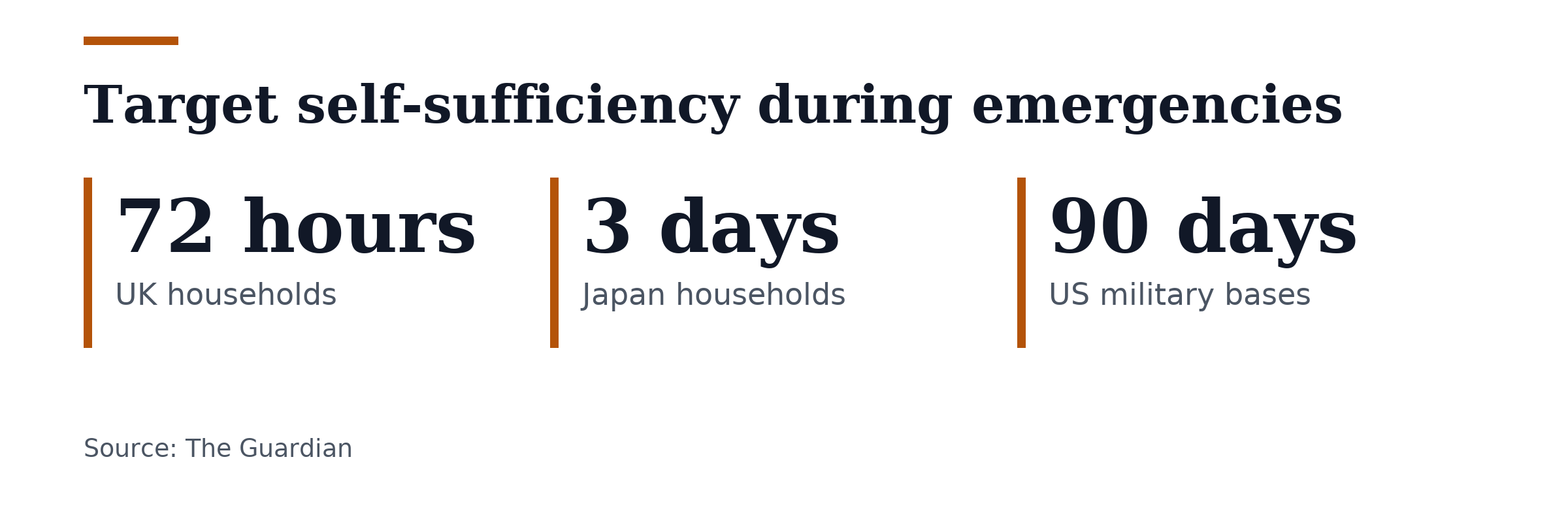
- The United Kingdom’s ‘Be Ready’ campaign advises households to stockpile supplies for at least 72 hours of self-sufficiency during emergencies, citing climate crises, technological dependency, and hostile state threats.
- Sweden’s Civil Defense and Resilience Agency warns that war, extreme weather, cyber-attacks, and disinformation campaigns pose growing threats, urging citizens to prepare for crises or conflict.
- The U.S. Pentagon launched FORTRESS America on September 30, 2026, an initiative to ensure military bases can operate independently for at least 90 days without external support.
- A vulnerability in a widely used programming language caused global website outages on October 21, 2026, underscoring the escalating cybersecurity risks addressed in international preparedness campaigns.
The Pentagon launched FORTRESS America on Sep. 30, 2026, an initiative to keep military bases operating independently for at least 90 days without outside support. The effort stems from a September 30 memorandum by Pete Hegseth establishing the program. The memorandum frames military resilience as a projection of national strength, saying the program is not a retreat but a foundation for an unassailable homeland. The initiative focuses on energy independence, supply-chain resilience, strategic defense reserves, installation hardening, cyber resilience, and space and spectrum security.
Japan’s disaster management minister, Goshi Hosono, announced an emergency appeal on Nov. 2, 2026, urging households to prepare supplies for at least three days of self-sufficiency. The appeal coincides with the launch of Japan’s new disaster management agency and mirrors Britain’s guidelines. Japan has updated its disaster management plans to emphasize self-sufficiency during emergencies.
Britain’s Be Ready campaign advises households to stockpile supplies for at least 72 hours of self-sufficiency during emergencies, citing climate crises, technological dependency, and hostile state threats. The campaign reflects broader global concerns about preparedness for cyber attacks and natural disasters. Sweden’s Civil Defense and Resilience Agency warns that war, extreme weather, cyber attacks, and disinformation campaigns pose growing threats, urging citizens to prepare for crises or conflict. The guidance aligns with Japan’s updated disaster management plans, which emphasize self-sufficiency during emergencies.
The U.S. Ready.gov program, launched in 2003 by the Department of Homeland Security, acknowledges 25 disaster types including cybersecurity threats, but lacks the centralized focus of Britain’s Be Ready campaign. The program reflects a decentralized, multi-level approach to emergency preparedness in the United States. The U.S. system of emergency management is structured as locally executed, state-managed, and federally supported, differing from centralized approaches in other countries like Britain. This decentralized model relies on collaboration across government levels.
The Pentagon’s FORTRESS America initiative aims for at least 90 days of independent operation for military bases, while Britain’s Be Ready campaign asks households to prepare for at least 72 hours and Japan’s minister has urged citizens to stockpile supplies for at least three days. The U.S. Ready.gov program acknowledges 25 disaster types including cybersecurity threats but lacks the centralized focus of overseas campaigns.
FORTRESS America rests on five pillars: energy independence; resilience of supply chains and the defense-industrial base; a strategic defense reserve; hardening of installations paired with cyber resilience; and resilience for space and spectrum. The initiative prioritizes military over civilian preparedness in emergency scenarios.
Lynn Budd, former president of the National Emergency Management Association and current director of Wyoming’s homeland security office, states that cyber attacks are an increasingly potent threat requiring heightened public and military preparedness. Budd highlights the risk of compounded threats, such as cyber attacks occurring during natural disasters like tornadoes. She says both civilian and military readiness must account for overlapping emergencies.
Dr. Tom Chandler, director of Columbia University’s National Center for Disaster Preparedness, argues that military and civilian preparedness needs differ, with military installations requiring prolonged operational resilience distinct from household readiness. Chandler emphasizes planning for extended disruptions rather than short-term emergencies.
James Trainor, former FBI cyber division assistant director, states that cyber threats are expanding due to increased data, connectivity, and AI-driven exploitation, necessitating continuous public outreach on cybersecurity. Trainor notes that AI accelerates the discovery and exploitation of vulnerabilities, including spear-phishing.

Dr. DeeDee Bennett Gayle, professor of emergency management at the University of Albany, reports that only 51% of U.S. adults believe they are prepared for disasters, based on FEMA’s 2024 National Preparedness Report. Gayle emphasizes gaps in public understanding of emergency management systems.
FEMA lost 4,300 employees, 17% of its workforce, in fiscal year 2025, according to a U.S. Government Accountability Office report. The workforce reduction strains state and local emergency management capacities. The reduction shifts responsibilities to states and localities, raising concerns about long-term preparedness.
A 2025 survey of 1,500 Americans found that 60% were comfortable with military involvement in domestic pandemic responses, while 46% observed military aid during COVID-19, with the National Guard being the most visible branch. Comfort levels varied by demographics, including vaccination status, political affiliation, and age. The survey tracked attitudes toward the military’s role in domestic crises.
The U.S. military and National Guard were activated during COVID-19, with 1 million service members and 47,000 National Guard personnel supporting healthcare, logistics, and supply chains under Operation Warp Speed. Military roles included medical care, facility construction, testing, and vaccine development.
Public comfort with military involvement in emergencies decreases among non-white respondents, unvaccinated individuals, non-Democrats, and ideological conservatives, per a 2025 multivariate regression analysis. Vaccination status and political affiliation were the strongest predictors of discomfort. The analysis examined attitudes toward military roles in domestic emergencies.
A vulnerability in a widely used programming language caused global website outages on Oct. 21, 2026, underscoring the escalating cybersecurity risks addressed in international preparedness campaigns. The incident highlights the growing intersection of cybersecurity and disaster preparedness. The outage demonstrated how a vulnerability in one programming language can disrupt websites worldwide.
Experts recommend that individuals assess personal risks, such as geographic hazards and data exposure, as a first step in emergency preparedness given the complexity of global threats. Local hazard awareness is critical for tailoring preparedness strategies.
Join the discussion