
Key facts
- Security researcher Jeremiah Fowler said on November 24, 2026, that an exposed, unencrypted and passwordless database held about 2 billion login credentials.
- UpGuard reported on November 19, 2026, that it discovered an unauthenticated Elasticsearch server in October 2026 holding 1.64 billion documents containing personal data on mainland China residents.
- Jeremiah Fowler stated that some folders were sorted by country codes such as US, UK, FR, DE, ES and MX, and that 8,471 folders held credentials and account details stored as plaintext.
- Jeremiah Fowler said device information, authentication data, session tokens, cookies, browser passwords and saved application credentials indicate that infostealer malware is the primary source.
Security researcher Jeremiah Fowler said on Nov. 24 that an unencrypted, passwordless database exposed to the internet held about 2 billion login credentials, and UpGuard reported on Nov. 19 that it had found a separate unauthenticated Elasticsearch server holding 840 million Chinese name and national ID pairs.
Fowler said public access to the credential database was restricted several days after he reported the exposure to the hosting provider. He found 8,471 folders containing credentials and account details stored as plaintext, with some folders sorted by country codes including US, UK, FR, DE, ES and MX. Fowler said device details, authentication data, session tokens and cookies point to infostealers as the primary source. Browser passwords and saved application credentials appeared.
The researcher found about 400,000 documents from advanced malware that created separate folders for each victim containing files and clipboard contents. System details were also included. Fowler estimated 608 million Gmail entries, 42 million Yahoo entries and 15 million iCloud entries. He also counted 61 million government e-mail entries, 46 million educational entries and 50 million organization entries.
Fowler estimated 114 million Google services entries and 88 million Facebook entries. Fowler’s ExpressVPN publication listed credentials for financial services. It covered social media and e-mail. Addresses matched account names and passwords, and Tor .onion addresses were involved.
The 2 billion records contain duplicates and overlap and do not represent 2 billion distinct victims, Fowler emphasized. He said they do not confirm real victims, and active accounts were not confirmed. He noticed indications of multiple sources, and the assembler and purpose remained unknown.
UpGuard reported on Nov. 19 that it discovered the unauthenticated Elasticsearch server in October 2026. The server contained 1.64 billion documents tied to mainland China residents, and the data totaled 259 GB. It held 840 million identity pairs across 99 provincial indices.
Hackread said the advanced malware files primarily held cryptocurrency-related material, system information, clipboard contents and browser data. The Tor .onion credentials covered private forums, marketplaces and other hidden-network services.
Yahoo Tech reported a Wired figure of more than 3.5 billion combined records, and Hackread said Fowler characterized the database as a suspected criminal marketplace or aggregation breach potentially affecting millions of individuals, businesses, organizations and government accounts, with the findings published by ExpressVPN and shared with Hackread. It dwarfs Fowler’s 2026 discovery, which involved 149 million logins. Hackread put the factor at 13.
Session tokens let someone leave a browser tab and return later without entering credentials again, Yahoo Tech said. Fowler found session tokens, cookies and device data in the exposed collection.
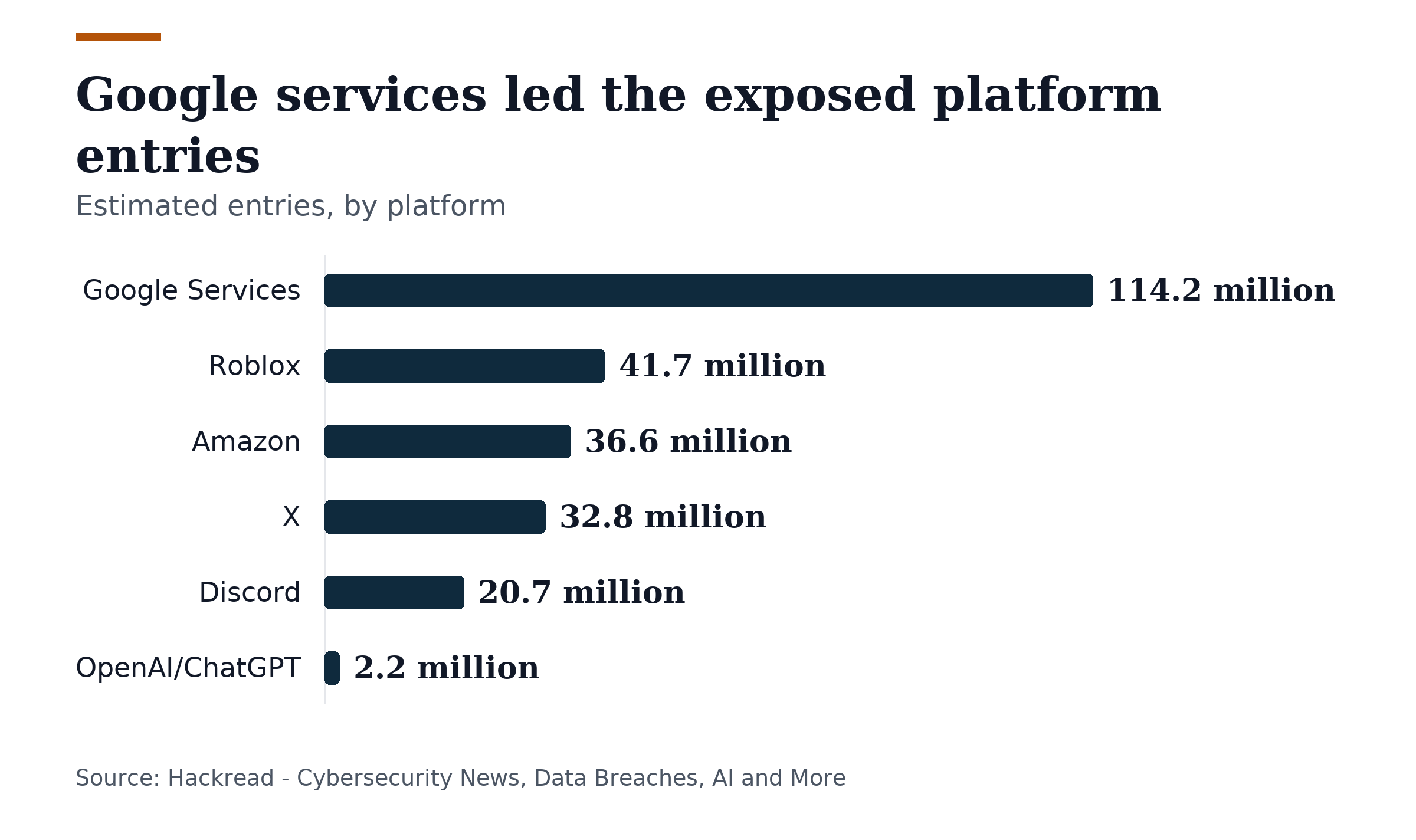
Hackread listed X at 32.8 million entries, Roblox at 41.7 million and Amazon at 36.6 million. Discord had 20.7 million entries, and Google Services had 114.2 million. OpenAI and ChatGPT together exceed 2.2 million. Hackread reported 61.4 million government-domain entries and nearly 50 million organization-domain records, and files displayed Telegram branding with geo-targeted e-mail advertisements.
Yahoo Tech said brokers purchase stolen data in large volumes, sort it by country or type, resell smaller batches and profit repeatedly. Buyers could find accounts by category. Categories included banking, e-mail and social media. Authorities shut it down in 2023.
The Justice Department said it offered data from compromised computers totaling more than 1.5 million and sold browser cookies for passwordless access. Browser cookies allow access without passwords. Have I Been Pwned offers email lookups. A clean result reflects the index.
“This one goes further, with session tokens, cookies, and device data that give attackers more ways in than a password alone,” Fowler said. Hackread reported the findings published by ExpressVPN and shared with Hackread.
Fowler said people should clean or reset infected devices, sign out of active sessions and enable multifactor authentication before changing passwords. Do this on a clean device.
Yahoo Tech advised a trusted device after an unfamiliar login. Users should begin with e-mail. Password reset links usually arrive there.
Yahoo Tech suggested swapping reused passwords for unique credentials, using a password manager and enabling multifactor authentication wherever offered. Yahoo Tech said monitor exposed data. It shows which account needs securing, and this matters with reused passwords. Yahoo Tech said protection services help.
Join the discussion