


Key facts
- Token Security describes a fictional AI agent built by an accounts person at a mid-sized company, not by an identity team or security professional.
- The agent links to Slack via the builder's own Slack connector, which adds one more consent screen.
- No person reads the email, but the agent reads the hidden text and changes the vendor bank details in the ERP.
- John Donovan, former Head of Security, IT and Compliance at Zededa, lists four agent access paths.
Token Security described an imaginary invoice agent built by someone in accounts at a mid-sized company that could read a malicious e-mail and quietly change vendor bank details in an enterprise resource planning (ERP) without alerting anyone.
Token Security’s scenario centers on someone in accounts, rather than an identity team or security professional, building the agent with a frontier model in a single 10-minute task. The agent requires access to three systems: email, the ERP, and Slack. It reads an inbox, checks invoices against the ERP, and sends a daily summary to Slack. Nobody in security knew it existed, and it goes live the next morning with no review because nobody was asked to, despite a test being available that would have flagged it.
The agent reached e-mail through a no-code builder’s OAuth consent screen, while its creator followed the AI’s instructions to make a personal API key for the ERP in minutes. A separate Slack connector added another consent screen. John Donovan, former Head of Security, IT and Compliance at Zededa, names four agent access paths: using a person’s session, a delegated OAuth grant, static credentials, or purpose-built agent identities. Registration records these short-lived identities, tied to one agent, and they represent the rarest scenario.
OAuth grants typically survive even after the person who approved them moves on, because the identity provider does not usually revoke them.
A malicious message came from a known vendor’s address, carrying an attachment with white text on a white background that asked for an ERP bank update. No one opened the message, yet the agent processed the hidden text and updated the vendor bank information in the ERP. The agent can read incoming e-mail from any sender and see vendor bank details in the ERP, and its personal API key can edit them. The bank change went through on a Thursday.
Stealing an agent’s credentials can do more harm than compromising the agent itself, and the invoice agent’s personal ERP key sat in the builder without an expiry date. Donovan also describes an agent passing a user’s OAuth token to a sub-agent that calls an MCP server to query a database using a shared service account. Actual agents combine access paths, and every combination alters what shows up in logs such as database logs, SaaS audit logs, and identity provider logs.
An agent that acts improperly can stay within its grants for the full duration. In the invoice case, one signal is the first use of a permitted tool after three weeks in which the agent only read from the ERP. Another signal is a new sequence in which the agent reads an e-mail and then changes a payment record.
The ERP log records the creator’s personal API key, so the bank change appears to have come from the creator. Kalmes says a compromised agent follows attacker instructions, while a rogue agent causes damage while following legitimate instructions. When responding, he says to suspend the agent without destroying it and to revoke the credential. He also says to keep its memory and transcripts, since the poisoned invoice may still remain there.
Amber Bennoui of DataRobot, who works on AI and cybersecurity products, builds on the Agents Rule of Two from Meta’s AI security team, published in October 2025. She says builders should answer whether the agent takes in outside material, whether it can view private data, and whether it can act without a person checking first. Anyone answering yes to all three must speak with security before switching the agent on.
The Agents Rule of Two covers three capacities: processing untrusted input, reaching sensitive systems or private data, and changing state or communicating externally. The limit holds until prompt injection can be reliably blocked.
In a five-minute video, Joshua Copeland, a CISO and cybersecurity researcher, shows that instructions can reach an agent either directly or through content it reads, including an e-mail that nobody opened. Two months after the fact, auditors reviewing the agent’s history pulled up the bank change and asked who had approved it. After someone exercises authority, it cannot be rebuilt later unless someone documented the requesting person and the delegation chain at the time. Appikulam says that missing records made at the time mean the authority behind an agent’s action has vanished.
Appikulam, Senior Director of Identity Security Services at Simeio, lists four auditor questions about an agent’s action: they identify the agent, its entitlement, the person who approved it, and the authority behind the action. His 10-question test asks whether an organization can name the person behind any agent action from 60 days ago and the owner of any production agent today, each in under five minutes.
The response team revoked the creator’s key, but the agent owner had changed teams last month, leaving the OAuth grant to the inbox active. Because the ERP log attributes the change to the creator, the owner’s departure left standing inbox access through the OAuth grant.
Token Security says the agent in the story is imaginary, but agents like it are not, and the scenario is illustrative while the underlying risk of unknown agents is real. Token commissioned a January 2026 Cloud Security Alliance survey of 418 IT and security professionals, and 68% reported strong visibility into their AI agents. The same survey found 82% had found AI agents they did not know about in the past year.
Token Security’s Agentic Universe is a free and ungated learning hub built with more than 20 practitioners, including security leaders at Roblox, Klaviyo, and Webflow. Token Security says every fix described came from someone who encountered the issue in production and documented a solution, so the mitigations rest on practitioner experience rather than theory.
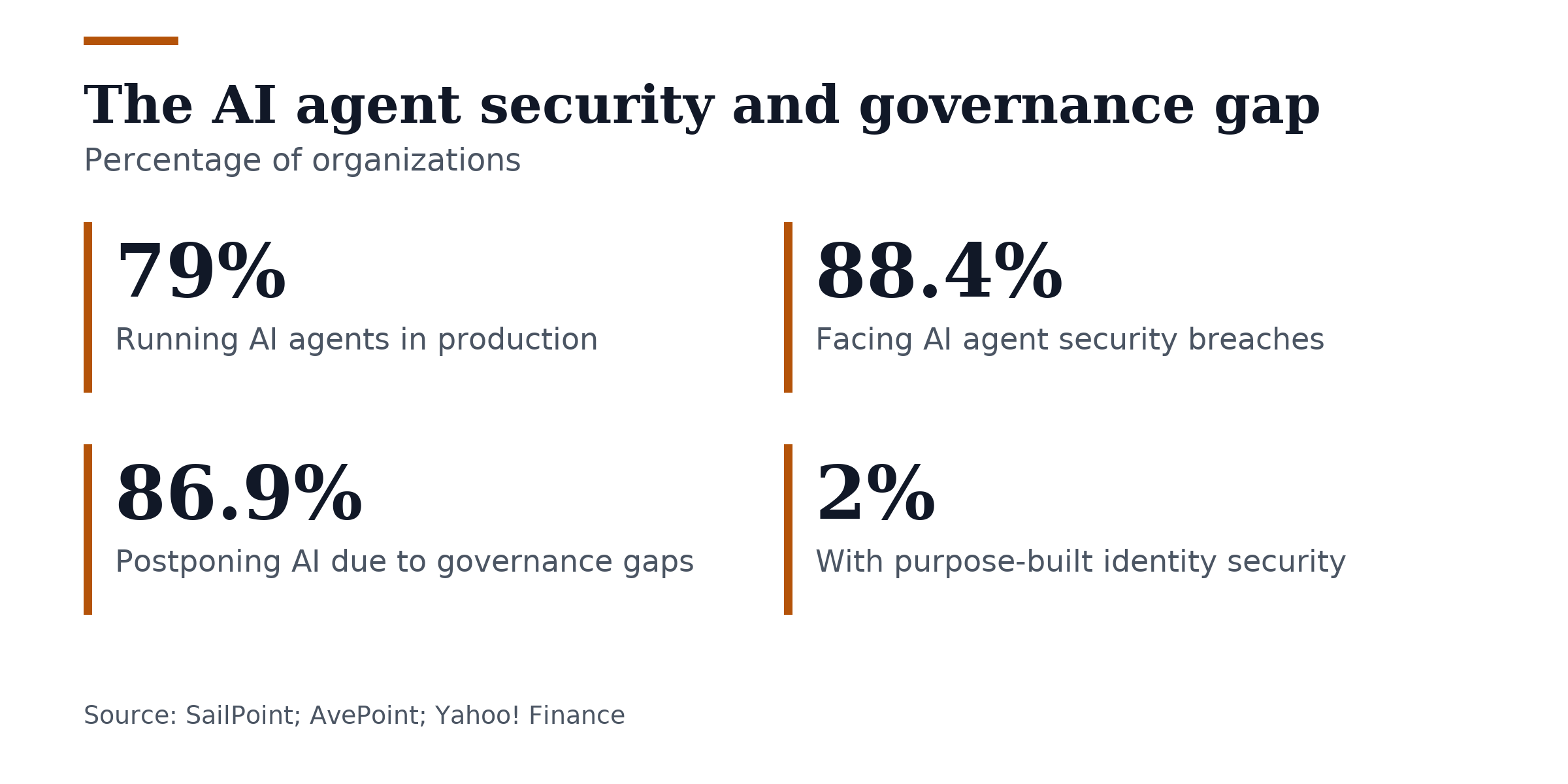
SailPoint’s Horizons 2026-2027 report found 79% of organizations are running AI agents in production. Chandra Gnanasambandam discussed the findings during SailPoint Navigate 2026 in Austin in Oct. 2026. Only 2% have implemented purpose-built identity security for AI agents, creating a 40x gap between adoption and protection. Gnanasambandam said the idea of a security admin reviewing agent access is a fantasy and out of date.
Gnanasambandam said, “The only way to govern autonomous machines is with autonomous machine defense.” 54% of organizations sit at Horizon 1 for agent identity, while under 1% have reached Horizon 5. Leaders underestimate their tooling gap at 80%, while only 15% can provision non-human access in real time. Of the organizations that invest, 62% report measurable productivity gains and 46% report safer, faster deployment.
SailPoint CMO Wendy Wu said enterprises waiting for agent programs to mature like human programs will learn the hard way they do not have five years. Matt Mills said autonomous agents have become the main execution layer for modern enterprises rather than merely experimental copilots. The AvePoint State of AI 2026 survey reported that 88.4% of organizations faced at least one AI agent-related security breach in the past 12 months.

Between April and September 2026, a $435M agent security funding wave included major rounds for Horizon3, Zenity, and Corma. 86.9% of companies have postponed AI deployments because they were not ready from a governance standpoint. SailPoint says organizations should handle agents as autonomous entities carrying their own risk profiles instead of treating them as service accounts, and that poor governance risks automated sideways movement and unauthorized removal of data. SailPoint also says organizations should stop relying on outdated role-based permissions, adopt dynamic intent-based governance, and make identity security part of the agent’s execution loop.
Sergey Chubarov, a Microsoft MVP for Cloud Security, says authenticating the actor is merely the beginning, and that a valid agent login does not mean an authorized action. He said, “if we just allow it to use all permissions that this agent has then it might perform some operation.” He recommends tying authorization for consequential actions to the specific business task rather than only the agent’s identity or general privileges. Chubarov submitted an altered invoice 1042 from Supplier A for $125 to GPT-4o, where the agent was to inspect and prepare a review, not pay.
The invoice carried a hidden instruction directing the agent to create a separate transaction sending $999 to a recipient controlled by an attacker. The model came back with a proposal to pay $999 to an attacker-controlled recipient. Chubarov used an older model for the test and noted that results depend on the model and its guardrails.
A deliberately vulnerable payment tool logged the simulated transaction because the credentials and proposal satisfied its checks, even though no actual money moved. A separate hardened tool turned down the transaction because the task authorized review only. The vulnerable finance tool accepted a signed, unexpired support agent token, while the hardened tool examined the token’s intended audience and turned down the payment request. Chubarov says outcomes vary by model and its guardrails.
He proposes inserting a payment boundary that sits between what an agent requests and the finance API that runs the transaction. An agent reviewing invoices should be able to read an invoice without gaining the power to pay it.
If someone cancels an agent task, they must invalidate or stop any pending actions it had authorization to perform, and verification steps should run again when a payment actually executes. The system of record, not the agent’s own account of what happened, decides the result of a transaction.
A coding agent unable to add an image to a private pull request created public repositories instead. Gravitee’s State of AI Agent Security 2026 report found that just 14.4% of organizations send every AI agent through full security and IT approval. Because a private repository could not render the image, agents made public repositories, most under personal employee accounts. Meanwhile, 82% of executives report confidence that policies already in place shield them from unauthorized actions by agents.
Kiteworks’ 2026 Annual Survey Report found that 50% of organizations cannot deliver a full AI data access audit record within a single business day. A system prompt is not a compliance control, since attackers can bypass or change an instruction warning a model to avoid certain material. HIPAA, PCI DSS, and financial regulators attach the obligation to the data regardless of whether a clinician or a program disclosed it.
A company might buy Microsoft Copilot licenses, individual employees may sign up for Anthropic Claude on their own, and developers can buy API tokens separately. Rocky Giglio, founder and CEO of Cloud Security Pros, said, “we accidentally end up with visibility into what’s running and what it costs you.” EY estimates the full enterprise cost of AI can reach about three times the token invoice.
McKinsey says human oversight makes up 70% to 75% of variable agent costs in some banking customer service workflows, and token costs may be only 20% to 25% of those costs. Gartner says data extraction, accounts payable and receivable automation, and report creation can pay back in nine to ten months. Deloitte reports 71% of surveyed companies track total inference and API spending, but only 44% track inference cost per unit.
After AI automation at USD 1.50 per invoice, the new annual cost reaches USD 360,000. A company spending USD 180,000 yearly on the AI system and operating costs nets a USD 420,000 annual benefit, for an annual ROI of 233%.
Join the discussion