

Key facts
- The crackdown follows President Donald Trump's Executive Order 14390, signed March 6, 2026, which ordered a government-wide campaign against fraud and predatory schemes.
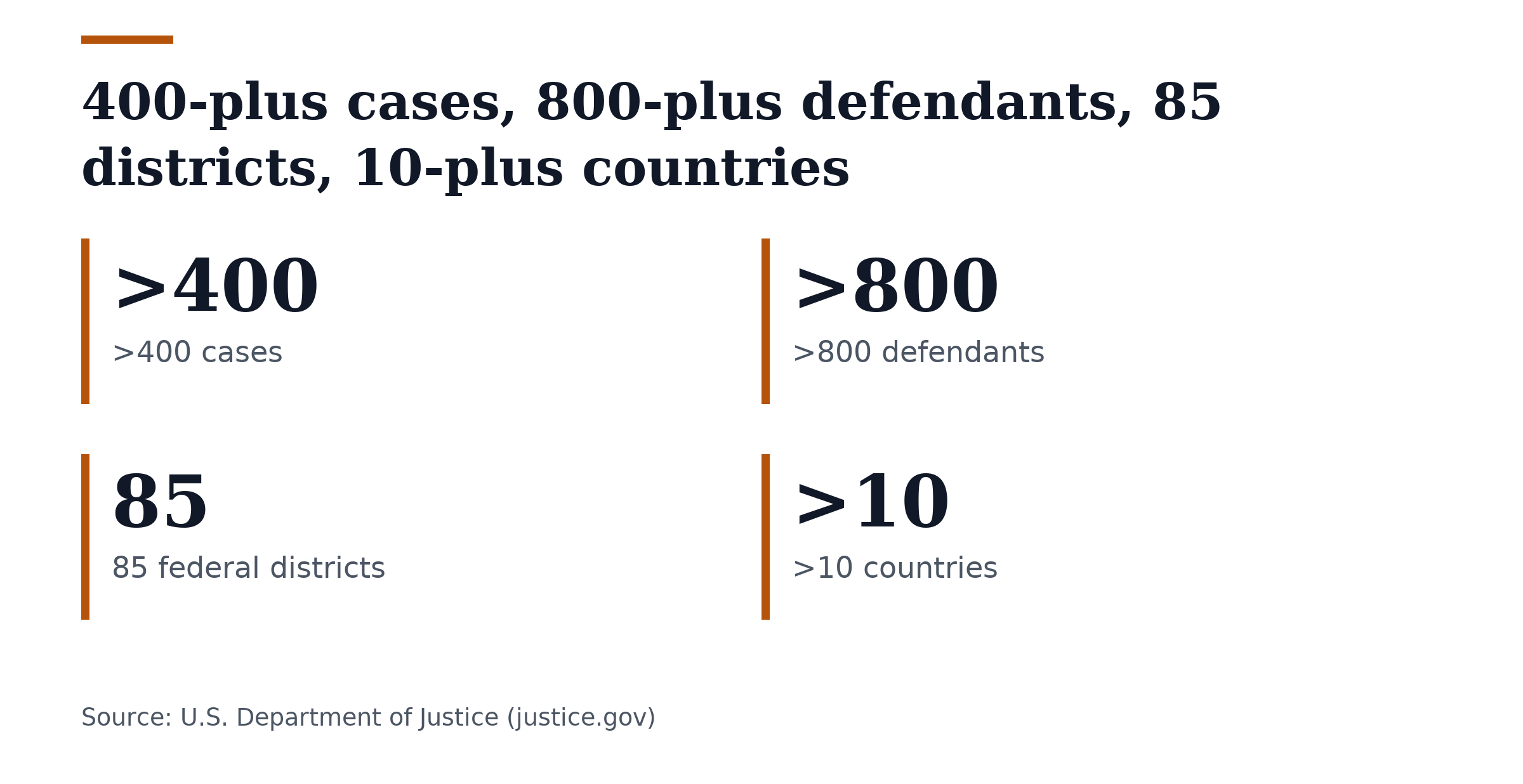
- Justice Department prosecutors took action in more than 400 cases against more than 800 defendants across 85 federal districts.
- Working with law enforcement in more than 10 countries, U.S. prosecutors and agents raided overseas scam call centers and compounds aimed at Americans.
- Operation Blackout helped break up more than 29 scam compounds spanning Asia, Africa, and the Middle East, and it led to the release and return home of more than 2,200 trafficked workers.
The Justice Department announced a crackdown on scams aimed at Americans on Tuesday, November 24, 2026, calling it the largest-ever effort of its kind. The move follows President Donald Trump’s Executive Order 14390, signed March 6, 2026, which instructed the government to wage a broad campaign against fraud and predatory schemes.
Prosecutors with the Justice Department acted in more than 400 cases involving more than 800 defendants in 85 federal districts, and authorities extradited 30 defendants to face scam-related charges in U.S. courts. Working with law enforcement in more than 10 countries, U.S. prosecutors and agents raided overseas scam call centers and compounds aimed at Americans.
The FBI’s Operation Blackout restrained nearly $17 billion in illicit funds and seized more than 14,000 digital devices. More than 29 scam compounds were shut down across Asia, Africa, and the Middle East, and the operation sent more than 2,200 trafficked workers home.
Since March 6, Homeland Security Investigations has made more than 300 arrests, helped indict more than 100 defendants, and secured roughly 80 convictions and guilty pleas. Its financial fraud investigations brought about action on more than $120 million in illicit proceeds, including seizure, restraint, freezing, or recovery. The U.S. Secret Service restrained illicit funds of more than $200 million, disrupted 1,780 scammer domains, and recovered more than $119 million.
Secret Service investigators investigated more than 1,540 business e-mail compromise incidents (a scam in which criminals hijack or spoof e-mail to trick victims into sending money), and the U.S. Postal Inspection Service sent more than 4,800 letters about unlicensed money transmitters since March. The Postal Inspection Service seized three domains tied to Georgia prison jury duty scams and sent visitors to government seizure banners.
Authorities identified a Secret Service-led cryptocurrency investment conspiracy that operated from scam centers in Cambodia and targeted at least 174 U.S. victims. In October, authorities extradited a Chinese national from the Netherlands, and prosecutors arraigned him in the Central District of California over alleged involvement in that conspiracy.
Prison gang members in Georgia used smuggled phones to call victims and claim they missed jury duty, then demanded a fine to avoid being arrested. Prosecutors brought three indictments charging 14 people in the jury duty scheme, and state courts charged 17 more people for smuggling phones into prisons.
The Federal Trade Commission took 16 actions challenging deceptive practices and returned almost $3 billion to consumers harmed by fraud and deception. Since April 2026, the agency connected more than 365 callers to the elder fraud hotline run by the Justice Department and gave the number to more than 7,100 people filing online.
A Mexico-based list broker knowingly sold the names and contact details of elderly Americans to dozens of scammers. Prosecutors charged a dozen defendants, including several Jamaican nationals, in a sweepstakes scheme aimed at elderly Americans. A Peruvian call center warned Spanish-speaking Americans that they would be arrested or deported if they failed to pay for English language-learning products.
Authorities extradited a Nigerian national from the United Kingdom over suspicion of trying to take U.S. service members’ military pay. Authorities charged Nigerian nationals in inheritance fraud schemes that falsely claimed victims must pay fees to get an inheritance, and a cremation services provider used bait-and-switch pricing that broke a court order and concealed his location from grieving families.
In October, Moldovan prosecutors trained by the State Department arrested three suspects in an online romance scheme. American and European victims lost $440,000 to the scheme in one month. Raids in the United Arab Emirates in April 2026 targeted nine compounds tied to cryptocurrency fraud against Americans, and 275 people were arrested. Cooperation with Ghanaian and Nigerian authorities led to 28 arrests in October 2026.

State Department-backed raids in Moldova closed five call centers and placed eight suspected coordinators in custody for allegedly running fake cryptocurrency trading platforms. The State Department said it funds and trains U.S. and Southeast Asian law enforcement. That law enforcement froze more than $1 billion in cryptocurrency that had been stolen. That effort also took down more than 1.4 million websites and accounts used for fraud.
The Securities and Exchange Commission brought charges against three platforms purported to trade crypto assets and four investment clubs, alleging they stole more than $14 million from retail investors. The SEC also filed actions against 39 entities for allegedly filing false Forms ADV (the registration forms investment advisers file with the SEC) and charged entities with investment confidence scams that misappropriated more than $15 million from investors. It additionally charged BG Wealth Sharing Ltd and DSJ Exchange Pty Ltd with an alleged scheme raising more than $130 million from tens of thousands of retail investors.
The FCC approved a rule on Nov. 19 letting prisons and jails use jamming technology to block calls from contraband cell phones. The agency said it blocked nearly 300 million illegal robocalls, which saved Americans at least $38 million, and it blocked more than 1,400 providers.
The Justice Department cited Gallup figures showing estimated U.S. scam losses of $68 billion for 2025. Gallup research cited by the department found about 10% of U.S. adults were affected by a scam in the past year, directly or through a household member. The FBI warned more than 11,000 Americans they were being targeted and estimated it prevented more than $690 million in potential victim losses.
Gallup research cited by the department found that most people harmed by scams reported harm to their mental health or well-being. Gallup found that the majority of scam losses were $500 or less, while the average loss was $5,578. In affected households, family members reported harm to their own well-being too, with the share at 65%. Researchers said the consequences include a wider loss of trust in everyday institutions and businesses.
Attorney General Todd Blanche said the Justice Department recovered more than $8 billion in intended victim losses. The figure for intended victim losses addressed by enforcement operations was $8 billion, and it does not represent money already returned directly to victims. Blanche also said the results are just the beginning and the Justice Department will continue prosecuting scammers.
The Justice Department began a public education campaign. It asks Americans to Share Your Scam Story with friends and relatives during the holiday season. The department noted that an indictment amounts to an allegation and that defendants remain innocent until proven guilty. The State Department said the threat is evolving and noted several pending extraditions.
In February 2026, authorities seized more than $580 million in cryptocurrency tied to Southeast Asian scam networks. Prosecutors in October 2025 sought to seize 127,271 bitcoin tied to a Southeast Asian scam operation. The Justice Department formed the Scam Center Strike Force in 2025 to target Southeast Asian crypto fraud, and it has restrained cryptocurrency worth about $1.08 billion.
Join the discussion