

This is a new development in a story we reported earlier: CISA Adds 10 actively exploited flaws to KEV catalog.
Key facts
- Accenture's APEX Labs said attackers exploited previously undisclosed Mitel MiCollab zero-day vulnerabilities before Mitel released the November 16 patch.
- The intruders entered at least one organization, reached Active Directory domain controllers, and stole database contents within a day.
- Accenture assessed the activity as belonging to a wider extortion campaign focused on stealing data from internet-facing MiCollab servers, and has not linked it to a specific threat group.
- Federal civilian agencies must fix four of the flaws by November 28, 2026, and the fifth by December 9, 2026.
Accenture’s APEX Labs said attackers exploited previously undisclosed zero-day vulnerabilities in Mitel MiCollab before the vendor released its Nov. 16 patch. The intruders entered at least one organization, reached Active Directory domain controllers and stole database contents within a day. All five unauthenticated flaws sit in the Audio, Web and Video Conferencing component of MiCollab 10.3 (10.3.0.18) and earlier.
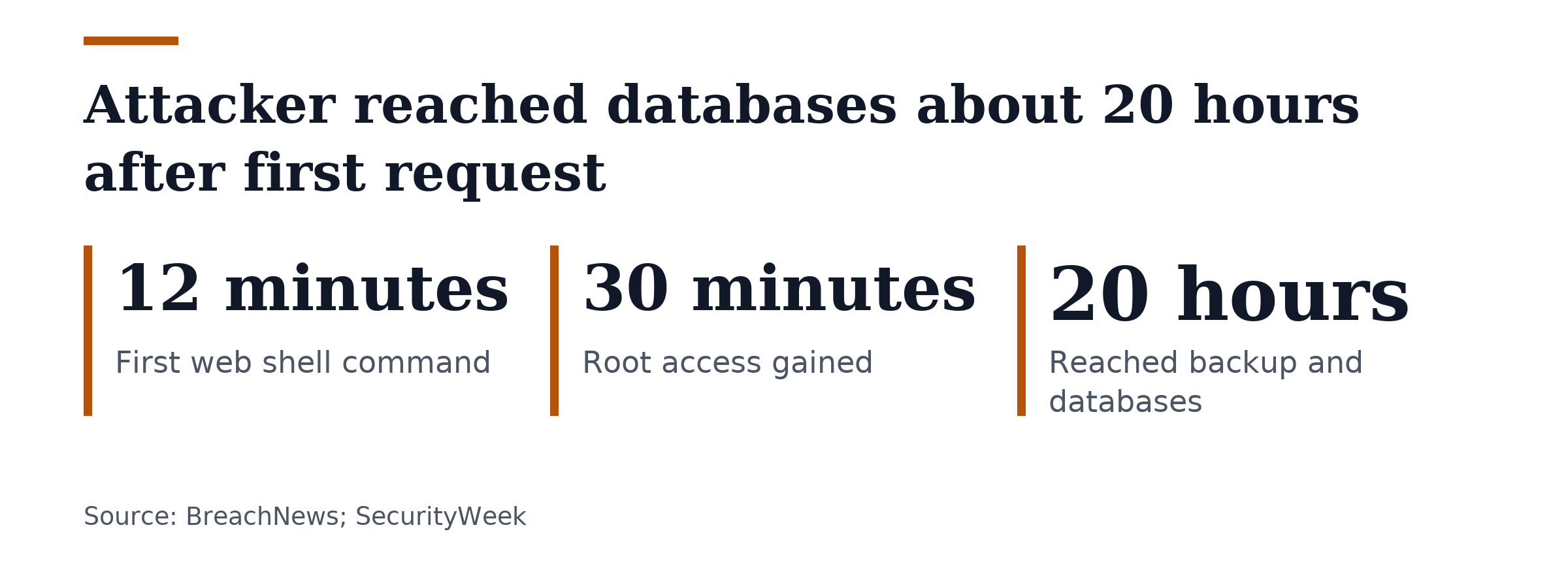
Accenture determined that attackers installed a web shell on a victim’s systems on Nov. 15, before Mitel issued its advisory. Twelve minutes after the first request, the attacker uploaded files and ran the first web shell command. The intruder gained root on the MiCollab server within 30 minutes. About 20 hours after the first request, the attacker reached a backup server and a line-of-business database server, dumped databases using custom Java tooling, and uploaded data in hundreds of short HTTPS sessions to a server it controlled.
A second organization’s MiCollab server maintained a persistent HTTPS connection to attacker server 204.76.203[.]204 since Nov. 9. The connection remained active before the patch became available on Nov. 16. Accenture lists that address and 204.76.203[.]216 among its indicators of compromise and urges defenders to block and hunt for both.
The attacker’s server communicated with two commercial AI API services for a combined 155 hours between Nov. 7 and Nov. 17. AI API traffic resumed at the exact moment of the authentication bypass request, following a silence of more than eight hours. “Apex Labs cannot determine precisely how the threat actor used the services,” Accenture said.
Accenture’s telemetry sampling prevents a precise determination of how the threat actor used the AI services. The company said observed activity is consistent with uses such as data triage, operational support, or extortion material preparation. Accenture assessed the activity as belonging to a wider extortion campaign focused on stealing data from internet-facing MiCollab servers and has not linked the intrusions to a specific threat group.
MiCollab draws attackers because it is often exposed to the internet and connects to Active Directory, according to Accenture. Threat actors regularly target Mitel products. CISA’s Known Exploited Vulnerabilities catalog, the agency’s list of flaws under active exploitation, currently includes a dozen Mitel vulnerabilities.
All five vulnerabilities are unauthenticated. Two are critical and permit arbitrary command execution. “Exploiting these vulnerabilities together can significantly amplify their impact,” Mitel said.
Mitel disclosed the flaws on Nov. 16 in security advisory MISA-2026-0012 and updated it with CVE numbers, identifiers for publicly disclosed security vulnerabilities, on Nov. 24. On Nov. 26, the advisory still did not state that the vulnerabilities had been exploited, and its most recent update dated to Nov. 24.
CVE-2024-41713 is exploitable without authentication, while CVE-2024-55550 requires an authenticated administrator. watchTowr researcher Sonny Macdonald reported both flaws to Mitel and later publicly disclosed details and a proof-of-concept. CISA told federal agencies they had three weeks to remediate the flaws added in that catalog update, which included the MiCollab and Oracle WebLogic flaws.
CISA added all five MiCollab flaws to its Known Exploited Vulnerabilities catalog on Nov. 25. Federal civilian agencies must fix four of the flaws by Nov. 28 and the fifth by Dec. 9.
Servers running 10.3.0.18 or earlier that face the internet should be considered potentially compromised. Forensic images should be captured before any patching or rebuild. Accenture warned that attackers may have compromised MiCollab servers before fixes were installed and urged organizations to block and hunt for indicators of compromise, signs that a system has been breached, 204.76.203[.]204 and 204.76.203[.]216.
Join the discussion