

Key facts
- The Treasury's Financial Crimes Enforcement Network issued an order on November 6, 2026 that removes MEXC Global from the US financial system because of sanctions evasion and cybercrime ties.
- Treasury acted under Section 9714(a) of the Combating Russian Money Laundering Act as part of Operation Economic Outcast.
- FinCEN labeled MEXC Global a primary money-laundering concern tied to Russian illicit finance and a financial institution.
- Between May 2021 and May 2026, MEXC sent or received roughly $1 billion in direct dealings involving more than 40 Iranian cryptocurrency exchangers.
On November 6, 2026, the Treasury’s Financial Crimes Enforcement Network ordered MEXC Global removed from the U.S. financial system over sanctions evasion and cybercrime ties.
The measure bars American banks and other covered institutions from handling money movements to or from MEXC Global, including cryptocurrency transfers. It covers every financial institution subject to U.S. anti-money-laundering rules, including securities broker-dealers and futures commission merchants. The restriction covers MEXC’s foreign subsidiaries, branches, offices and successor entities.
American financial firms and people face secondary sanctions or enforcement for moving money to or from MEXC Global. Violations may bring civil or criminal penalties. The order does not freeze customer balances or compel MEXC to shut down worldwide operations.
This differs from a standard OFAC listing and does not automatically block MEXC assets or place the exchange on the sanctions blocklist. The order carries no end date, while FinCEN retains the power to impose conditions or grant exemptions. Rules already in force under the Bank Secrecy Act and OFAC-administered sanctions continue to apply unchanged.
The measure takes effect 30 days after publication in the Federal Register. As of November 7, the Federal Register publication date remained unconfirmed, leaving the precise start date undetermined. Finance Magnates calculated that the 30-day timeline puts the U.S. ban in December 2026 at the earliest.
FinCEN alleges that MEXC handled at least $16 billion in illicit transactions tied to sanctions evasion and cybercrime from May 2021 through May 2026. Sources disagree on the exact total figure. Yahoo Finance reported the suspected illicit volume as approximately $16.7 billion over the same five-year period.
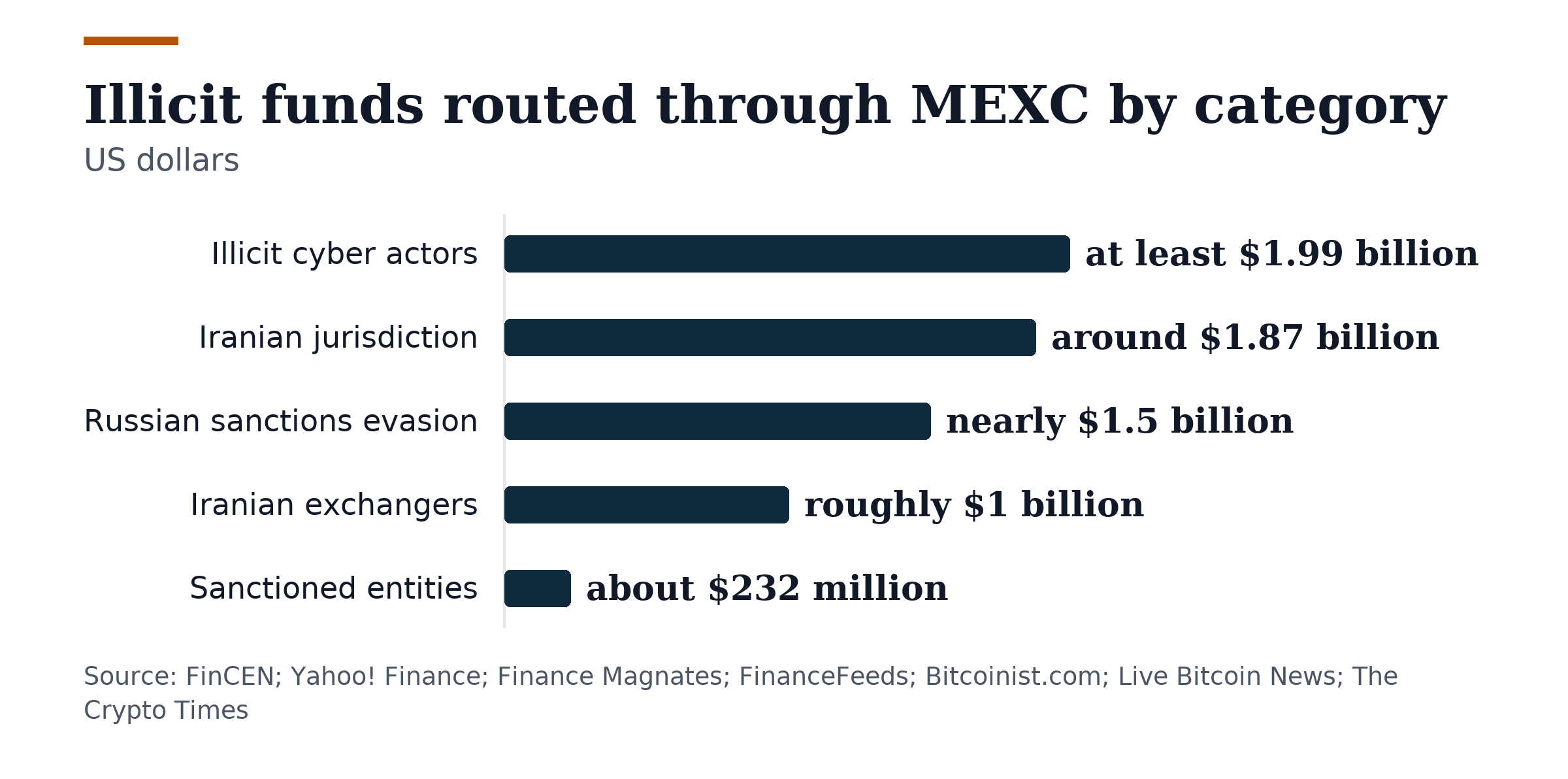
Nearly $1.5 billion of the alleged total traced to Russian sanctions evasion, Treasury said. About $232 million covered direct transactions with entities under sanctions from the United States, European Union or United Kingdom. Almost $200 million in transactions touched the ruble-backed A7A5 stablecoin, while at least $26 million went to the sanctioned A7 network.
FinCEN alleged MEXC kept handling transactions with sanctioned Russian exchange Garantex and successor Grinex as recently as June 2026. FinCEN put roughly $129 million in transactions with Garantex and $4.1 million with Grinex after U.S. sanctions hit the two exchanges. FinCEN alleged roughly $350,000 in payments for sanctioned North Korean money launderer Sim Hyon Sop between June and September 2025.
From May 2021 to May 2026, MEXC sent or received roughly $1 billion in direct dealings with more than 40 Iranian cryptocurrency exchangers. FinCEN linked about $1.87 billion in activity to Iranian jurisdiction. About $22 million in transactions aided Iran’s Central Bank, the Islamic Revolutionary Guard Corps and its Qods Force.
Treasury moved under Section 9714(a) of the Combating Russian Money Laundering Act as part of Operation Economic Outcast, a Treasury campaign launched in August targeting financial entities accused of helping Iran evade sanctions. Treasury Secretary Scott Bessent said, “Financial institutions cannot have it both ways: Either you support the Iranian regime, or you have access to the U.S. financial system.” In June 2026, Treasury sanctioned Nobitex, Iran’s largest crypto exchange, saying it handled more than half of Iran’s crypto inflows in 2025. In September 2026, the United States sanctioned BitBank, another Iranian exchange, over alleged bitcoin transfers to the Islamic Revolutionary Guard Corps.
FinCEN designated MEXC Global a primary money-laundering concern tied to Russian illicit finance and a financial institution. Treasury said severe deficiencies marked MEXC’s anti-money-laundering controls and customer identification and verification policies. The findings amount to an administrative assessment, not a criminal conviction establishing wrongdoing by MEXC. Earlier FinCEN findings put roughly $9 billion behind suspected Iranian shadow-banking activity routed through intermediaries abroad.
MEXC launched in 2018, operates from Seychelles, and serves more than 40 million users across more than 170 countries with access to 3,000 cryptocurrencies and tokenized assets. Treasury estimates MEXC handled more than $1 billion in daily transactions as of September 2026, while Finance Magnates cited FinCEN saying the figure topped $1 billion as of June 2026. MEXC held approximately $5 billion in reserve assets.
Customer funds stayed secure and trading, deposits and withdrawals continued without interruption, the company said. “MEXC is aware of the order issued by the U.S. Financial Crimes Enforcement Network (FinCEN) on November 6, 2026,” MEXC said. MEXC launched an independent review of its anti-money-laundering and sanctions controls.
CEO Vugar Usi said the order does not freeze or seize customer assets held on the exchange. Usi said deposits and withdrawals continued despite heavier withdrawal volumes, with the process staying orderly.
MEXC recorded $126.03 million in net outflows across the 24 hours surrounding the announcement. Finance Magnates calculated the outflow at about 2.9 percent of tracked assets.
The company did not directly address FinCEN’s transaction figures or reveal the extent of its U.S. financial relationships. MEXC has not announced changes to customer access or provided details on a possible legal challenge. MEXC said it plans to work constructively with FinCEN and other relevant regulators and competent authorities worldwide.
The exchange appointed Robert MacDonald, a former Bybit executive, as chief compliance officer in July. MEXC is working with analytics firms including Elliptic to restore its addresses to the exchange category. Usi said Elliptic returned MEXC Global to the Exchange category in its systems and removed a prior special risk label.
The order targets the movement of money through U.S. financial institutions, including transactions involving customers living elsewhere. A trader in Europe might see a crypto transfer between MEXC and a U.S.-regulated exchange rejected after the prohibition takes effect.
The Treasury order does not show that customers lost assets or that MEXC is insolvent. Foreign exchanges and banking partners might reconsider relationships with MEXC to avoid regulatory exposure, potentially disrupting deposits and withdrawals and affecting liquidity worldwide.
Star Xu of OKX told customers not to send funds directly from MEXC, saying funds tied to MEXC may be frozen and connected accounts investigated. Xu said OKX views FinCEN special measures with roughly the same caution as sanctions. On social media, OKX customers said deposits arriving from MEXC were being held because they appeared to originate from a potentially high-risk address.
FinCEN warned users to avoid unsolicited messages promising to unlock accounts because impersonation and recovery scams exploit confusion around enforcement actions. Customers should watch for direct notices from the exchange and their own banks. Institutional firms should read the actual order and consult legal advisers rather than assuming a general announcement covers every obligation.
FinCEN’s order identifies Seychelles, Hong Kong and Japan as places where MEXC operated without a license. Service ends for Dutch customers on November 16, 2026, while the first French accounts start winding down two days later.
Treasury called the illicit finance threats linked to MEXC serious. The order sits within a wider U.S. push to dismantle financial networks that allegedly move money for sanctioned parties through digital assets.
Join the discussion