

Key facts
- Wiz Research, OpenAI, Calif, and PHP maintainers formed a coalition that used frontier AI to uncover the PHP2Shell memory-safety flaws.
- The flaws can corrupt process memory, allow code execution without authentication, and expose passwords, tokens, API keys, and certificates.
- Maintainers had planned disclosure for Oct. 22 but shipped fixes a day early after details leaked.
- On Wednesday, OpenAI said it led a two-month effort involving PHP maintainers and security researchers plus security companies to address the flaws.
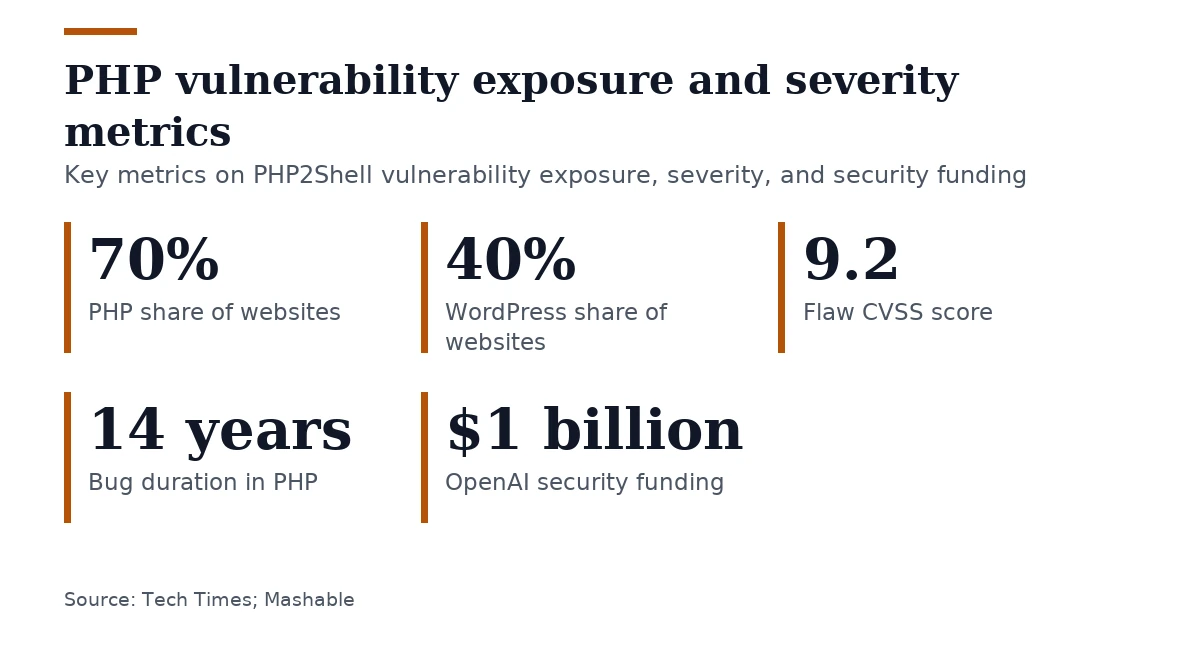
Wiz Research, OpenAI, Calif, and PHP maintainers came together in a coalition that relied on frontier AI to find the PHP2Shell memory-safety flaws in code running on roughly 70% of websites, disclosing them Oct. 21. Maintainers shipped emergency patches a day early after details leaked. Maintainers had originally planned disclosure for Oct. 22. The vulnerabilities can corrupt process memory, permit code execution without authentication, and leak passwords, tokens, API keys, and certificates.
The two vulnerability classes carry CVE-2026-109618 and CVE-2026-109619 and rate 9.2 on CVSS. CVE-2026-109618 involves out-of-memory handling that leaves a corrupted internal PHP state, which then treats invalid data as valid following cleanup requests. CVE-2026-109619 covers request-owned internal state that survives across requests, allowing later requests and users to reuse stale data. The flaws affect PHP versions dating back to PHP 5.4.
Researchers used the latest container images of WordPress, Drupal, and Joomla to demonstrate the bugs. Of all websites online, WordPress hosts 40%. PHP powers roughly 70% of all websites. On Oct. 21, PHP developers warned about security issues in their code and said emergency updates were necessary.
Attackers knocked many websites offline, including government sites across Europe and Wikipedia. Websites for the Port of Rotterdam, Overheid.nl, and KNVB in the Netherlands went offline. Kombit, a Danish municipal IT company, Valtori, a Finnish IT service provider, and France’s Interior Ministry were also affected. The Wikimedia Foundation said the Oct. 21 Wikipedia outage was linked to those vulnerabilities and took other systems offline as a precaution before patching them safely.
Downdetector listed trouble for Asana, GOG, Duolingo, Capital One, Bitbucket, Moodle, Quest Diagnostics, Final Fantasy XIV, War Thunder, and Internet Archive. Most of those sites have not said whether PHP connects to their problems.
OpenAI said Oct. 21 it led a two-month effort involving PHP maintainers, security researchers, and security companies to address the flaws. OpenAI and other industry partners and cybersecurity researchers received thanks from the PHP foundation in a blog post Oct. 21. Research and protection preparations before the flaws went public drew on OpenAI, Wiz, Cloudflare, and other partners.
In August, Calif found a version of the bug. OpenAI’s own team found a more complete version in September, working independently. A smaller version surfaced in 2024 but was not considered serious then. Greg Brockman said the bug had existed in PHP for 14 years.
Two months of preparation mattered to Brockman because the fixes involved complicated work, and he said an earlier leak could have done far more damage. He called current bug handling slow and manual.
U.S. agencies including the White House’s Super Intelligence Force, the Office of the National Cyber Director, and CISA worked with OpenAI. Brockman cited a separate Node.js remote code execution flaw disclosed Oct. 21.
GPT-5.6-Sol and Claude Mythos helped drive a rapid rise in bug discoveries this year, pushing some zero-day initiatives to shut down. On X, Brockman wrote that PHP was the first programming language he learned. He said current bug handling is slow and manual and will not scale as AI improves. OpenAI says this will not be the last case involving PHP.
OpenAI has already found other serious vulnerabilities and expects similar discoveries to rise sharply in the coming months. OpenAI committed $1 billion to subsidize security tool access for organizations that protect essential services. OpenAI is seeking security community feedback on a new process for coordinating disclosures.
Governments or authorized defenders could scan the internet for vulnerable systems, warn owners, and patch systems in extreme cases under one proposed idea.
Site operators can use a new OpenAI tool to check whether they run a vulnerable version of PHP. Japan’s prime minister used X on Oct. 21 to urge website operators to act. Owners were asked to check for PHP and install the fix at 11 p.m. Japan time on Oct. 21. Most people face only temporarily unavailable sites, and regular users do not need to install anything.
Join the discussion