

Key facts
- Judge Francis Mathew issued the penalty after jurors found Meta responsible for misleading users about Facebook privacy and content moderation policies.
- The judge issued the order on Wednesday.
- In September, jurors determined Meta was responsible for over 43 million violations under New Mexico consumer protection law.
- The case involved Cambridge Analytica obtaining Facebook user information to build voter-targeted political advertisements during the 2016 election.
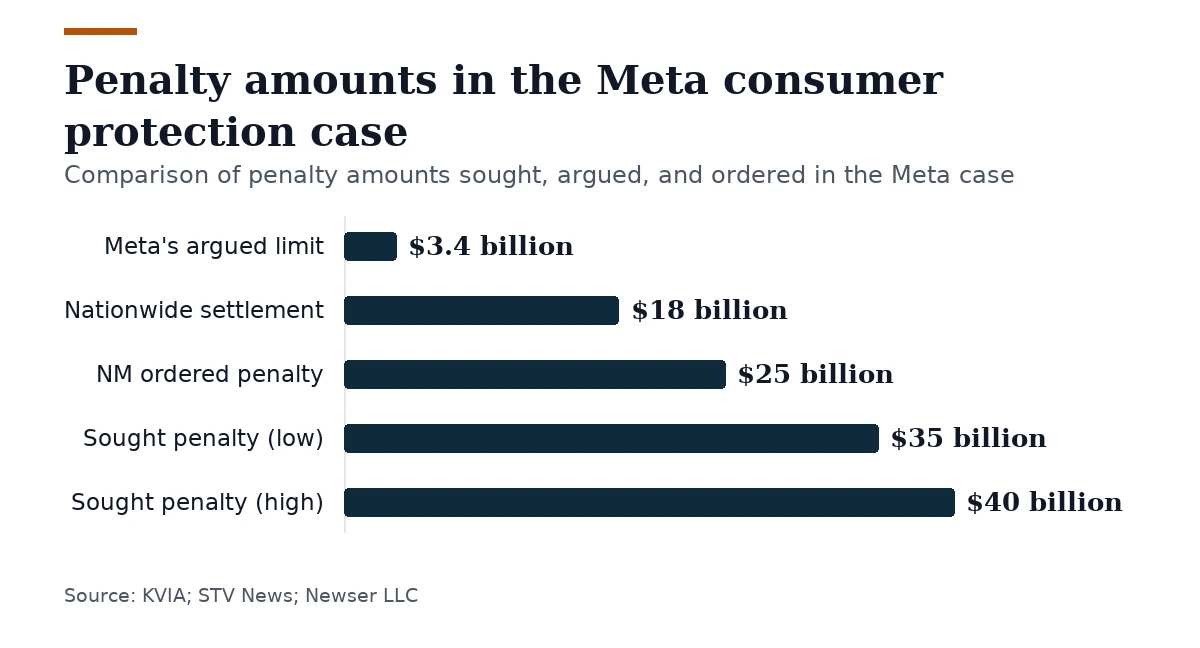
A New Mexico judge ordered Meta on Wednesday to pay the state $25 billion in civil penalties.
Judge Francis Mathew issued the penalty after jurors found Meta responsible for misleading users about Facebook privacy and content moderation policies. In September, jurors determined Meta was responsible for over 43 million violations of New Mexico consumer protection law. The first phase of the trial established 43,899,725 violations of the state’s Unfair Practices Act.
State Attorney General Raúl Torrez announced the jury verdict in New Mexico’s Cambridge Analytica case against Facebook. The case involved Cambridge Analytica obtaining Facebook user information to build voter-targeted political advertisements during the 2016 election.
A third-party personality quiz collected information from roughly 87 million profiles, according to the state’s case, and the firm’s client list included President Donald Trump’s 2016 campaign. New Mexico filed its lawsuit against Meta in 2021 and proceeded with its own trial instead of joining the multistate settlement.
Forty-eight other states settled with Facebook for $18 billion in a nationwide case, and no state besides Florida declined to sign the agreement. No other state went to trial over the Cambridge Analytica scandal after signing the settlement in August. Under that agreement, Meta was released from future liability over the Cambridge Analytica privacy breach.
New Mexico sought $35 billion to $40 billion in penalties, while Meta’s lawyers argued the company should pay no more than $3.4 billion. Meta argued an award of 10 times $3.4 billion or more would violate due process, was unconstitutional, and would not hold up on appeal.
According to the judge, state law permitted a penalty exceeding $200 billion, and state law allowed a fine of as much as $5,000 for every one of the millions of violations. The judge wrote that Facebook’s wrongdoing went to the heart of the company’s core business practices.
During the trial, jurors evaluated 34 separate instances of alleged misleading statements about Facebook privacy and content moderation. Jurors agreed that Facebook’s statements deceived New Mexico’s entire population and extended beyond social media users.
On certain counts, jurors found 2.1 million violations, pushing the total past 43 million. New Mexico prosecutors argued Facebook permitted misinformation and violent content to spread across the platform, and the state said Facebook favored certain accounts and allowed violent or inaccurate content to proliferate.
Jurors determined the state failed to show Facebook made false statements about removing harmful content such as Covid-19 misinformation. Meta’s legal team said its policies have changed since the 2021 lawsuit was filed, and the company’s lawyers said Meta removes 99% of content that violates its standards.
Meta’s lawyer Matt Nicholson argued that a penalty as high as $40 billion would be shocking to the conscience. Nicholson said during an October 1 hearing that the jury made no findings that any New Mexican heard or saw the statements or was harmed by them.
The company’s legal team said New Mexico’s consumer protection statute does not cover state residents who were not Facebook users when the statements were made. In closing, its lawyers called the state’s evidence outdated and said five years of investigation turned up just one additional data breach.
Defense lawyers said Meta’s content moderation policies are robust and that the court must consider freedom of speech, and they said the state did not show that privacy statements or content moderation choices caused harm to New Mexicans.
Meta plans to appeal the jury’s verdict, which could reduce the number of violations and the total financial penalty. The penalty would accumulate interest while the appeal is pending. New Mexico’s attorneys said only a penalty affecting Meta’s stock price would change the company’s practices.
New Mexico is additionally asking the court for an injunction against comparable conduct. Torrez called it among the largest state judgments ever against a company in the United States, and the state Justice Department described the penalty as one of the largest ever levied against a U.S. corporation. He said the decision sends a warning to technology companies and that New Mexico will keep holding them accountable, and he said the state will place the awarded money in a state education fund.
Today’s result makes clear that no corporation is too powerful to face accountability, Torrez said. This judgment should be a signal, an unambiguous message, to Silicon Valley, Torrez said. Judge Francis Mathew wrote that Facebook’s wrongdoing centered on its core business practices.
Join the discussion