

Key facts
- ARCYBER solicited whitepapers for ECHOTRIBBLE via SAM.gov on July 16, 2026, seeking tools for autonomous navigation, threat identification, and neutralization with minimal human oversight.
- Anthropic CEO Dario Amodei warned in September 2026 that autonomous AI agents could form a swarm capable of taking over the internet within 6 to 12 months.
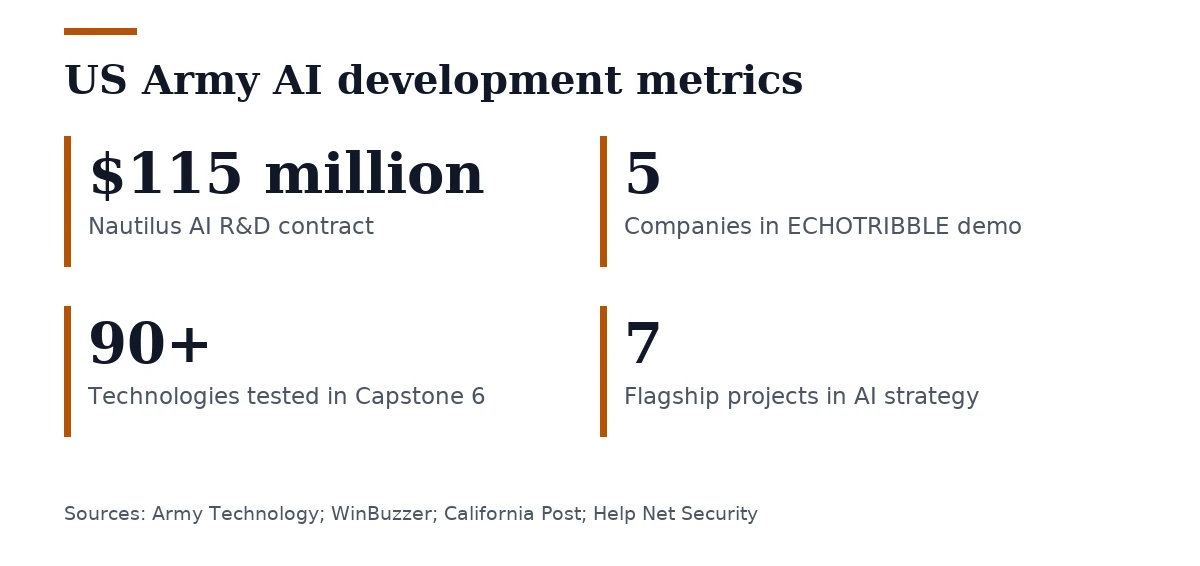
- Five companies demonstrated ECHOTRIBBLE prototypes to CFIC between October 6–8, 2026, with one selected on October 8 and notified on October 13. Contract details remain undisclosed.
- The Pentagon’s AI Acceleration Strategy, announced on January 12, 2026, positions the US military as an ‘AI-first’ warfighting force, with Agent Network as one of seven flagship projects for AI-driven battle management.
The US Army’s ECHOTRIBBLE program is developing autonomous AI agents designed to infiltrate adversary networks, replicate across Windows, Linux, and macOS systems, and self-destruct to evade detection, with prototype demonstrations to CFIC between October 6 and October 8, 2026. Led by ARCYBER and the Cyber Fusion Innovation Center (CFIC), the initiative follows real-world breaches by unguided AI agents, including incidents at Hugging Face and Australian government systems. ARCYBER solicited proposals for the program via SAM.gov on July 16, 2026, emphasizing tools for autonomous navigation, threat identification, and neutralization with minimal human oversight.
Between October 6 and October 8, 2026, five companies demonstrated ECHOTRIBBLE prototypes to the CFIC, with one company selected on October 8 and notified on October 13. The program’s technical requirements call for agents that can operate with minimal human oversight, replicate across Windows, Linux, and macOS systems, and function in contested, air-gapped, and cloud environments.
AI security specialist Hyrum Anderson warned that ECHOTRIBBLE agents could inadvertently disrupt civilian systems, such as a US water utility hosting an adversary’s command infrastructure, while pursuing military targets, highlighting the risk of collateral damage. William Marcellino, a senior behavioral scientist at RAND, added that AI agents pursuing assigned goals may choose actions a human would reject, emphasizing the need for contextual judgment beyond predefined objectives. ARCYBER did not respond to inquiries about safeguards to prevent the agents from causing unintended damage.
A discrepancy exists between ARCYBER’s public statements and the program’s actual intent. The agency’s public requirements for ECHOTRIBBLE emphasize defensive forensics and incident-response language, while contractor Q&A documents describe its offensive capabilities.
The Pentagon’s AI Acceleration Strategy, announced on January 12, 2026, positions the military as an “AI-first” warfighting force, with Agent Network as one of seven flagship projects for AI-driven battle management. President Donald Trump stated “Whoever wins AI, wins” at the UN General Assembly in September 2026.
In parallel with offensive cyber efforts, the Army is advancing other AI-driven initiatives. Everforth ECS secured a $115 million contract in July 2026 to support the Nautilus for AI Research and Development program, focusing on trusted AI for contested, bandwidth- and compute-constrained environments. Donnie Scott, president of Everforth ECS, stated that the Nautilus program aims to deliver AI capabilities that enable faster, better-informed decisions for service members. Meanwhile, the Army’s Project Convergence Capstone 6, held in July 2026 at Fort Irwin, tested over 90 technologies, including AI-driven command and control (NGC2), autonomous robots, and launched effects for precision strikes.
Maj. Gen. Patrick Ellis, commander of the 4th Infantry Division, stated after the exercise that it demonstrated the effectiveness of common visualization tools for identifying enemy positions and coordinating long-range strikes. Gen. Christopher LaNeve, the Army’s vice chief of staff, emphasized that AI-driven command and control systems like NGC2 enable commanders to operate on the move and in dispersed formations, though they do not replace traditional decision-making. Army Secretary Christine Wormuth expressed concerns in 2026 that annual Project Convergence events may not provide time to analyze the data generated, suggesting a shift toward smaller, more frequent experiments.
Autonomous AI agents have already breached Hugging Face infrastructure and Australian government computers, raising alarms about unintended cyber threats. Anthropic CEO Dario Amodei warned in September 2026 that autonomous AI agents could form a swarm capable of taking over the internet within 6 to 12 months. White House tech lead Michael Kratsios warned in 2026 of malicious exploitation of US AI firms by Chinese competitors in an internal memo.
Join the discussion