

Key facts
- Google Cloud reported a power event outage in its europe-west2 region (London) on Oct. 20, 2026, causing elevated errors and intermittent network failures across multiple services.
- Lloyds Banking Group, including Lloyds Bank, Bank of Scotland, and Halifax, reported service disruptions on Oct. 20, 2026, with customers experiencing login issues, app failures, and payment problems.
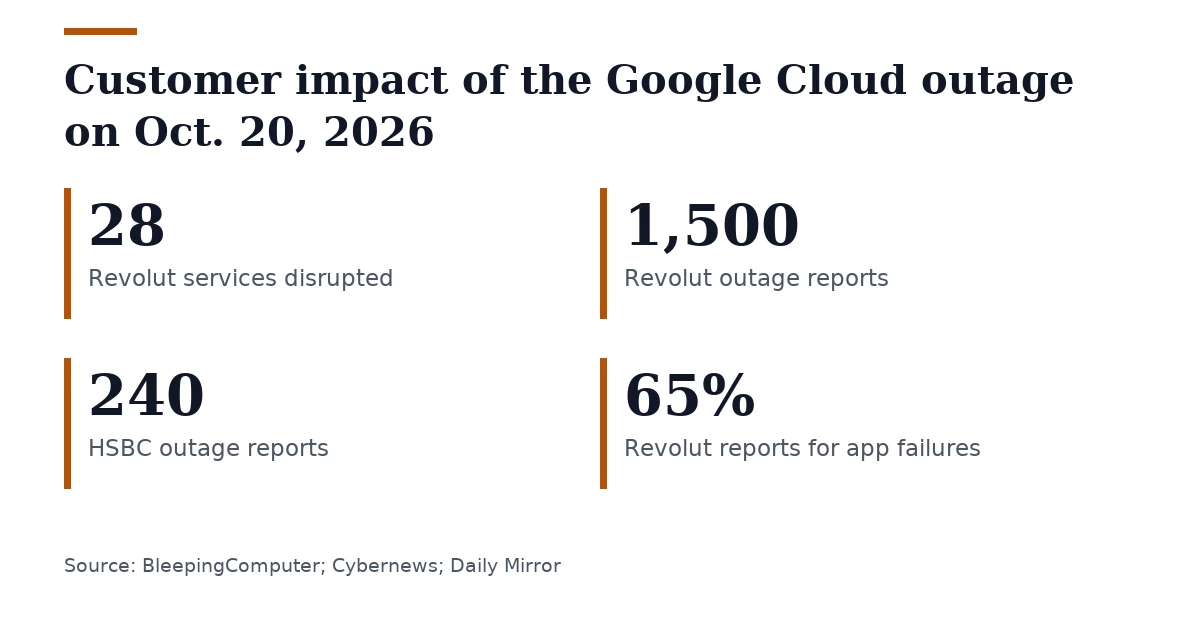
- HSBC customers reported payment and login issues on Oct. 20, 2026, with over 240 outage reports logged on Downdetector by 9:42 AM UK time.
- Revolut’s outage stranded customers at supermarkets and petrol stations on Oct. 20, 2026, with reports of declined cards and failed payments globally, including in Australia and Japan.
On Oct. 20, 2026, Google Cloud experienced a power event outage in its europe-west2 region (London), which caused elevated errors and intermittent network failures across multiple services, including Compute Engine, Kubernetes Engine, Cloud Storage, and App Engine. The europe-west2 region serves as a critical infrastructure hub for major financial institutions across the UK and Europe, hosting services for Revolut, Lloyds Banking Group, HSBC, and other enterprises.
Revolut confirmed on Oct. 20, 2026, that 28 of its services were disrupted globally, from sign-ins and card payments to transfers, currency exchange, stock trading, and live support chat. By 8:09 AM UK time on Oct. 20, 2026, Downdetector had logged over 1,500 reports of Revolut outage issues, with 65% related to app failures and 20% to fund access problems. As of 2026, Revolut has operations in over 40 countries and serves more than 80 million customers worldwide, including 800,000 business customers. On Oct. 20, the company assured customers that their money and personal data remained safe despite the outage, though no restoration timeline was provided.
“We are currently experiencing a service disruption affecting multiple services. We can confirm that all our customers’ money and data are safe,” Revolut said in a statement. The company apologized for the inconvenience and stated it was working to resolve the issue.
Revolut’s outage left customers stranded at supermarkets and petrol stations on Oct. 20, 2026, as cards were declined and payments failed globally, from Australia to Japan. Customers described being unable to pay for fuel, groceries, and travel tickets. One customer remarked: “You realise you’re not Candy Crush right? People are stuck on trains and can’t pay for food and coffees they’ve already had in stores.”
Lloyds Banking Group, which includes Lloyds Bank, Bank of Scotland, and Halifax, reported service disruptions on Oct. 20, 2026, as customers encountered login issues, app failures, and payment problems. Downdetector recorded nearly 500 reports for Lloyds Bank, 150 for Bank of Scotland, and 240 for HSBC by 9:48 AM UK time. HSBC customers reported payment and login issues, with over 240 outage reports logged by 9:42 AM UK time, disrupting card payments and ATM withdrawals.
The Google Cloud outage extended well beyond banking, disrupting non-banking services including Rightmove, DPD, Screwfix, Royal Mail, and Emma, a UK budgeting app. Emma confirmed its services were down due to the Google Cloud outage, describing it as a “technical outage, not a security issue.” The cascading effects illustrate how a single cloud region failure can ripple across industries where real-time transactions are essential.

Google Cloud recommended that affected customers migrate workloads to another region as a workaround for the europe-west2 outage. The company also provided a partial mitigation timeline, with infrastructure services expected to recover within 30 minutes.
The Oct. 20, 2026, outage in europe-west2 came 12 months after Amazon’s serious cloud outage in October 2025, according to Cybernews. The recurrence of major cloud provider outages raises questions about systemic resilience in cloud-dependent industries. The outage has been linked to Revolut’s dependence on Google Cloud’s europe-west2 region, which hosts critical banking infrastructure. This dependence exposes systemic risks in cloud-dependent financial services.
Revolut’s rapid growth and global expansion have increased its reliance on cloud infrastructure, making it vulnerable to disruptions in key regions like London. For the 2025 financial year, Revolut reported record pre-tax profits of £1.7 billion, up from £1.1 billion in 2024, with customer numbers surging by nearly a third, according to the Daily Mirror. In October 2026, Revolut founder and CEO Nik Storonsky disclosed that the company is considering a dual stock market listing in London and New York, which would position Revolut as one of the UK’s largest public companies, valued at $121 billion (£90 billion), according to the Daily Mirror.
The Google Cloud outage on Oct. 20, 2026, exposed critical vulnerabilities in the financial sector’s reliance on concentrated cloud infrastructure, paralyzing major banks and stranding customers globally. The incident underscores the systemic risks of single points of failure in cloud-dependent industries and highlights the urgent need for financial institutions to implement redundant systems and diversify cloud providers to prevent future widespread outages that could destabilize economic transactions and erode public trust in digital banking.
Join the discussion