

Key facts
- HUMAN Security's Satori Threat Intelligence and Research Team disrupted BADBOX 3.0 and published findings on November 18, 2026.
- The peak was larger than everything Satori published over the previous five years put together.
- This number counts bidding requests for ad space rather than viewed ads, completed payments, or infected device totals.
- The malware targets inexpensive handsets, tablets, and streaming boxes that run the Android Open Source Project to carry out ad fraud and traffic proxying.
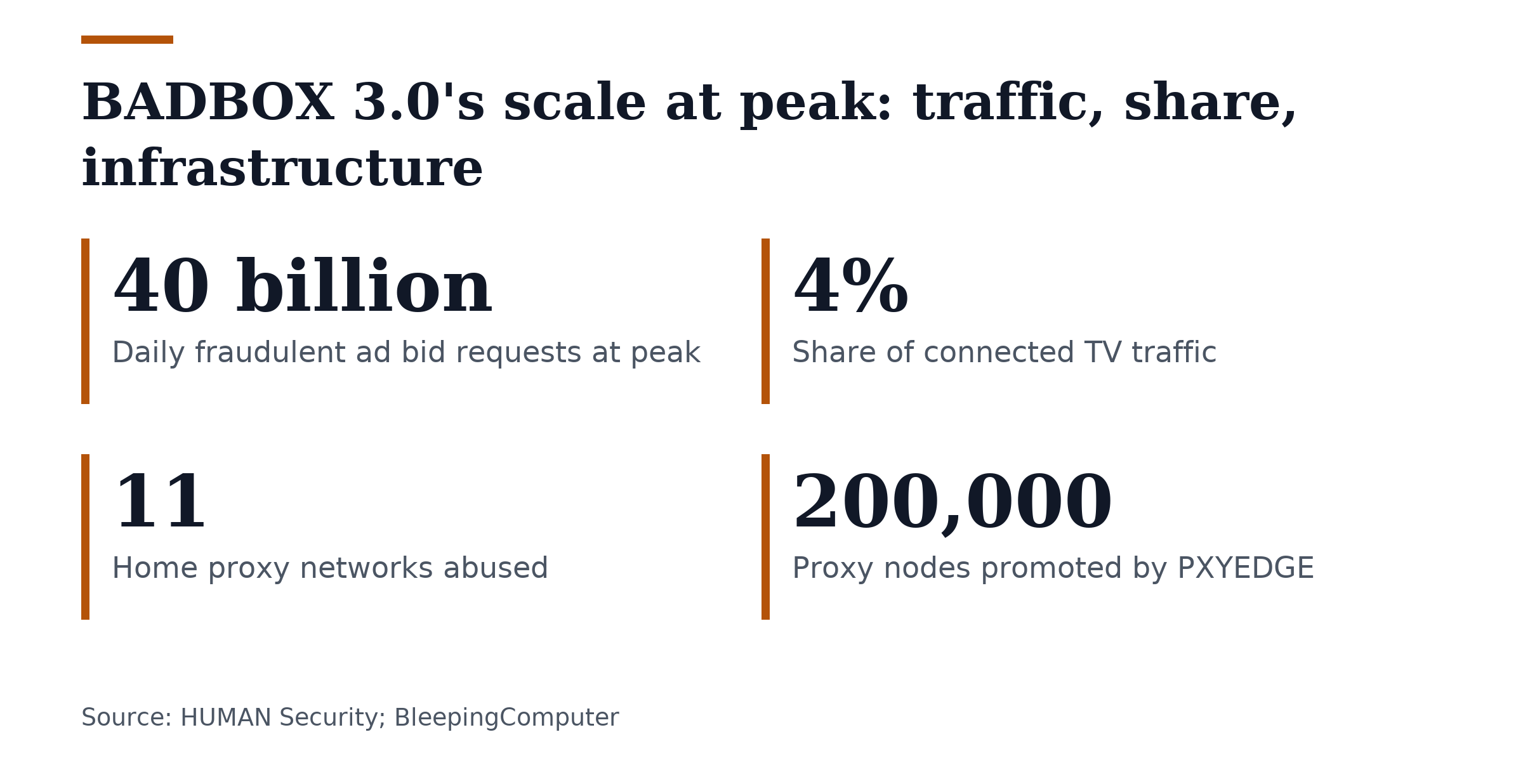
HUMAN Security said its Satori Threat Intelligence and Research Team disrupted BADBOX 3.0, which infects inexpensive devices built in mainland China that ship internationally, and published findings on November 18, 2026. The botnet resumed ad fraud peaking at roughly 40 billion fraudulent ad bid requests each day.
The peak volume was more than three times VASTFLUX, the previous record holder. HUMAN said BADBOX 3.0 was the largest ad fraud operation by bid volume ever disclosed, and the peak also exceeded everything Satori published over the previous five years combined. It amounted to over 4% of connected TV traffic on the Human Defense Platform. The figure measures bidding requests for ad space, not viewed ads, completed payments, or infected device totals, and researchers have published no equivalent count of unique infected devices for this campaign; the 10 million device figure applies to the earlier BADBOX 2.0 campaign instead.
The software targets low-cost handsets, tablets, and streaming boxes running the Android Open Source Project for ad fraud and traffic proxying. These devices run Android Open Source Project, are assembled in mainland China, and ship to buyers abroad, but they do not use Google‘s Android TV OS and have no Play Protect certification. Hidden ad modules stream video in invisible windows, while bid requests pose as legitimate connected television applications. Investigators also observed server-side ad insertion requests that made advertisers believe ads ran on streaming hardware, though no actual device or video ad was involved, and for one mimicked app about 80 percent of U.S. requests came from residential proxy exit addresses.
Compromised machines joined one of 11 home proxy networks without their owners’ permission. HUMAN said PXYEDGE replaced IpMoYu, which was a home proxy service linked to the earlier BADBOX 2.0 campaign, and Nokia researchers independently reached similar conclusions. PXYEDGE advertised roughly 200,000 proxy nodes, and unique connections observed reached about 340,000 at their highest point. Illicit ad traffic also moved through residential proxies to appear authentic and get around abuse filters.
Satori researchers tied TXCZ, a Chinese electronics manufacturer, to the BADBOX 3.0 catalog using command infrastructure, domains, preloaded software, device checks and code repositories. An account with TXCZ in its name hosts a repository distributing ad fraud launchers. Those devices and catalogs support hidden ad fraud and proxyjacking activity together.
Infected devices pull malware modules from public code repositories, and copies of payloads sit on several hosting platforms to resist takedowns and add redundancy. Once infected, the boxes contact command servers and download fraud modules from a catalog kept in public repositories and backup sites. Investigators found Vo1d Android TV botnet code blended with the new fraud components, reinforcing a link spotted in earlier BADBOX work, and previous stories about malware in photo frames also noted related Vo1d activity on different Android hardware. Satori studied one sample where a system app showed video ads through a transparent player beyond the visible screen.

Researchers first found BADBOX in early 2023 on a T95 Android TV box bought through Amazon, and German cybersecurity agencies warned in December 2024 that botnet infections affected tens of thousands of devices. In March 2025, an operation by HUMAN and Shadowserver cut more than 500,000 BADBOX 2.0 devices from control servers, and Google removed 24 malware-spreading apps from Google Play that same month. In April 2025, Google said the earlier botnet had compromised more than 10 million Android devices, and in July 2025 Google announced legal action against the operators of BADBOX 2.0. Previous takedowns did not stop the operators from rebuilding the network and setting new fraud records.
HUMAN worked with Google to take down the related XCPE malware operation, and that effort removed multiple command-and-control domains for BADBOX 3.0. Google said XCPE had signed up over 1.3 million set-top boxes. HUMAN removed one malware repository and now filters fraudulent advertising traffic for BADBOX 3.0. HUMAN said the operators will likely adapt to this disruption the same way they have before, and Satori researchers continue to monitor threat actors for further adaptation.
The company’s platform spots malicious automated behavior based on what the behavior does, regardless of the network route it uses, and malicious activity cannot be hidden from HUMAN’s detection systems by routing through residential proxies. Clients using HUMAN’s Ad Fraud Defense and Ad Click Defense products are protected from BADBOX 3.0 fraud effects. Users of HUMAN’s Sightline Cyberfraud Defense and AgenticTrust services get protection against account takeover, fake accounts, and carding attacks.
The company advises buyers to purchase certified Android devices from well-known makers and to confirm that Play Protect is turned on, and the FBI’s BADBOX advisory directs households to disconnect suspicious devices from their own network. Coverage from Cyber Security News and CyberInsider says buyers should check Play Protect certification before buying and use only official app stores, and if a box has the Google Play Store, certification can be checked under Profile, Settings, About. Google offers an official list of certified devices through its store.
Join the discussion