
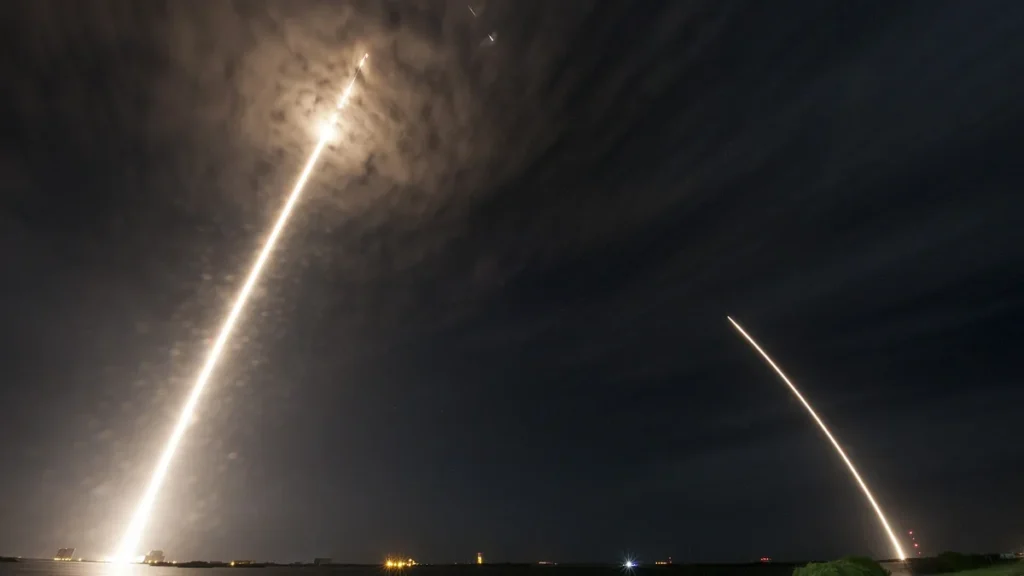

This is a new development in a story we reported earlier: SpaceX catches Starship upper stage with launch tower arms for first time.
Key facts
- About 40 minutes after liftoff, the ship released 26 Starlink V3 satellites, and every one of them entered orbit successfully.
- SpaceX called off the booster catch roughly six and a half minutes into flight and flew the booster to a controlled Gulf splashdown.
- The company has caught the Super Heavy booster at the launchpad three times previously, most recently in March 2025, but not yet with the version 3 booster.
- SpaceX has reused two Super Heavy boosters to date but has not yet demonstrated reflight of a Starship upper stage.
SpaceX sent the 15th uncrewed Starship test flight from Starbase in South Texas on Friday, Nov. 13, 2026, at 4:47 p.m. local time, and the upper stage reached orbit about 27 minutes after liftoff. The flight was the vehicle’s 15th uncrewed test flight and the second time SpaceX has flown Starship into low-Earth orbit.
The ship released 26 Starlink V3 satellites roughly 40 minutes after liftoff, and every satellite reached orbit successfully. Each V3 satellite carries solar panels stretching 60 meters when fully deployed.
SpaceX called off the booster catch about six and a half minutes after liftoff because of an unspecified issue. The booster went down in the Gulf of Mexico rather than flying back to Starbase for a tower catch.
The booster’s impact produced a powerful explosion visible from more than 10 miles away. The company said it still does not know why the catch was called off. NBC News said the reason was unclear immediately after launch. Scientific American cited booster engine trouble, and the two explanations have not been reconciled or confirmed.
SpaceX aimed to recover both stages during their return, though not simultaneously, yet Flight 15 did not complete a double catch. The company must complete one more test flight before trying to recover all rocket parts on a single mission.
The company may attempt to return the upper stage to Starbase on Nov. 14, 2026, aiming for a 3:15 p.m. local touchdown if health checks pass after orbit. Safety checks after orbit decide if the ship can fly back to Starbase for a catch; otherwise controllers may ditch it in the Pacific or steer its reentry into the Gulf.
Had the mission kept to schedule, the upper stage would reenter about 22.5 hours after launch, belly-flop briefly, then turn vertical for capture by Mechazilla’s chopstick arms. Coming down from orbital altitude, the upper stage comes back much faster than the Super Heavy booster. The flight plan included the first Starship upper stage reentry over inhabited regions, over sparsely populated areas of northern Mexico and southern Texas. SpaceX hoped to catch the upper stage about 21 hours after liftoff, pending orbital checks, with three V3 satellites checking the heat shield.
SpaceX has landed the Super Heavy booster at the launchpad three times before, most recently in March 2025, though not with the version 3 booster. To date, SpaceX has reused two Super Heavy boosters, but it has not yet flown a used Starship upper stage again.
Flight 14 reached orbit in September for the first time. An engine issue cut the mission short, sending the vehicle into the Pacific Ocean.

Elon Musk said on X on Nov. 6, 2026, that catching both stages would mean the first intact return of every part of an orbital rocket to Earth. In an October SpaceX earnings call, Musk said humanity needs a fully reusable orbital launch vehicle to extend consciousness beyond Earth for the long term.
He expects Starship to launch weekly in the first half of 2027 and at least twice per week after 2027 ends. Starship now ranks as an operational orbital rocket and the biggest, most powerful vehicle humans have ever launched into space.
Starship flew four times in 2024 and five times in 2025, making Flight 15 the fourth launch of 2026. SpaceX flew 165 Falcon 9 missions in 2025, about half of all global orbital launches.
The 26 V3 satellites aboard Flight 15 equal roughly 10 Falcon 9 launches that carried Starlink V2 Mini spacecraft. Each V3 Starlink satellite adds 1 terabit of capacity to the company’s broadband network.
SpaceX intends to deploy 100,000 V3 Starlink satellites, and roughly 11,000 current-generation Starlink satellites are already flying. SpaceX’s Starmind project aims to send up to 1 million satellites to serve as orbital AI data centers.
Singulus Technologies of Germany announced a Nov. 10, 2026, contract worth more than 60 million euros to build a solar cell production line tied to Starmind satellites produced in Bastrop, Texas, backing 100 gigawatts of yearly solar cell equipment. Starbase in Texas has authorization for 25 launches a year, while the Louisiana site will not host a launch before 2029.
The company targets roughly 10,000 Starship launches per year by 2030 and filed comments with the FAA in late October expecting 10,000 launches per year itself. A national space transportation policy aims to enable more than 1,000 U.S. rocket launches each year by 2030.
After a successful catch, SpaceX must show that a reused upper stage can fly again, followed by orbital refueling needed for NASA’s Artemis program. Life support hardware for the Starship moon lander version completed ground testing, but no Starship has flown with such a system. Elon Musk said, “This is the critical breakthrough needed to make life multiplanetary.”
Join the discussion