

This is a new development in a story we reported earlier: Apple confirms October 13 'Welcome Home' event in New York City.
Key facts
- Apple announced the HomePod mini 2 on October 13, 2026, and opened preorders the same day.
- In the United States, the HomePod mini 2 costs $149.
- Apple describes the S10 chip as enabling advanced computational audio.
- Geeky Gadgets says the $149 price is a 50 percent increase over the original $99 launch price.
Apple began selling the HomePod mini 2 in stores on Friday, Oct. 30, 2026, in the United States at $149, and the speaker also began arriving to customers that day, the latest development in its rollout after Apple announced it on Oct. 13, 2026, and opened preorders the same day.
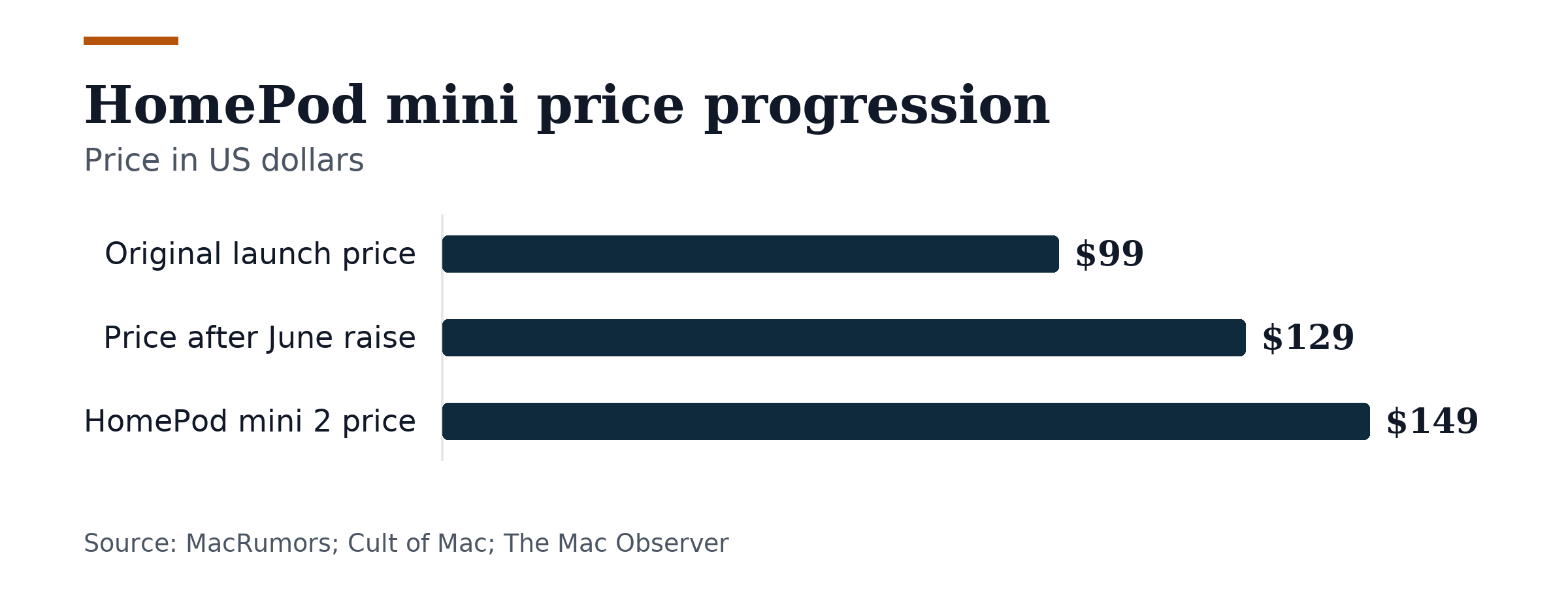
Apple originally sold the HomePod mini for $99, then raised the price to $129 in June. The original model arrived six years before the HomePod mini 2. Geeky Gadgets calls the $149 price a 50 percent increase over the original $99 launch price.
Siri AI is the speaker’s headline upgrade, but it will not work at launch. Apple said support will arrive in a future software update without specifying a release date, and that the update will be free. Apple Intelligence, the company’s AI system, powers Siri AI, described as a more intelligent and personalized Siri that first appeared on iPhone 15 Pro and newer devices in September.
When the feature arrives, ZDNET says Siri AI should process commands at once, answer complicated questions, and keep personal context during natural conversations. The outlet has not tested Siri AI on the HomePod mini 2 and cannot guarantee its performance. Certain features will require an Apple Intelligence-compatible iPhone or iPad, Apple said. Apple also promised voice recognition that identifies up to six users and gives personalized responses through future software updates.
The speaker uses Apple’s S10 chip from the Apple Watch Series 10 instead of the Series 5 The Mac Observer chip from the original model. Apple describes the chip as enabling advanced computational audio. The company has not explicitly confirmed that sound quality improved over the original HomePod mini. The speaker moved to Wi-Fi 6E, a faster wireless standard, from Wi-Fi 4 and now has three Siri microphones instead of four.
It comes in green, pink, blue, midnight, and white, with green and pink as all-new options.
Sound Glow makes the speaker’s top surface glow and pulse with the music, and a software update added the feature to the original HomePod mini and the full-sized HomePod 2. The speaker works with Apple’s HomeKit smart-home system and can recognize smoke and carbon monoxide alarms as critical alerts. Mac computers with Wi-Fi 6E or later can use the HomePod mini 2 as the default sound output, and the full-sized HomePod 2 gained the same ability after installing HomePod software version 27.2 through the Home app.
A fourth-generation Apple TV 4K can connect four speakers in front and rear pairs for surround sound. Speakers within each pair must match, though the front pair and rear pair may differ from each other, and Apple says the front two speakers virtualize the center channel somewhat. Some customers have experienced occasional disconnections while pairing the speaker with Apple TV, Geeky Gadgets said.
Apple is offering three months of Apple Music free with a HomePod mini 2 in the United States. The trial is for new subscribers only and runs three months after device activation. Each Apple Account gets one offer regardless of how many eligible devices it buys. After the trial, the plan costs $11.99 per month and renews automatically until cancelled.
Geeky Gadgets says the speaker’s dependence on iPhones and iPads for setup and full functionality may limit its appeal outside the Apple ecosystem. The outlet also notes that Amazon and Google sell smart speakers with similar functionality for less money.
Join the discussion