

Key facts
- Ransomware is a form of cyber extortion that encrypts data and demands payment for the decryption key.
- Extortionware shares payment demands (often in cryptocurrency) with ransomware and the reputation‑threat aspect of doxing attacks.
- Cyber extortion tactics can include DDoS floods, doxing, data breaches, software‑vulnerability threats, sextortion, killware, whistleblower coercion, deepfake deception, and repeat extortion.
- Frequent targets of cyber extortion and ransomware are banks, hospitals, schools, government offices, manufacturers, critical infrastructure providers, and legal or financial firms.
According to ConsultNet, Inc., in May 2021 the DarkSide group attacked Colonial Pipeline, received 75 bitcoin (about $4.4 million) for decryption, and the resulting pipeline shutdown caused fuel shortages along the US East Coast.
According to ConsultNet, Inc., Arctic Wolf Networks, Emsisoft, and Cisco, extortionware, cyber extortion and ransomware are related but distinct threats that attackers use to extract money from victims. Ransomware is a form of cyber extortion that encrypts data and demands payment for the decryption key. Extortionware involves stealing data, identifying damaging information and threatening to leak it unless victims pay a ransom. Cyber extortion describes attacks where threat actors take or control assets and demand payment for their return.
While ransomware focuses on making data unavailable through encryption, extortionware centers on the threat of exposing stolen information. Both share payment demands, often in cryptocurrency, and the reputation‑threat element of doxing attacks. Cyber extortion covers a broader set of tactics that can include DDoS floods, doxing, data breaches, software‑vulnerability threats, sextortion, killware, whistleblower coercion, deepfake deception and repeat extortion.
According to ConsultNet, Inc. and Arctic Wolf Networks, attackers frequently target the same sectors regardless of the specific method. Banks, hospitals, schools, government offices, manufacturers, critical infrastructure providers and legal or financial firms are common victims of cyber extortion and ransomware. This overlap means defenders must prepare for a range of extortion techniques when protecting these organizations.
The way attackers apply pressure differs between the three categories. In traditional ransomware the pressure comes from the loss of access to encrypted systems until victims supply a decryption key. Extortionware applies pressure by threatening to publish or misuse stolen data, which can cause reputational harm, regulatory penalties or loss of customer trust. Cyber extortion may combine any of the listed tactics to increase coercion, such as launching a DDoS attack while also threatening to leak data.
Payment demands show similarities and differences across the threat types. Ransomware and extortionware both often ask for payment in cryptocurrency, which helps obscure the transaction trail. Extortionware adds the reputation‑threat aspect of doxing, meaning attackers may ask victims to pay twice—once for decryption and again to prevent the release of sensitive information. Cyber extortion groups can also demand payment for halting a DDoS flood or for returning control of a compromised asset.
While backups can often defeat traditional ransomware, they do not stop extortionware because attackers keep copies of stolen data for leverage. Effective defense against cyber extortion relies on layered controls such as firewalls, multi‑factor authentication, encryption, anti‑malware, regular patching, incident‑response planning and employee awareness training. Further technical controls reduce the likelihood of initial compromise.
Network segmentation, securing remote‑desktop protocols, limiting remote access and monitoring traffic help lower the chance that attackers gain a foothold in the network. These measures are part of a broader defense‑in‑depth strategy that addresses both encryption‑based and data‑theft‑based extortion.
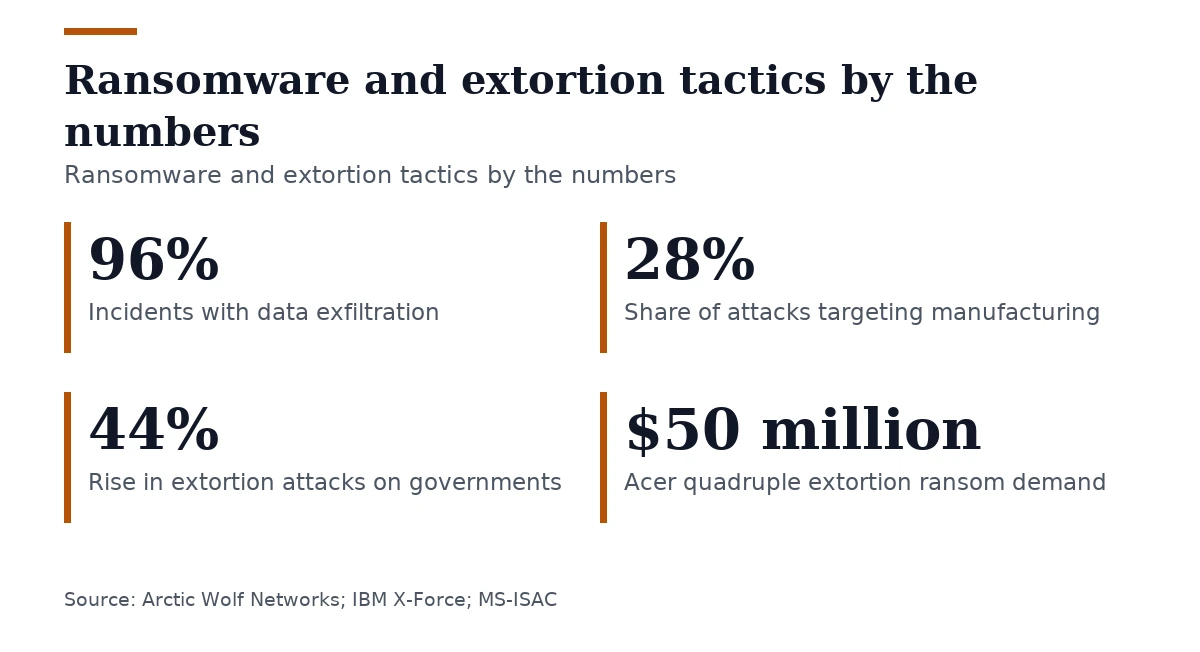
Arctic Wolf’s 2025 analysis found that 96 % of ransomware incidents also involved data exfiltration used to raise the ransom demand. This high overlap means that most ransomware attacks now carry at least one extortionware element, blurring the line between pure encryption‑only ransomware and data‑theft‑focused extortionware.
Incident response and disclosure planning must change depending on whether an attack involves encryption, data theft or both. Knowing whether an attack uses encryption, data theft, or both influences reliance on backups, legal disclosure duties and communication strategies during incident response. Plans must address possible data theft and reputational harm, not just encryption, requiring capabilities to detect exfiltration and prepare leak‑notification communications.

The evolution of ransomware shows how groups have added data‑theft layers to increase pressure. Early ransomware relied only on encryption; later groups added data theft to create double, triple and quadruple extortion schemes. Double extortion occurs when attackers steal data before encrypting it, creating pressure from both operational shutdown and possible public exposure.
Triple extortion adds a layer where attackers have taken individuals’ data (such as patients or staff), and those individuals are directly pressured to pay. Quadruple extortion further incorporates DDoS attacks, social engineering or public shaming via leak sites to increase coercion.
Real‑world cases illustrate how attackers have applied these tactics. In May 2021 the DarkSide group attacked Colonial Pipeline, received 75 bitcoin (about $4.4 million) for decryption, and the pipeline shutdown caused fuel shortages along the US East Coast. The 2017 Equifax breach exposed data from 51 databases after attackers remained in the network for 76 days without a needed patch.
Other notable incidents highlight the use of multi‑layer extortion. In late 2019 the Maze ransomware group published almost 700 MB of data stolen from Allied Universal and warned that more would follow unless a 300‑bitcoin ransom was paid. In 2021 the REvil group used a quadruple extortion tactic against Acer, demanding roughly $50 million while threatening data leaks, client targeting and service disruptions. The WannaCry ransomware outbreak in May 2017 affected an estimated 230,000 Windows computers across 150 countries.
A 2012 DDoS flood aimed at GitHub peaked at 1.35 TB per second but defenders stopped it within five minutes, showing how quickly defenders can mitigate such attacks when defenses are ready. Sector‑specific data reveal where extortion attacks are most prevalent.
According to IBM’s 2024 Cost of a Data Breach Report, the average breach cost in the healthcare sector exceeds eleven million US dollars. IBM’s 2024 X‑Force Threat Intelligence Index found manufacturing to be the most targeted sector for ransomware and extortion, representing 28 % of global incidents. The MS‑ISAC 2024 report recorded a 44 % rise in extortion attacks on state and local governments compared with 2023.
Understanding these distinctions helps organizations focus on defenses and shape response plans. Teams should verify whether backups are adequate for encryption‑only ransomware, while also investing in data‑loss‑prevention and leak‑detection capabilities for extortionware scenarios. Incident playbooks must include steps for assessing data exfiltration risk, preparing regulatory notifications and communicating with stakeholders about reputational impacts.
By recognizing what each threat targets and how pressure tactics differ, security leaders can distribute resources more effectively. A layered defense that combines technical controls, employee training and thorough incident‑response planning offers the best protection against the evolving threat environment of cyber extortion, extortionware and ransomware.
Join the discussion