
Key facts
- An IrpiMedia investigation by Rosita Rijtano builds on a 2024 Lookout discovery.
- The app showed the Interior Ministry logo and referred to a protection decree.
- The spyware could activate the microphone, intercept internet calls and record the screen through added components that also track the phone.
- It could also access contacts, call logs, files and text messages.
IrpiMedia’s investigation by Rosita Rijtano builds on a 2024 Lookout discovery to expose FirmaDigitale, a fake Italian Interior Ministry Android app that promised asylum seekers updates on their protection status while delivering spyware, software that secretly monitors a device, instead.
It attributes the malware to IPS, a supplier in Latina serving prosecutors, police and intelligence agencies. Nobody knows who ordered the FirmaDigitale operation or whom it hit.
Victims downloaded the FirmaDigitale app from firmadigitale.assistenza-mobile.it, a page imitating the Poste Italiane website. The app showed the Interior Ministry logo and referred to a protection decree. Police deny any link to the app. Poste Italiane did not comment.
Osservatorio Nessuno gave the name Morpheus to the spyware in April 2026 after discovering it in a fake Fastweb app. The spyware could activate the microphone. It could intercept internet calls. It could record the screen through added components that also track the phone.
It could also access contacts. It could access call logs. It could access files. It could access text messages.
Morpheus can hijack WhatsApp using a fake biometric prompt, a security check that relies on physical characteristics such as a fingerprint or face.
The download page has been unreachable since 2025, though the app may still circulate elsewhere. Attackers misused several telecom brands including TIM, Iliad, PosteMobile and WindTre. Iliad said it had no knowledge of such apps.
Osservatorio Nessuno is a volunteer group that studies digital surveillance technologies. It gives technical assistance to journalists and activists. The group attributes the problem to weak Italian and European rules, opacity and absent ethical limits.
The civil liberties coalition Cild asks why authorities targeted asylum seekers, who authorized the operation and what it produced.
According to a researcher, at least five activists recently received links containing spyware. Giorgia Linardi of Sea-Watch reported zero-click surveillance, monitoring that reaches a device without any action by its owner, in 2021. IrpiMedia does not connect either case to FirmaDigitale.
Surveillance and intelligence tools brought in €214.4 million in 2024 revenue for nine established firms. Other firms in the field include RCS, Area, SIO and Innova alongside IPS. Germany authorized 91 spyware operations, instances in which authorities deploy surveillance software against targets, in 2024, and authorities conducted 57 of them. Among the five countries disclosing geographic breakdowns, Italy supplied 72.8% of revenue.
In 2021 there were 2,894 spyware targets, people or devices selected for surveillance. That figure rose to 5,611 in 2025, about 94% more. For 2025, mafia cases represented 2,930 targets. Ordinary crimes represented 2,618 targets.
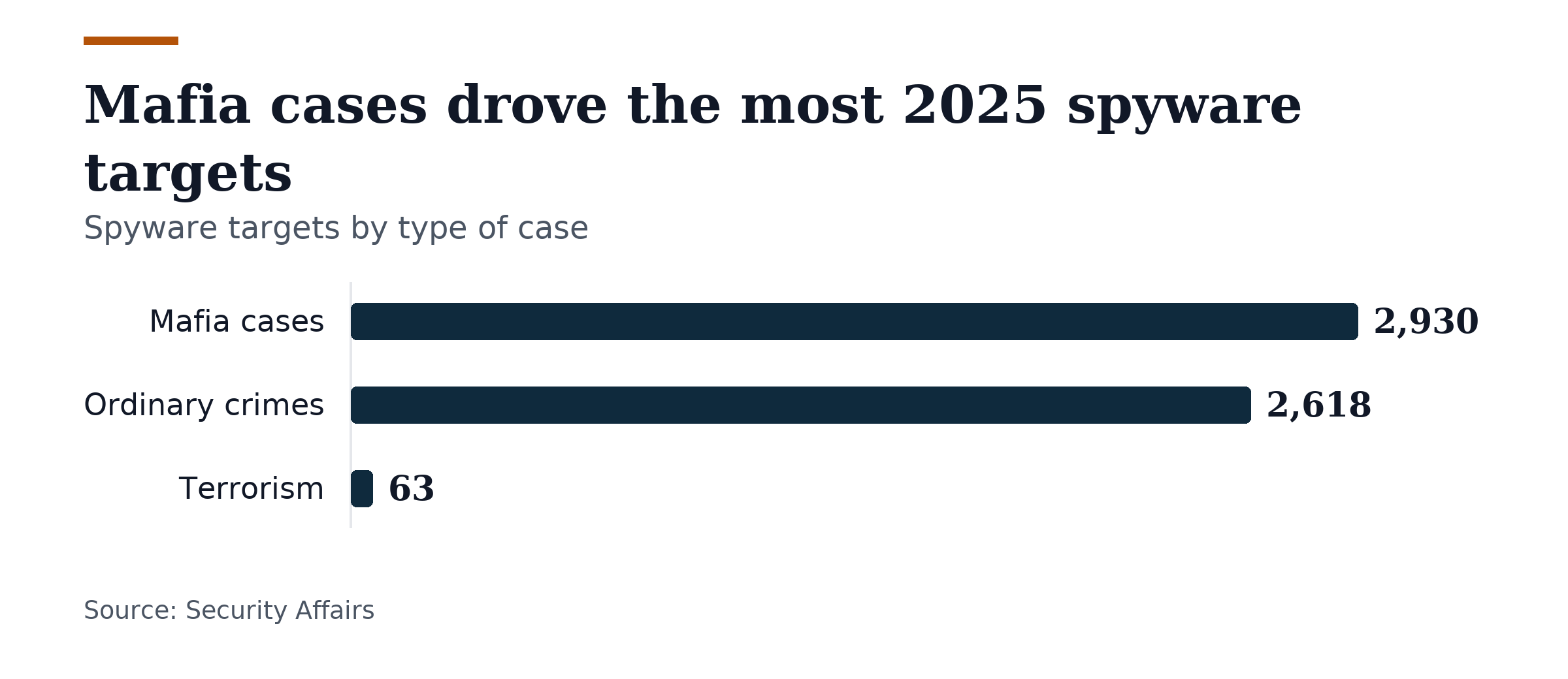
Terrorism represented 63 targets.
For 2025, interception spending reached about €299 million despite a national price list intended to cut costs. Italy performs no prior quality check on spyware software, programs that secretly gather information from a phone. Authorities lack the skills to verify it. A company stored intercepts on its own servers in the eSurv case.
The trial continues.
Italian law allows spyware use beyond mafia and terrorism cases, extending to corruption and many ordinary crimes. Italy lacks a complete law limiting spyware capabilities, says lawyer Giovanni Battista Gallus.
Gallus says investigators may keep collected material in prosecutor archives rather than delete it. Authorities do not have to notify targets if an investigation is shelved. Collected data can stay archived.
A criminal association charge may allow surveillance even against unionists and activists, warns defence lawyer Eugenio Losco. Marcello De Chiara, vice president of the magistrates’ association, says spyware is essential. He says current safeguards are adequate. He wants stricter controls for private vendors, including clearer ownership and a national register.
Join the discussion