


Key facts
- Kenyan authorities are investigating an unverified claim by ByteToBreach that about 740 gigabytes of data were stolen from eCitizen, the government's central services portal.
- VECERT Analyzer reported that neither the government nor the named institutions confirmed an intrusion, specific data volumes, or authentication system compromise.
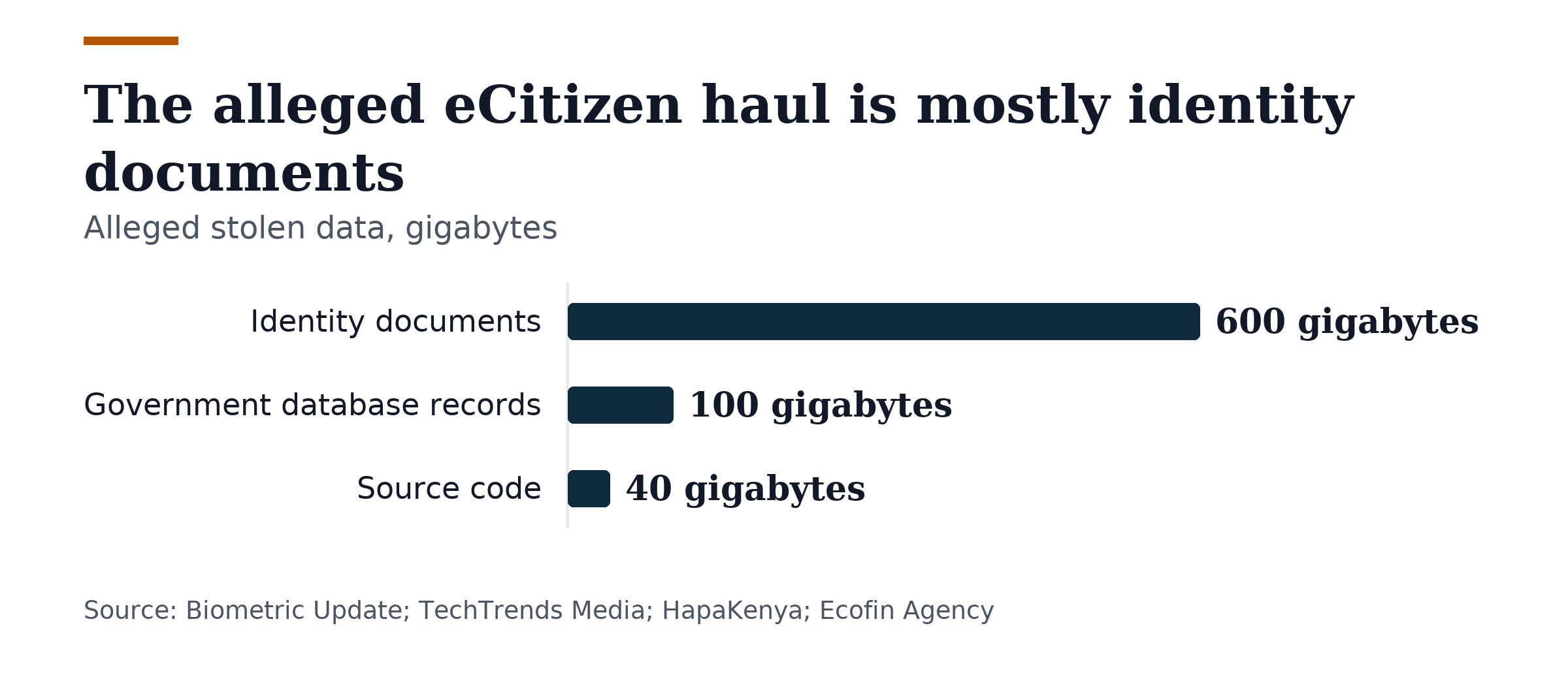
- The alleged haul includes about 600 gigabytes of know-your-customer identity documents, 100 gigabytes of government database records, and 40 gigabytes of source code.
- The claim also alleges compromise of eCitizen's OAuth and single sign-on systems used to authenticate users across connected services.
Kenyan authorities are investigating an unverified claim by ByteToBreach that about 740 gigabytes of data were stolen from eCitizen, the government’s central services portal, and the cyber threat intelligence account VECERT Analyzer said ByteToBreach posted the allegation on an underground forum on November 22, 2026.
The claim breaks down to about 600 gigabytes of know-your-customer identity documents, 100 gigabytes of government database records, and 40 gigabytes of source code. ByteToBreach also alleges it entered through a file-upload vulnerability and installed a web shell (a script for remote commands) permitting remote command execution on a server, and that eCitizen’s OAuth (an open standard) and single sign-on systems used to authenticate users across connected services were compromised.
Connected institutions named in the claim include the Social Health Authority, the Directorate of Criminal Investigations, and the National Police Service; Safaricom is named in some reporting. Authorities have not confirmed that any connected agency was affected or that unauthorized access to eCitizen occurred, and VECERT Analyzer reported that neither the government nor the named institutions confirmed an intrusion, specific data volumes, or authentication system compromise.
The State Department for Immigration and Citizen Services said eCitizen remains operational and services remain available. “Protecting the personal data entrusted to the State Department is a priority and the public will be updated once the investigations are complete” the department said.
Kenyans rely on eCitizen to apply for passports, register businesses, get driver’s licenses, and obtain certificates of good conduct. Belio Kipsang, principal secretary for immigration and citizen services, said in August 2025 that eCitizen served more than 13.67 million registered users and recorded 500,000 visits per day.
William Kabogo, cabinet secretary for the Ministry of Information, Communications and the Digital Economy, said eCitizen grew from about 500 government services in 2022 to 24,000 in 2026. A distributed denial-of-service attack in July 2023 disabled eCitizen and other government and private services, disrupting passport, visa, and driver’s license processing, and then-ICT Cabinet Secretary Eliud Owalo said no citizen data had been accessed or lost during that attack.
The Business Registration Service breach exposed records for more than two million businesses, including about 2.09 million physical addresses, 832,648 e-mail addresses, and 812,863 phone numbers, and involved shareholders, company directors, and beneficial ownership information. The Office of the Data Protection Commissioner issued an enforcement notice to the Business Registration Service and closed the case without a fine after compliance.
Shared dependencies from consolidating thousands of services on one platform mean a successful attack has a bigger impact. Having access to an identity provider does not mean controlling it, since every linked agency maintains its own authorization controls, and token-signing keys, administrative privileges, and active user sessions determine how far a compromise could reach, but none of that has been disclosed.
Source code exposure could reveal system architecture, authentication processes, and software vulnerabilities, giving an attacker additional knowledge of how the platform operates. Some allegedly stolen files carry timestamps from November 14 and 15, preceding the November 22 forum post.
A facial image exposed in know-your-customer files that contain selfies or facial images with ID scans cannot be protected by a password reset. Deepfake attacks, which use realistic but fabricated media, and injection attacks target remote onboarding for banks, telecom operators, and fintechs, using genuine documents and matching face images as raw material, and manipulated images and deepfakes used in identity verification create a new risk for the misuse of real identification records.
The Ministry of Interior and National Administration said technical and security teams are investigating the incident’s extent and what data may have been accessed, and the teams are working with other government agencies on the investigation. A data controller has 72 hours under Section 43 of Kenya’s Data Protection Act to notify the Data Commissioner after becoming aware of a qualifying breach, and a real risk of harm and access to personal data by an unauthorized person trigger the law. Officials have not said whether the incident meets the threshold, whether they notified the commissioner, or whether eCitizen’s security monitoring flagged activity before the claim was posted.
The State Department urged users who reuse eCitizen passwords on other sites to change them and set strong, unique credentials. The department warned Kenyans to be wary of calls, texts, e-mails, and links claiming to come from eCitizen because fraudsters may exploit the news. The department advised never sharing passwords or one-time PINs, noting eCitizen will never request those details, and asked the public to report suspicious activity. It also asked the public and media not to spread unverified information and to rely on official communication channels.
Kenya ranks in Tier 1 of the International Telecommunication Union’s 2024 Global Cybersecurity Index, the highest tier, though the index measures national commitments in legal, technical, organizational, capacity-building, and cooperation areas and does not guarantee protection against intrusions. The Communications Authority of Kenya’s July-September 2026 report states that the National KE-CIRT/CC logged nearly 2.7 billion cyber threat events, a 14.45% increase over the previous quarter, and approximately 27.4 million web application attacks were recorded nationwide, reflecting threat detections rather than successful eCitizen intrusions.
On November 10, the government launched the SecureKE/Konza Sovereign Security Operations Centre, jointly developed by the Konza Technopolis Development Authority and SecureKE. The ICT Ministry says the centre will offer AI-powered support, coordinated incident response, vulnerability management, investigation, threat detection, and continuous monitoring.
Sumsub reported that Kenya’s identity fraud rate fell 42% between 2025 and 2026, while the same report said African identity fraud rates increased 10% and fraud complexity rose 15%. Sumsub also said 75% of African businesses faced confirmed or suspected fraud in the previous year.
In August 2026, Kenya sought help from France’s IN Groupe for developing a national authentication platform intended to cut repeated identity checks and citizens submitting the same information to multiple agencies. The National Public Key Infrastructure will use a Government Certification Authority deployed on a public key infrastructure platform from Nexus, an IN Groupe subsidiary, selected by Kenya’s ICT Authority. Kenya joined the Digital Public Goods Alliance and the 50-in-5 campaign in November 2026 and intends to grow open-source training for civil servants from 70 to more than 200, deploy a sovereign open-source digital stack at the Konza National Data Centre, and nominate at least two locally developed solutions for assessment under the Digital Public Goods Standard.
Kenya is rolling out its Maisha Namba digital ID alongside eCitizen. An Auditor-General’s report for the financial year ending June 2023 found eCitizen lacked an approved ICT policy, an ICT steering committee, and an approved business continuity plan, according to Amnesty Kenya, and the government has not said whether it closed those gaps.
eCitizen had collected more than 500 billion Kenyan shillings, about US$3.9 billion, since launch, with daily collections of 700 million to one billion Kenyan shillings, about US$5.4 million to US$7.7 million. The Directorate of eCitizen Services was created in 2023 to speed up digitization of public services, and in August 2025 Belio Kipsang said the government had assumed full control of eCitizen, covering operational control, technical knowledge, system architecture, and source code.
Kenya began plans in June 2026 to commercialize anonymized data produced by eCitizen and other state systems. The government said in September 2026 that it plans to construct backend infrastructure for AI agents using eCitizen as the base.
Join the discussion