

Key facts
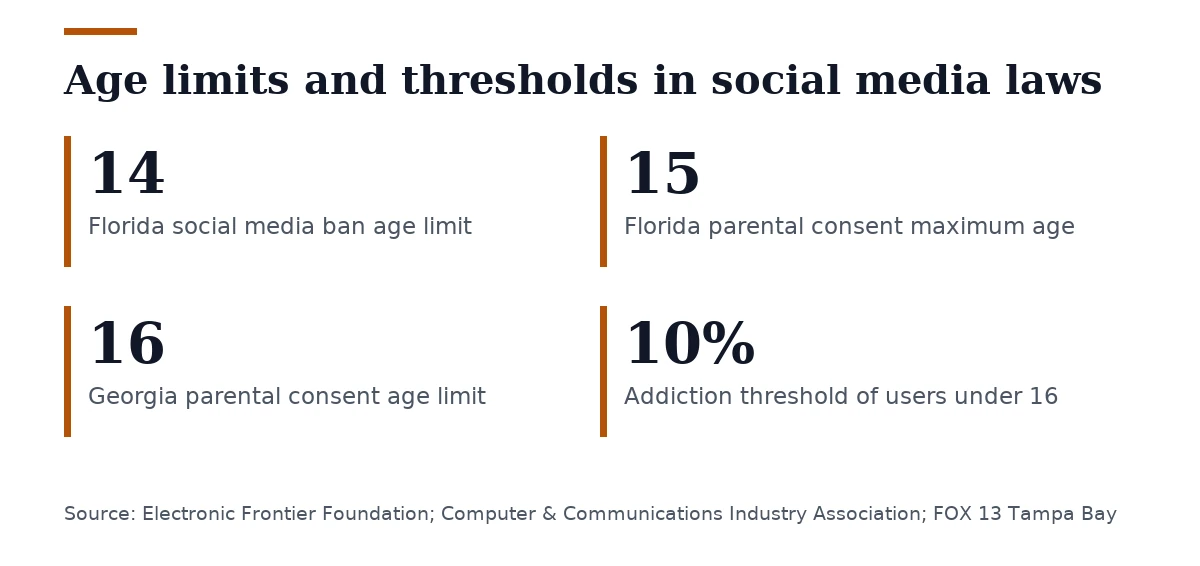
- Florida’s HB 3, which bans users under 14 from opening or maintaining social media accounts, can now be enforced after the 11th U.S. Circuit Court of Appeals lifted a preliminary injunction on October 14, 2026.
- Florida’s HB 3 requires social media platforms to ban users under 14 from opening or maintaining accounts, even with parental permission.
- The 11th Circuit Court ruled that Florida’s HB 3 is content-neutral and does not substantially burden more speech than necessary, allowing enforcement despite First Amendment concerns.
- Georgia’s S.B. 351, requiring parental consent for minors under 16 to hold social media accounts, can now be enforced after the 11th Circuit lifted an injunction.
The 11th U.S. Circuit Court of Appeals acted on Oct. 14, 2026, lifting a preliminary injunction and clearing HB 3 for enforcement in Florida. The law bars users under 14 from opening or keeping social media accounts even when parents give permission. The ruling lets Florida enforce limits on social media access for minors under HB 3 even though First Amendment challenges continue.
Georgia can now enforce S.B. 351 as well. The 11th Circuit lifted an injunction there. The law requires parental consent for minors under 16 before they can hold social media accounts, and platforms must make commercially reasonable efforts to confirm ages, which may mean handing over sensitive identification documents. The same 11th Circuit panel handled both decisions.
HB 3 covers services that use algorithms, host content uploads, or track engagement through tools such as livestreaming, infinite scrolling, or push notifications, effectively reaching the major social media services minors use. Users aged 14 and 15 may keep accounts only with parental consent.
The court said HB 3 is content-neutral and does not impose a greater burden on speech than required, allowing the law to stand despite First Amendment concerns. The court deferred to Florida’s argument that the law addresses online addiction risks for minors.
The ruling backs Florida’s argument that platforms are addictive when 10% of users under 16 spend more than two hours a day on them. The Electronic Frontier Foundation says the court uses time online as a proxy for harm without separating helpful use from harmful use. The foundation argues the measure sweeps in beneficial and harmful use alike.
Initially, a federal judge had issued an injunction to block enforcement, but the 11th Circuit reversed that ruling. The Supreme Court blocked HB 3 and sent it back to the lower courts for a full hearing ahead of the 11th Circuit’s latest ruling, so Florida is trying to enforce social media restrictions for minors for the second time.
NetChoice lawyer Paul Taske said the court’s decision disappointed him and that NetChoice is weighing legal options to defend online rights and parents’ choices. Matt Schruers said, “This ruling is deeply concerning and risks altering First Amendment protections against government interference in online speech for users young and old alike.”

The Electronic Frontier Foundation says the laws in Florida and Georgia put the free expression and privacy of minors and adults at risk without making the internet safer. The group says the laws keep minors from reaching lawful information, joining online communities, organizing campaigns, or making art, and may disrupt how minors talk with peers or take part in school discussions.
The Electronic Frontier Foundation says Florida’s law takes away parental choice by barring parents from letting children under 14 use social media, even with consent. It limits how parents decide about their children’s online lives.
The Electronic Frontier Foundation argues the rules create privacy risks by demanding identification or sensitive personal information to verify age. Others could mistake adults for minors, or adults might drop their accounts rather than share that data. Age-gating laws condition access to platforms on proof of age.
The Electronic Frontier Foundation asks people affected by the laws to record incidents such as lost accounts, failed age checks, or privacy problems. That record might use screenshots, timestamps, and descriptions of the restrictions people hit. The foundation wants that record to support potential legal challenges.
It asks people to e-mail agegates@eff.org with reports of age-gating trouble, including accounts taken down, failed verification, or privacy concerns. The foundation says that material could support challenges to the laws in court or in legislatures.
Join the discussion