

Key facts
- Entry-level technical hires fell from nearly 30% to 9% since March 2025, while the relevant headcount share fell from about 21% to 14%.
- Junior-level employees in technical departments fell from 21% to 14% from early 2025 to 2026, while junior technical hires fell from 27% to 9%.
- Starting in May 2026, AI agents recorded more work time than human employees, according to Anthropic's report.
- By August, interactive AI agent work hours exceeded human employee hours by a six-to-one ratio.
Anthropic says its growing reliance on Claude AI agents has shifted hiring away from junior technical workers and made human attention the main constraint, according to workplace report coverage.
Entry-level technical hires fell from nearly 30% to 9% since March 2025, while the relevant headcount share fell from about 21% to 14%. Anthropic attributes the changes to AI usage and describes staff as a thin layer above a rising group of AI agents. The figures come from a company workplace report.
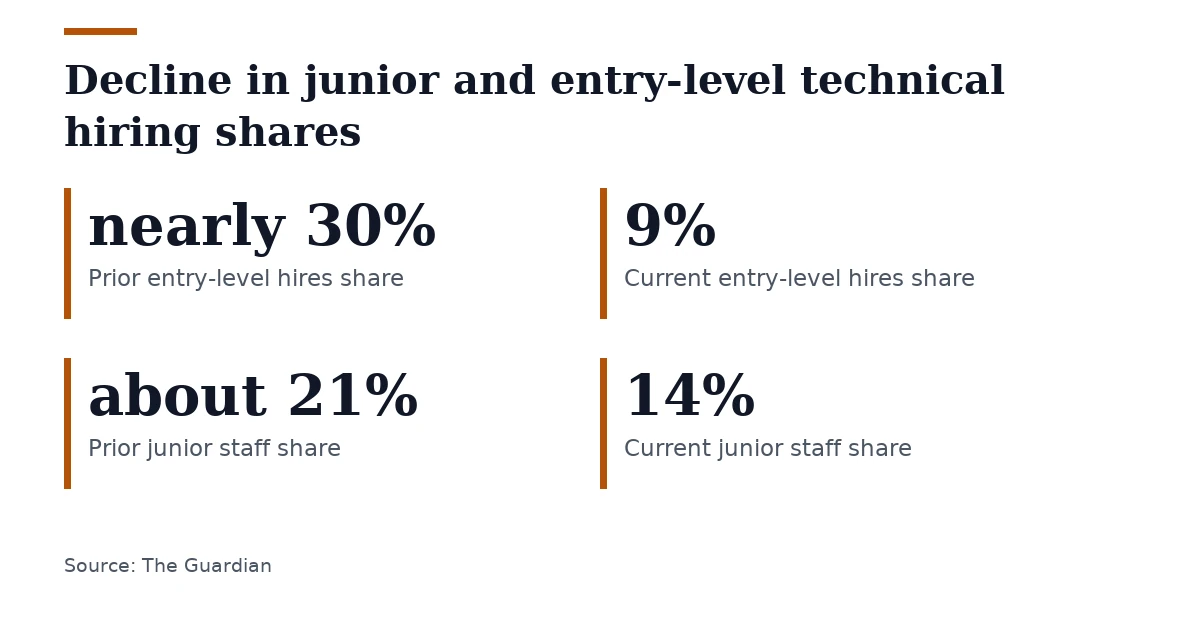
Separate figures place junior technical hires at 27% to 9% and junior-level technical staff at 21% to 14% from early 2025 to 2026. Anthropic says the slowdown began as teams found AI could increasingly handle junior coding and bug-finding tasks. daily.dev’s summary of Anthropic’s research ties reduced junior hiring directly to AI capability growth in specific tasks.
The company presents its internal workforce shifts as stemming directly from AI adoption instead of an outside trend. Anthropic says AI changed how work gets done and restructured employment at the company. The Guardian reports that Anthropic frames its internal workforce shifts as a direct result of AI adoption, not an external trend.
Starting in May 2026, AI agents recorded more work time than human employees, according to Anthropic’s report. Workers spend roughly 22% of their time managing Claude agents, more than double the previous year’s share, based on chat summary analysis. Claude AI agents are the systems Anthropic relies on as it reduces junior technical hiring.
By August, interactive AI agent work hours exceeded human employee hours by a six-to-one ratio. Combined autonomous and interactive agent hours passed total human work hours for the first time during March 2026. The data comes from a summary of Anthropic’s research.
The company’s report says AI agents take on broad software engineering, testing, and maintenance tasks, with people moving into oversight roles instead of doing the work themselves. The report describes a shift from human execution to human supervision of agent-driven engineering work. The report also suggests single-person startups where a human founder steers agent swarms to generate billions in revenue as one possible future.
Anthropic claims its deep AI adoption raised productivity within a few months through more code per person, more sales per representative, and more contracts processed. The report says performance improved in engineering, sales, legal, and other areas once workers started using coding agents.
The amount of code increases sharply once engineers begin using agents. No measurable difference exists in removed or reverted lines between agent-written and human-written code among 192 adopters and 74 non-adopters. The internal comparison tracks two groups of engineers in the company’s analysis.
Non-technical staff must spend half of their work week reading agent output. Anthropic’s report suggests that software engineers may face a harder employment outlook, while workers just entering technical roles will have difficulty gaining skills and experience. Anthropic positions its own restructuring as a preview of broader industry effects as AI agents spread.
Hiring managers increasingly value autonomy and judgment over domain expertise. Anthropic has an early-warning system for at-risk roles and an internal redeployment push, though junior hiring was not protected.

Some AI researchers doubt the report signals major changes and say it likely aims to boost Anthropic’s valuation before its initial public offering. Anthropic may list on the stock market as early as November. Investors now project Anthropic’s valuation at $1.5tn, down from prior estimates of $2tn or more, because revenue growth is slowing.
Dario Amodei warned AI could cut half of entry-level white-collar jobs and draft 90% of code within six months, but neither prediction came to pass. The Guardian notes a divide between industry interpretations and academic findings on AI’s role in job losses. Anthropic’s claims seem to back tech executives’ view that AI is behind recent corporate layoffs, but research complicates that view.
Morgan Frank’s peer-reviewed paper shows AI-exposed job markets declined before ChatGPT arrived in November 2022, complicating the claim that AI drives recent layoffs. Frank, a Case Western Reserve University researcher, said recent job losses could reflect cutting pandemic-era hires and AI-washing, where bosses credit AI for layoffs they might have made anyway. “It doesn’t appear that the launch of ChatGPT corresponds to any major increase in loss or worsening outcomes,” Frank said.
Julián Posada says the report had no independent assessment by outside auditors and reflects a company that wants people to invest in it. Posada, a Yale social scientist, said the report’s figures and graphs only tell part of the story without revealing how workers feel or engage with models.
Anthropic released the report one day after pledging 5% of shares to the public good without providing details. Critics noted philanthropy has long doubled as a reputation builder used by tech titans like Bill Gates and Mark Zuckerberg. The Guardian connects Anthropic’s public-good share pledge to a broader pattern of tech philanthropy.
A draft S-1 filing shows Anthropic recorded a $80bn net loss during the first half of the year and received a junk credit rating in June. Pew Research Center says most Americans are wary of AI, particularly about AI-related job losses.
AI debt swamps CoreWeave, Anthropic’s cloud computing partner, as its stock falls, raising concerns that the AI bubble may deflate. Anthropic suggests worker stock ownership as a response to rising concerns.
Dylan Baker says Anthropic’s human bottleneck characterization misunderstands software writing, architecture, and design as social, interpersonal, and human processes. Baker, lead research engineer at the Distributed AI Research Institute, said shifting software development to AI while hiring few entry-level workers and having engineers wrangle agents seems shortsighted. The report quotes an unnamed engineer describing an army of Claudes asking for attention, which Baker called unfruitful and unlikely to yield thoughtful products.
Dylan Baker said software engineers and other tech workers will surely feel the effects regardless of when or whether the AI bubble pops. His hope is a reckoning or re-evaluation of how much AI adoption has always been about human work. Baker links Anthropic’s situation to wider concerns about AI investment valuations and CoreWeave’s debt.
Anthropic did not answer the Guardian’s request for comment. Anxiety about AI over-reliance, skepticism about self-reported gains, and suspicion of marketing dominate Daily.dev community discussion of Anthropic’s report, with 296 comments reflecting reader distrust of Anthropic’s self-reported productivity claims.
Join the discussion