

Key facts
- U.N. talks in Geneva on autonomous weapons collapsed without a regulatory agreement, yielding only a pledge to discuss options for future rules.
- The final session ran until 5 a.m. on the last day.
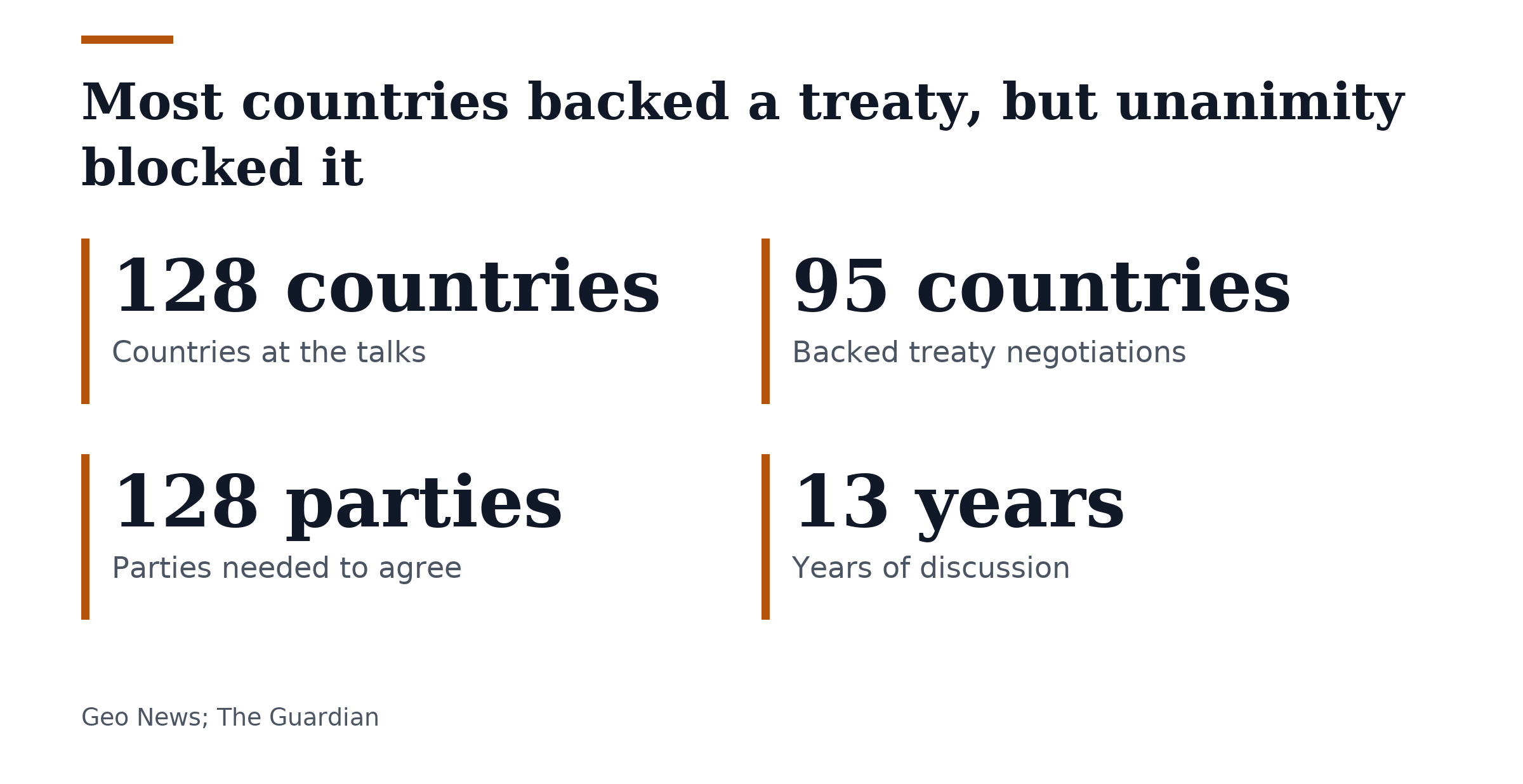
- Over 95 countries backed negotiations toward a treaty.
- The conference adopted a weaker mandate asking countries to elaborate by consensus on an instrument that may not carry legal obligations.
Representatives from 128 countries ended five days of U.N. talks in Geneva on autonomous weapons without a regulatory agreement on Nov. 21, 2026, yielding only a pledge to discuss options for future rules.
The negotiations took place under the Convention on Certain Conventional Weapons, and the final session ran until 5 a.m. on Nov. 21, 2026. Russia, the United States and Israel opposed binding commitments, while more than 95 countries backed negotiations toward a treaty.
The conference adopted a weaker mandate asking countries to elaborate by consensus on an instrument that may not carry legal obligations, short of the original goal of a legally binding treaty. Talks will continue until 2028, with no guarantee they will produce an enforceable treaty.
The Convention on Certain Conventional Weapons requires unanimous agreement from all 128 parties to pass a statement and has failed to pass any new weapons laws in the past 30 years. States have discussed autonomous weapons and the need for international rules for 13 years.
Substantial parts of a treaty had already been agreed before the collapse. A bloc of seven countries, Austria, Belgium, Brazil, Ireland, Mexico, New Zealand and Panama, pushed for a binding treaty within one year. Bonnie Docherty, senior arms adviser at Human Rights Watch, said on Nov. 21, 2026, that treaties could be agreed within 15 months, dismissing a five-year United States proposal.
Lethal autonomous weapons systems, commonly called killer robots, can identify targets on their own, then select and attack them, possibly keeping humans out of life-or-death decisions. Campaigners say these weapons have already been tested or used in conflicts such as Ukraine.
Brazil’s delegate said on Wednesday that these systems are already deployed and under development, and that states are late in creating norms for them. South Korea, Japan, Turkey, the United Kingdom, France and Germany opposed a binding law and backed a nonbinding agreement instead.
Ukraine, China and Iran were among European and NATO states expressing support or willingness for a new protocol on Nov. 21, 2026. Support for a new protocol extended beyond Western states.
The United States says existing international humanitarian law is sufficient and supports non-binding guidelines instead of new binding legal restrictions. The International Committee of the Red Cross called for bans on unpredictable autonomous weapons and weapons made to target people directly. Nicole van Rooijen of Stop Killer Robots warned that postponing a legally binding instrument endangers civilians and humanity.
Diplomats said Russia deliberately filibustered and acted in bad faith, while United States delegates sought a consensus statement. The exclusion of nonmember states prompted a rare protest on the final day, Nov. 21, 2026, with Egypt’s delegation shouting at the conference chair. A European diplomat said there was no political will to regulate these weapons commensurate with the urgency and need.
Max Tegmark, who heads the Future of Life Institute, said on Nov. 21, 2026, that world leaders did not meet the moment. Tegmark criticized the years of discussion without binding action.
Join the discussion