
Key facts
- FortiGuard Labs' Holiday Season Cyber Threats Report 2026 warns that cybercriminals are targeting the holiday shopping season.
- The threats include fraudulent storefronts and retailer impersonation.
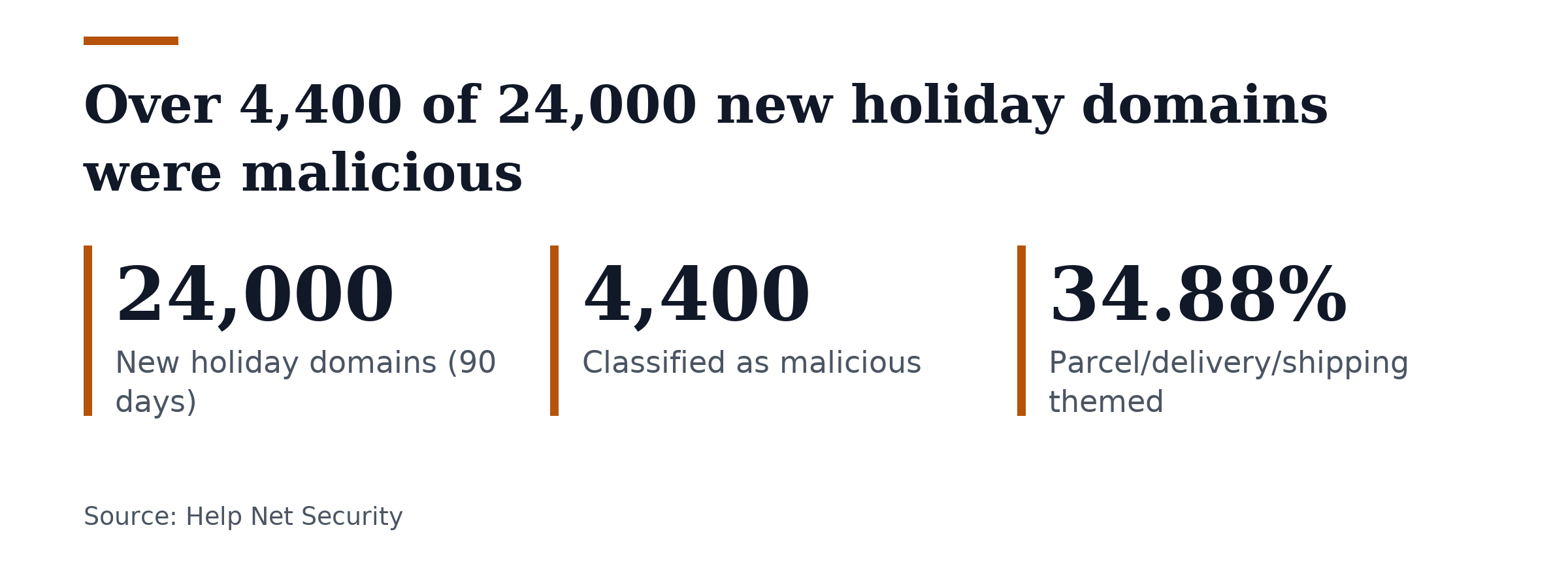
- Researchers found more than 24,000 newly registered domains tied to seasonal shopping keywords over a 90-day period.
- More than 4,400 of those domains were classified as malicious.
FortiGuard Labs researchers found more than 4,400 malicious domains tied to holiday shopping keywords, the firm said in its Holiday Season Cyber Threats Report 2026.
Cybercriminals are targeting the holiday shopping season with fraudulent storefronts, retailer impersonation, payment fraud and account takeover, FortiGuard Labs’ Holiday Season Cyber Threats Report 2026 warns. Over a 90-day period, researchers identified more than 24,000 newly registered domains built around seasonal shopping keywords. Of those, more than 4,400 were classified as malicious. The most common theme was parcel, delivery and shipping language, which appeared in 34.88% of the newly registered holiday-related domains. Other registrations referenced retail brands, gift cards, rewards and discounts.
The report said attackers may run fake delivery websites asking for payment details by claiming a missed delivery, customs charge or rescheduling need. The identified domains referenced DHL, UPS, FedEx and USPS. Researchers documented a fraudulent Walmart site advertising Black Friday deals. It copied the retailer’s colors, product listings and branding to look legitimate.
Researchers collected about 1.72 million infostealer log entries linked to seven major e-commerce platforms on a Russian marketplace between August and October 2026. Amazon accounted for about 1.49 million entries, ahead of eBay with 82,900 and AliExpress with 66,410.
Infostealer malware pulls browser-stored credentials and session cookies from infected devices. It also grabs autofill data and other sensitive information from those devices. Stolen records are sorted by domain, geography and account type so buyers can locate information tied to specific retailers.
“Stolen session cookies may potentially be reused to hijack authenticated sessions, depending on their validity and the security controls implemented by the affected platforms,” FortiGuard Labs researchers said. Stolen credentials and session data could let attackers get into accounts, make fraudulent purchases and misuse stored payment information.
Underground marketplaces facilitate the sale of stolen customer information, access to e-commerce infrastructure and services that support financial fraud, FortiGuard Labs said. Underground forums advertise phishing kits promoted as able to bypass multifactor authentication, subscription-based phishing services and automated payment card validation tools. Criminals also advertise access to merchant systems, banking credentials and compromised gift card information, and fraudulently obtained gift cards can be resold or converted into cash or cryptocurrency.
Researchers identified an advertised refund-as-a-service operation that targets retailers along with food delivery, electronics and travel companies. Its operator claims to secure refunds in exchange for a commission.
Doppel’s separate research found most confirmed fake Black Friday pages live at web addresses that do not resemble the impersonated brands. About one in four lookalike pages were hosted on legitimate platforms such as Google Sites, Blogger and GitHub Pages.
Visitors arriving through ads, search results or promotional e-mails could be tricked into giving up login credentials, submitting payment details or paying for goods that never arrive. Certain fraudulent shops rely on domain names that do not imitate retailer names.
Join the discussion