

Key facts
- The court set Yaroch's sentencing for March 4, 2027.
- Beginning no later than December 2024, Yaroch used his access to transfer funds out of wallets linked to FBI investigations.
- The stolen cryptocurrency came from wallets controlled by at least two adversarial nations, ten crime victims, and one FBI-created operational wallet.
- Yaroch exchanged stolen coins for other cryptocurrencies and ran additional transactions to hide where the funds came from.
Patrick Steven Yaroch, a 37-year-old former FBI Supervisory Special Agent, entered a guilty plea Thursday in federal court in Alexandria to wire fraud and money laundering for taking more than $2.4 million in cryptocurrency from wallets tied to FBI investigations. He faces up to 20 years in prison, and the court set his sentencing for March 4, 2027.
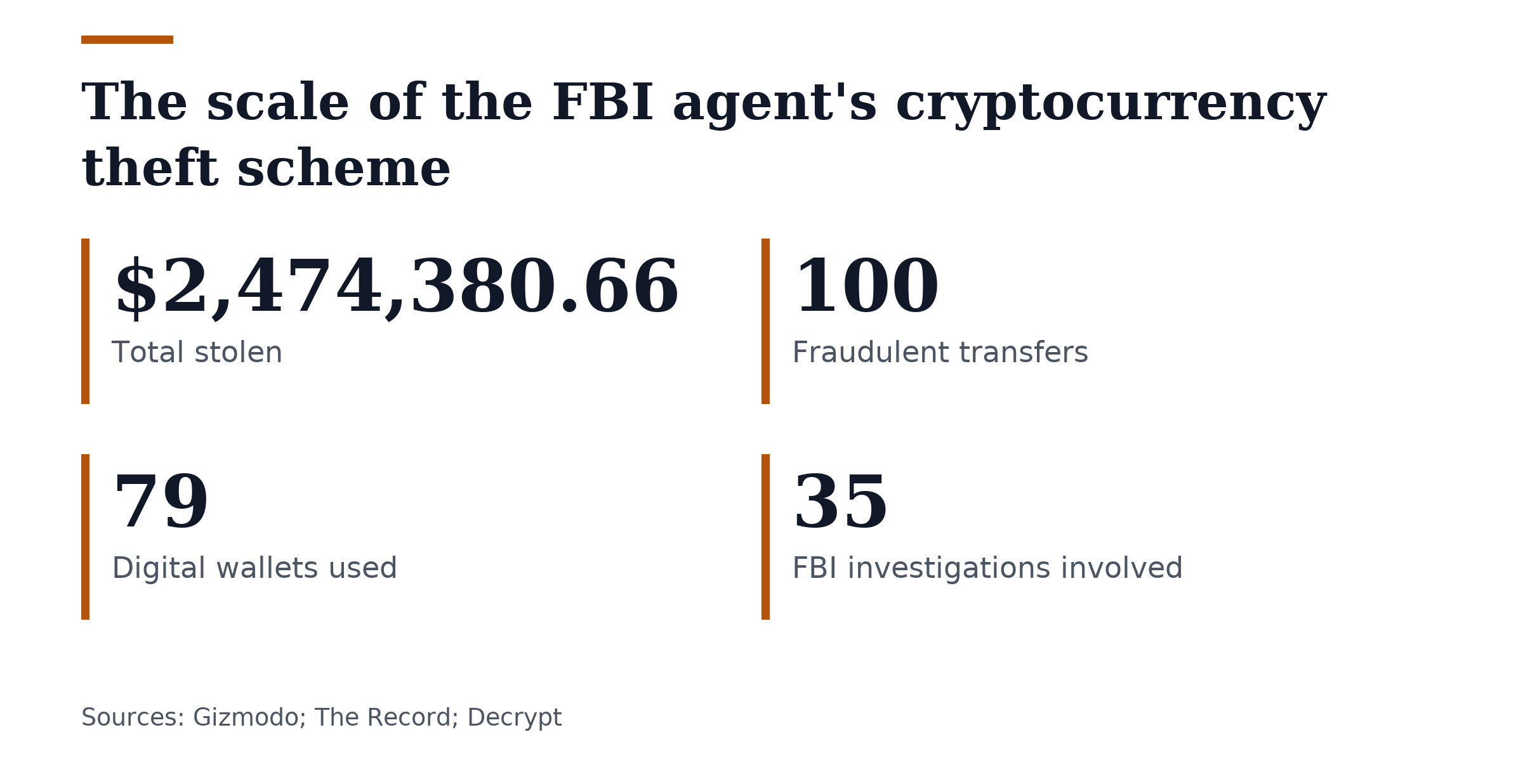
The thefts ran from December 2024 through July 2026 and included about 100 transfers out of 79 digital wallets tied to 35 FBI investigations, prosecutors said. The stolen cryptocurrency came from wallets controlled by at least two adversarial nations, ten crime victims and one FBI-created operational wallet.
Yaroch exchanged stolen coins for other cryptocurrencies and ran transactions to hide where the funds came from. His actions exposed FBI investigations to those who controlled the wallets and compromised sources and methods, prosecutors said.
At FBI headquarters, Yaroch served as a Supervisory Special Agent in the Counterintelligence and Espionage Division, focusing on an unnamed nation-state. He worked at the FBI Boston Division from 2017 until early 2025 as part of a squad focused on an adversarial nation-state, then shifted to the bureau’s Counterintelligence and Espionage Division in February 2025 and remained there through July 31, 2026, when the bureau terminated him. The position gave him access to FBI systems that held cryptocurrency credentials gathered during investigations.
Beginning no later than December 2024, Yaroch used his access to transfer funds out of wallets linked to FBI investigations. The thefts occurred between December 2024 and July 2026, spanning more than a year and a half.
Yaroch owed hundreds of thousands of dollars on credit cards, loans and car payments, and he paid off large loans. Prosecutors Kathleen Robeson and Russell Carlberg said he was after personal gain and dismissed the notion he was a selfless Robin Hoodesque figure. “The evidence is clear that the defendant planned to use this cryptocurrency for his own personal enrichment, just like any other fraudster,” the prosecutors said.
Initially, Yaroch told investigators that his transfers totaled about 10 to 12 and came to under $1 million, far below his plea amount. Charges filed in August covered roughly $1 million in digital assets, but the guilty plea spans more than $2.47 million. Prosecutors said the thefts yielded roughly $2,474,380.66 through about 100 unauthorized transfers connected to 35 FBI investigations.
Agents seized a Trezor hardware wallet, a device that stores cryptocurrency keys offline, multiple passports, power-of-attorney paperwork and handwritten notes matching crypto seed phrases, the word strings used to recover cryptocurrency wallets, from Yaroch’s home. About $188,600 sat in his Kraken account, while $933,800 sat in a Suilend lending protocol on the Sui blockchain. Investigators transferred roughly $925,000 from those accounts into government-controlled wallets, though about $165,600 in dollars on Kraken remained out of reach. Yaroch said he chose a wallet simply because he liked that the logo was a water droplet.
Yaroch told investigators the FBI could not or would not move against adversarial crypto holdings, so he took matters into his own hands. He spoke with a Justice Department National Security Division employee on July 29 about poor decisions involving crypto wallets, and he filed an online self-report with the FBI Security Division. Agents arrested him two days after that.
In May, Yaroch went to Portugal without telling the federal government and booked a family trip for September before his July arrest. He bought plane tickets for himself, his wife and his child for the September trip. On June 15, he authorized Portuguese lawyers to handle tax registration and get a Portuguese tax identification number on his behalf. The Justice Department reviewed his ChatGPT chats and learned he wanted to buy a vineyard in Portugal and retire.
Prosecutors said Yaroch’s misuse of stolen cryptocurrency credentials from FBI systems damaged FBI investigations related to criminal groups and nation-state adversaries. The thefts left FBI investigations open to the people running the wallets and exposed sources and methods.
The public court records do not identify the adversarial nations behind the drained wallets. Yaroch’s case follows earlier insider crypto thefts by law-enforcement personnel, including DEA agent Carl Force and Secret Service agent Shaun Bridges in the Silk Road investigation, and a charge earlier this year against John Daghita tied to a U.S. Marshals Service seized-crypto stockpile. Those earlier cases also involved law-enforcement insiders who stole cryptocurrency linked to investigations.
Join the discussion