

Key facts
- Federal prosecutors in the Southern District of New York charged three foreign nationals with using AI to impersonate corporate executives and attorneys in a fraud scheme that stole more than $129 million.
- The indictment says the group used AI to fake the voices and images of company executives and lawyers at major law firms, then convinced employees to send money to accounts the defendants controlled.
- The defendants told employees, usually in accounting departments, that help was needed on a secret financial deal and used AI to copy the chief executive's voice.
- A participant in the scheme directed an employee to transfer funds to a specific bank account run by the conspirators.
Federal prosecutors in the Southern District of New York charged three foreign nationals with using artificial intelligence to impersonate corporate executives and lawyers in a fraud scheme prosecutors say stole more than $129 million from July 2024 to February 2026.
The indictment says the group used AI to fake the voices and images of company executives and lawyers at major law firms, then convinced employees to send money to accounts the defendants controlled. The defendants told employees in accounting departments that they needed help on a secret financial deal and used AI to copy the chief executive’s voice. Pretending to be the chief executive, they directed employees to contact attorneys at large international law firms who were actually part of the scheme.
A participant in the scheme directed an employee to transfer funds to a specific bank account run by the conspirators. Once the money arrived, the group converted it into cryptocurrency to hide where the stolen money came from and split it with co-conspirators.
Prosecutors say the men claimed to be at least seven senior corporate executives in different countries. The deals were not real, and staff never talked to the actual chief executive or lawyer.
The fraud collected over $129 million globally from businesses, including a New York investment bank and a Rhode Island bank. The list also covers hospital systems in Missouri and California, a United Kingdom financial technology company, a Massachusetts mutual fund company and a Florida pet food business.
A Missouri hospital system lost $4,829,580, and a Rhode Island bank lost $2,684,580. A California hospital system lost $2,968,497, while a financial technology company in the United Kingdom lost $11,578,474. A mutual fund company in Massachusetts lost $4,639,918, and a pet food company in Florida lost $5,242,747.
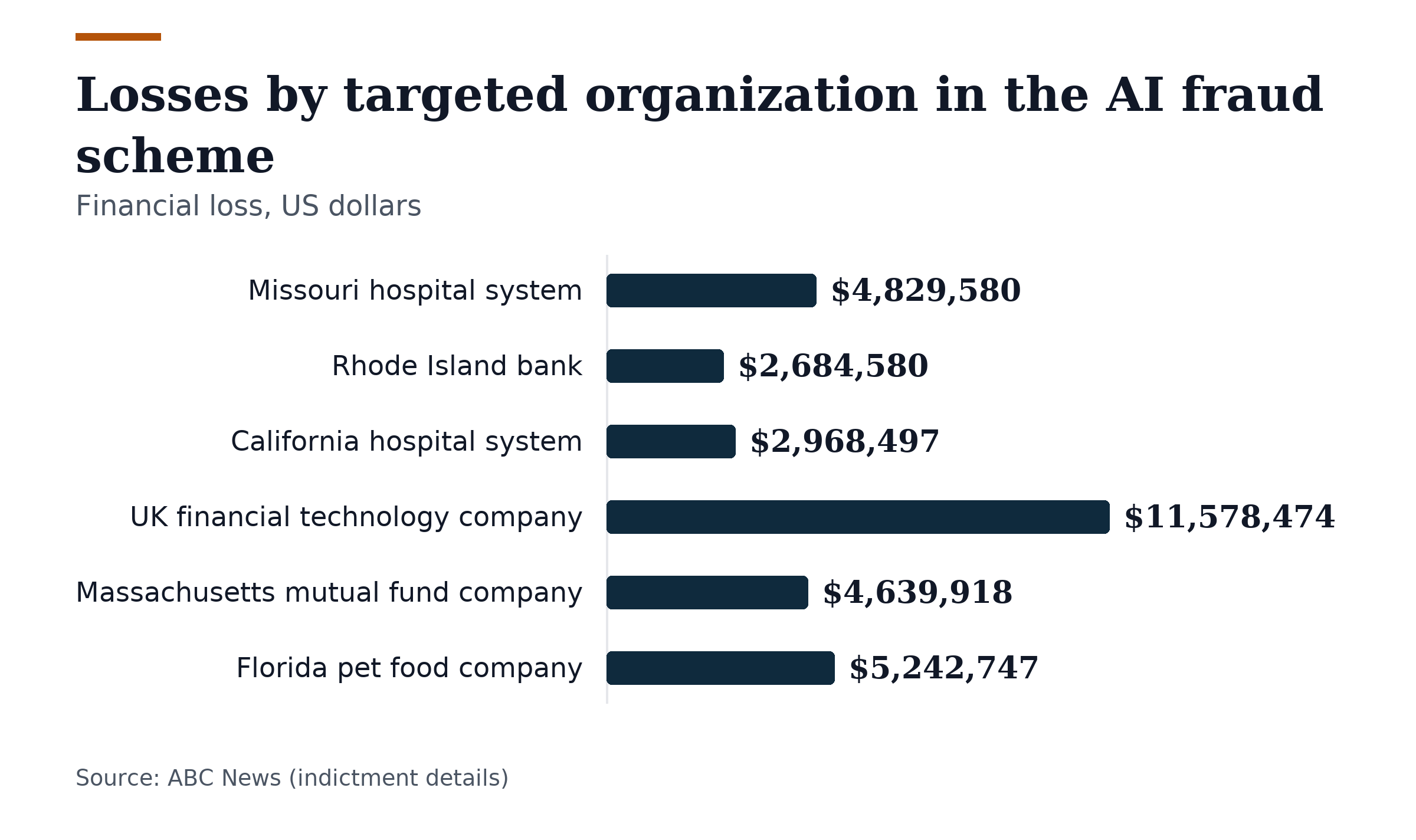
Prosecutors say the group took more than $11.5 million from a United Kingdom financial technology company in March 2025. In April 2025, a Massachusetts mutual fund company lost more than $4.6 million to the group. In June 2025, the group took more than $5.2 million from a Florida pet food company.
In June, Spanish authorities arrested Jacob Soall, known as Rocky Balboa and Seba Clarke. In August, Spanish authorities arrested Sharon Hazan, known as Superman Cash, Impossible Mission, Fat Boy and Ron. Authorities arrested Guy Sheetrit in the United Kingdom in September. All three await extradition to the United States.
Soall, 41, of Spain and the United Kingdom, pretended to be British lawyers using a document called “Lawyer Call” and a handwritten legal script. Prosecutors say Hazan, 54, of Israel, and Sheetrit, 42, of Israel and the United Arab Emirates, handled the stolen money. Hazan laundered money taken in the scheme, and prosecutors also accuse Sheetrit of laundering money.
A court convicted Hazan in 2008 of conspiracy to commit bank fraud. Prosecutors say he said he began laundering money in 1994, moved more than $400 million within three years, and described himself as the world’s top money launderer.

Prosecutors accuse each man of conspiracy to commit wire fraud, wire fraud, aggravated identity theft, money laundering conspiracy and money laundering. The defendants each face seven criminal counts. A conviction on each count carries up to 20 years in prison.
U.S. Attorney Jamie McDonald said super intelligence technology (SI, the Justice Department’s term for artificial intelligence) offers tremendous potential, but some people use emerging technology for criminal goals.
McDonald said the men used super intelligence technology to pretend to be real people and trick company leaders into sending about $129 million. “I encourage individuals and the business community to consider how to best protect themselves from the emerging threat of SI-enabled crime,” McDonald said.
The Justice Department launched the Super Intelligence Task Force on November 5, 2026. Stanley Woodward and Stephen Weiss co-lead the task force, and both report to Attorney General Todd Blanche.
The unit serves as the law enforcement mirror of the White House’s Super Intelligence Force, which Director of National Intelligence Jay Clayton chairs. The Justice Department officially adopted the term “Super Intelligence” or “SI” rather than conventional artificial intelligence.
Federal prosecutors across the country must notify the task force before launching any superintelligence-related investigation. The unit targets foreign governments, criminal groups using AI for fraud and money laundering, and people and companies inside the United States who misuse the technology.
Associate Deputy Attorney General Stephen Weiss said the department has a responsibility to use law enforcement tools to deter improper use of SI and ensure companies exercise vigorous internal controls. Attorney General Todd Blanche said critical SI technologies serve the American people and are not manipulated by bad actors at home or abroad.
Blanche said the department plans to identify and pursue people who use the technology illegally, including those targeting taxpayers, critical infrastructure or national security. Blanche said AI development will keep drawing on American innovation, and the task force will work to ensure the technology helps the public instead of hostile actors using it. The task force will recommend misuse prevention priorities, develop prosecution guidance for related crimes, and serve as the Justice Department’s main link to the White House’s Super Intelligence Force.
For fiscal year 2027, the Securities and Exchange Commission’s exam priorities dropped “AI” and use “super intelligence” 11 times. The OCC put out its first AI examiner framework for banks on November 4, 2026.
The OCC framework sorts AI risk by potential financial harm rather than model sophistication. The White House’s Super Intelligence Force must complete a risk report on security risks linked to super intelligence within 120 days beginning in mid-October 2026. The White House force’s vice chairs represent the FTC, the Pentagon and OPM.
Join the discussion