
Key facts
- Project Watershed 250 began in San Antonio on Aug. 31, 2026 as a pilot to help water utilities find and fix cybersecurity weaknesses before attackers exploit them.
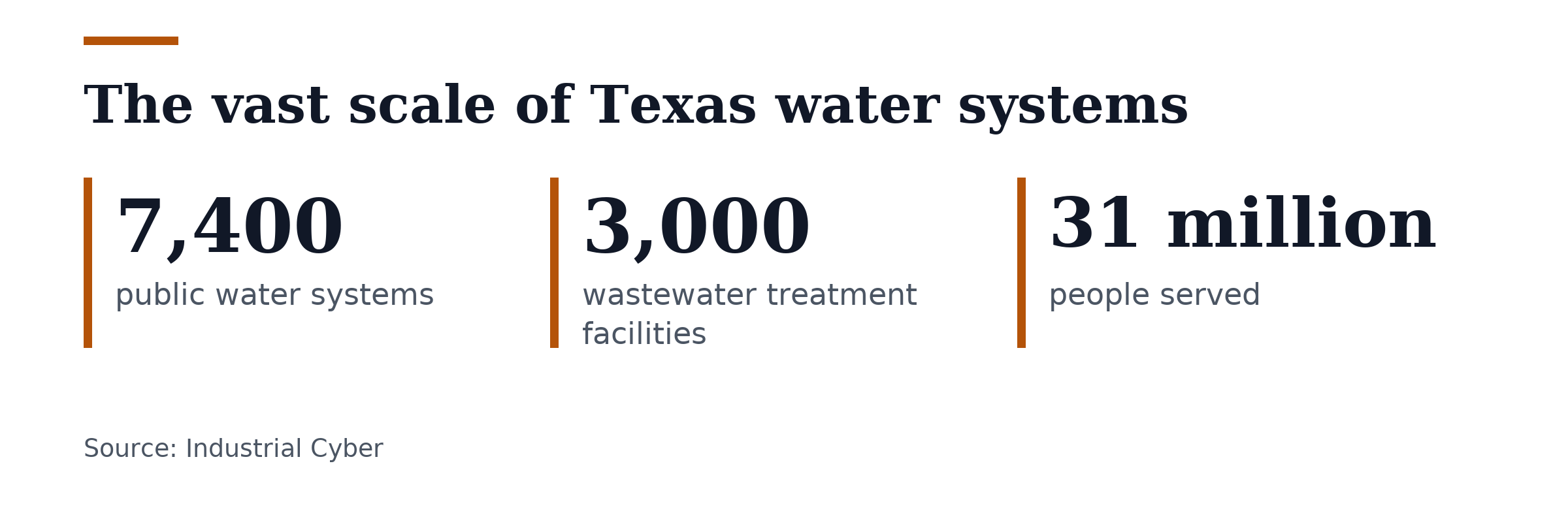
- Texas runs more than 7,400 public water systems. It also runs 3,000 wastewater treatment facilities. Together they serve 31 million people.
- The FBI and EPA issued an alert on July 30 saying utilities in at least seven states faced attacks starting July 27.
- Some incidents disrupted water operations. Attackers altered device passwords and IP addresses so operators could no longer monitor and control equipment.
Project Watershed 250 began on Aug. 31, 2026 in San Antonio as a pilot to help water utilities find and fix cybersecurity weaknesses before attackers exploit them. The Office of the National Cyber Director, Texas Cyber Command, the Texas Governor’s Office, the Environmental Protection Agency, and the Cybersecurity and Infrastructure Security Agency take part in the pilot. Participating utilities receive red-team assessments, AI tools, threat intelligence, training support, remediation help, and defensive tools at no charge.
Texas runs more than 7,400 public water systems and 3,000 wastewater treatment facilities, together serving 31 million people. Water providers are widely considered among the most vulnerable critical infrastructure sectors because many lack enough cybersecurity personnel, funding, and technical expertise.
The FBI and EPA issued an alert on July 30 saying utilities in at least seven states faced attacks starting July 27. Attackers targeted internet-exposed Rockwell Automation/Allen-Bradley MicroLogix programmable logic controllers. Some incidents disrupted water operations when attackers altered device passwords and IP addresses, leaving operators unable to monitor and control equipment. Officials suspect recent cyber attacks tied to Iran targeted community water systems in Minnesota and several other states.
State officials said affected water systems kept operating safely with no known public health effects. The FBI and CISA assisted with the response.
Project Watershed 250 will use Texas as a testing ground for a six-month pilot to find water system vulnerabilities and help utilities address them with private-sector cybersecurity and AI tools. The administration plans to expand the model nationwide.
Abnormal AI joined Project Watershed 250 to strengthen cybersecurity for Texas water utilities. For the duration of the pilot, Abnormal AI will provide its AI-native e-mail threat detection free of charge to participating Texas water utilities. Participating companies including Abnormal will contribute red-teaming, system hardening, and threat detection capabilities.
James Yeager of Abnormal AI said most water and wastewater systems lack dedicated security operations centers and count among critical infrastructure’s most under-resourced targets.
Created last year and based in San Antonio, the Texas Cyber Command received $135 million in state funding. Its job is guarding state and local government systems and coordinating responses to cyber attacks. Retired Navy Vice Adm. TJ White leads the command, having previously commanded U.S. Fleet Cyber Command and led the Cyber National Mission Force.
Texas Cyber Command vendor rules require providers to disclose service limits, expiry dates, and post-pilot costs, and they bar automatic conversion to paid services. The EPA announced $11.75 million in grants on Aug. 31 for projects addressing cybersecurity and extreme weather resilience at midsize and large drinking water systems.
Those awards include SCADA modernization but went to larger systems rather than the smaller utilities most exposed, and they do not establish a lasting funding model. Alycia Farrell of the Roosevelt Group said the federal government mainly recommends that assessments and remediation be funded by states and localities, noting this funding depends on annual congressional appropriations.
Farrell said the State Revolving Fund supports grants for non-construction work such as diagnosis, planning, and training, plus loans for physical and technical remediation. EPA said the loan portion can fund cybersecurity installations through low-interest loans that utilities must repay. Farrell noted the State Revolving Fund requires a 20% state funding match, a requirement she said weighs heavily on small, disadvantaged rural water utilities.
Federal conditions on SRF money, including Buy America sourcing rules, add steps that can slow small purchases of IT and operational technology. Farrell said SDWA Section 1433(g), which reaches small systems, expired in 2021 and never received funds.
She said SDWA Section 1459G, a technology grant, expired in 2026 without ever receiving money. Farrell said the only funded program, Section 1459F, supports only systems serving 10,000 people or more.
Farrell said Congress must fund reauthorized sections going forward to address shortfalls involving state and local water utility cybersecurity. She said a state can combine small regional systems into one project to advocate for remediation together and help with cost-sharing. Farrell suggested using loan forgiveness for disadvantaged small systems to convert loans into grants.
EPA’s Water Sector Cybersecurity Evaluation Program offers no-cost assessments but does not pay for remediation, Farrell said. She said SRF financing for capital remediation is subject to timing and loan-repayment limits. Farrell said resilience grants are available only for systems serving 10,000 or more people, and emergency assistance supports only post-incident response and is also expiring.
Farrell said the SDWA emergency assistance authorization provided $35M per year from FY2022 through FY2026 and expires after this fiscal year. She said Congress needs to reauthorize and fund the State and Local Cybersecurity Grant Program, which may be more likely after this month’s election results.
Farrell said pending legislation could add funding options, and she said MS-ISAC-provided threat intelligence services have been severely degraded due to DOGE efforts. She called monitoring, threat intelligence beyond MS-ISAC services, and managed detection recurring operating costs, and said federal money for water mostly funds one-time capital projects.


Andrew Ohrt of West Yost expects remediation efforts will likely end when the program ends for most utilities. Ohrt said utilities will benefit, but without sustainable funding or regulatory requirements, new improvements are unlikely after the program ends. Farrell said donated services and tools become paid subscriptions when the pilot ends without payment, otherwise they disappear.
Ben Burke of Dispel said grant resources should fund ongoing sustainment through five-year grants with annual installments rather than one-time grants. He said this shifts from capital to operating expense, but securing water systems requires recurring effort. Burke said the pilot should set clear sustainment costs and identify linked funding options across municipal, state, and federal levels.
Without proper sustainment, Burke said the project will cease when the program closes. Ohrt said operating costs for water utilities have risen over the last seven years.
Funding non-negotiable costs such as chemical supplies has strained utilities significantly. Utilities that can raise rates can secure funding as needed, but prices for hardware, software, and professional services keep rising. Ohrt advised creating a yearly budget line item for cybersecurity investment and maintenance.
Ohrt said funding, decision-making authority, and competing priorities all matter, but he focuses on decision-making authority. He said even larger utilities may secure technology well but lack governance to make changes and adapt quickly to evolving threats. Ohrt said utilities often identify serious vulnerabilities but lack a process to work with staff and contractors on risk characterization, compensating controls, and leadership discussion.
Leadership teams will manage risk proactively when given the opportunity, Ohrt said. He called this fundamentally a governance issue where technology and staff acknowledge vulnerabilities but no decision-making process supports timely remediation.
Serino said regulations enable utilities to build cybersecurity costs into operating budgets, while unbudgeted utilities depend on grants that are sometimes hard to obtain and require matching funds. Serino said primacy agencies should adopt cybersecurity requirements that are reasonable, doable, and risk-based, allowing flexible solutions rather than overly prescriptive rules. He said regulations cannot solve every vulnerability immediately, and utilities should address basics before follow-on changes.
Cybersecurity improvements are costly, and ratepayers should not bear the full cost without supplemental sustained state and federal funding and support, Serino said. He said cybersecurity improvements must be sustained for the life of the utility through a full program covering staff allocation, budget, and policies.
Utility staff receiving assistance often hold other public works jobs, including mowing public green spaces and coordinating road repairs, and staff also engage with the public. Gus Serino of I&C Secure Inc. cited available staff, procurement challenges, stakeholder scheduling, technical hurdles, and project dependencies as impediments. Serino said security tools carry licenses and ongoing yearly fees, and security technology requires maintenance and support.
Serino said barriers include lack of funding and lack of trust in firms that must alter continuously operational legacy systems. He said limited staff, competing priorities, and lack of awareness that the threat is real also affect decision-making authority. Serino said six months is just getting a project started, OT-capable (operational technology) security professionals are scarce, and many projects will barely be off the ground in six months.
Security controls may be examined as root causes after failures occur in critical industrial operations, Serino said. He said security practitioners must be present to troubleshoot and restore services, which takes time, expertise, and money. Some improvements likely need new hardware, but current supply chains may not permit procurement and installation within the pilot’s short time frame.
Ben Burke of Dispel said automatically generated reports often rank vulnerabilities by CVE score without considering whether a particular risk is easy to exploit. He said prioritization should follow operational workflows where operators create or engage with risk, rather than relying on raw CVE scores. Andrew Ohrt of West Yost said he does not know how federal partners identify, prioritize, and support remediation of critical vulnerabilities.
Ohrt said most small utilities depend on local or regional integrators, and those integrators must add cybersecurity to reliability and performance services. He said integrators and utilities must value cybersecurity as much as performance, reliability, and safety. Ohrt said adversaries are increasingly willing to compromise U.S. critical infrastructure for physical consequences, making cybersecurity key to water system performance, reliability, and safety.
Burke cited friction between security and operating teams, between security and governance teams, and between operating and governance teams. He said team friction slows decisions until inaction seems preferable, leaving systems vulnerable.
Join the discussion