

Key facts
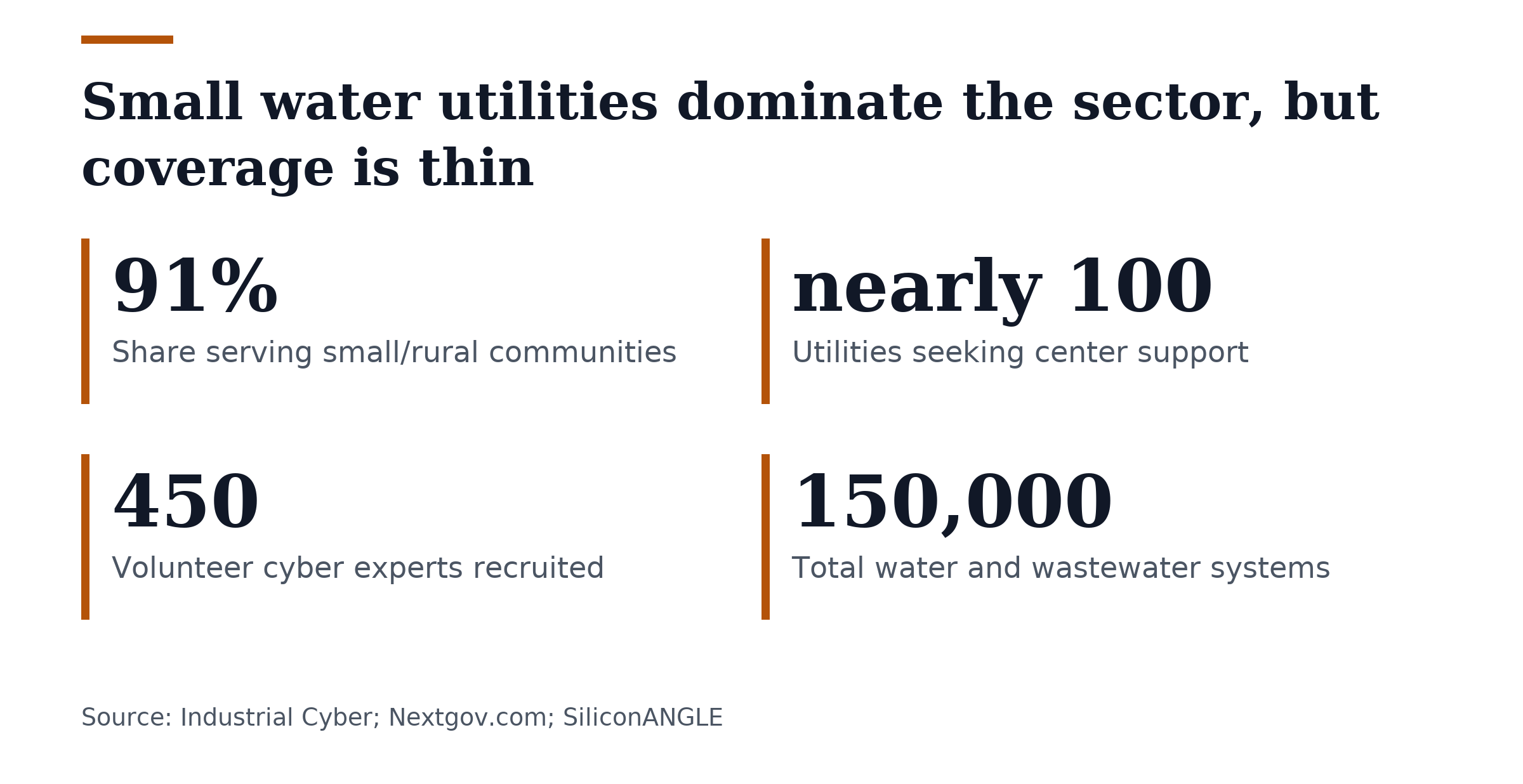
- 91% of community drinking water systems serve small and rural communities, often backing high-value targets such as hospitals, military installations and data centers.
- American water and wastewater utilities rank among the most targeted infrastructure sectors while also being among the least defended.
- The first participating systems were already under round-the-clock monitoring, and utilities from Maine to California were included.
- More than 100 water and wastewater utilities have expressed interest in the center's free monitoring and hygiene support.
The National Rural Water Association’s Water Watch Center gives nearly 100 small and rural water utilities across 26 states free cybersecurity monitoring, three months after it began Aug. 7, 2026, at DEF CON in Las Vegas with DEF CON Franklin.
The center provides under-resourced small water and wastewater systems with free monitoring around the clock, threat intelligence, basic cyber hygiene guidance and help responding to incidents, the National Rural Water Association said. Systems that joined first already had round-the-clock monitoring, and participants ranged from Maine to California. Over 100 water and wastewater utilities have asked for the center’s free monitoring and hygiene assistance. Every interested system serves no more than 10,000 people.
Defendify, Legato Security, L1 Secure, Rapid7 and Sentinel Technologies, five managed detection and response providers that monitor client networks and respond to intrusions, offer cyber services to small water utilities serving under 10,000 people. Using a dedicated collaboration mechanism, the providers exchange threat information and patches and forward results to NRWA, the national hub. The program is supported by Craig Newmark Philanthropies, the Hewlett Foundation and the Defense Advanced Research Projects Agency, and craigslist Inc. founder Craig Newmark provided seed money.
U.S. water and wastewater utilities rank among the most targeted infrastructure sectors and among the least defended. Community drinking water systems serving small and rural communities make up 91%, and they often back high-value targets such as hospitals, military installations and data centers.
More than 30 Minnesota water systems were hit by intrusions in late July 2026, and officials saw similar activity in roughly 12 states after the Minnesota intrusions. Industrial Cyber said suspected Iran-linked actors breached water systems in a dozen U.S. states in 2026. The FBI and CISA are handling incident response for the Minnesota intrusions but have not confirmed Iranian involvement.
Older operational technology that relies on exposed programmable logic controllers, industrial computers that run physical processes, and weak credentials is common in small water and wastewater systems, and monitoring focused on IT may not detect direct interaction with those controllers. Small utilities frequently do not have a chief information security officer, a security operations center, or money to hire for either position. Kevin E. Greene, BeyondTrust Corp.’s public sector chief cybersecurity technologist, says many small water systems fall beneath the cyber poverty line—the point below which an organization lacks the resources for baseline cybersecurity—and he says philanthropy helps in the short run, but municipalities should not depend on it for baseline cyber resilience.
Almost 450 volunteer cyber experts were recruited and matched with water and wastewater utilities in Arizona, Indiana, Oregon, Utah, Vermont, Washington and Wyoming. The volunteer push strengthened individual plants but revealed limits to volunteer labor against some 150,000 water and wastewater systems. “Smaller and mid-sized utilities often lack the staff, funding, and modernization runway needed to rapidly strengthen their defenses,” said Adam Ford, chief technology officer for state and local government and education at Zscaler.
Maryland is already working to find vulnerable rural water systems. Vanderbilt University is using Defense Advanced Research Projects Agency CASTLE program research, so digital twins of water systems can be used in automated-defense tests.
Water and wastewater operators are on edge after high-profile suspicious glitches at the FAA, the NSA, Microsoft and United Airlines. The Federal Aviation Administration stopped all departing flights in a ground stop that the agency blamed on legacy technology. Hackers sympathetic to Iran were tied to a March 2026 attack on the Los Angeles County Metropolitan Transportation Authority.
Join the discussion