
Key facts
- GAO warned that incomplete federal cybersecurity work for the food and agriculture sector creates gaps in sharing threat information and preparing for emergencies despite increasing risks to the food supply.
- USDA and FDA met most cybersecurity obligations under the 2021 National Defense Authorization Act, but five requirements were only partially met or unmet.
- GAO said staffing and resource constraints create gaps in how USDA and FDA share cyber threats and vulnerabilities.
- GAO cited a 2021 ransomware attack against a global meat processor that closed large slaughterhouses and worsened meat shortages in the United States and abroad.
The Government Accountability Office said on Nov. 20, 2026 that incomplete federal cybersecurity work for food and agriculture leaves gaps in threat-information sharing and emergency preparedness despite rising risks to the food supply, exposing the U.S. food supply to ransomware and operational disruption, Industrial Cyber reported.
The watchdog said incomplete cybersecurity work leaves gaps in how USDA and the FDA share cyber threats and vulnerabilities, and staffing and resource constraints drive those gaps. GAO said the shortfalls leave the food supply exposed to attacks that could halt production and distribution, create unsafe conditions and damage public trust.
Under the 2021 National Defense Authorization Act, USDA and the FDA met most cybersecurity obligations, though five requirements were only partially met or went unmet. The agencies met all three requirements for sector coordination, acting as federal interfaces, chairing the Government Coordinating Council and holding seats on the Federal Senior Leadership Council. Information sharing was the weak spot: they met three of four requirements, leaving one only partially met, so CISA and the sector still lack full visibility into current threats, vulnerabilities and mitigations.
USDA, the FDA and DHS named cybersecurity incidents and supply chain disruption as top concerns in a 2024 draft sector risk assessment. The draft Food and Agriculture Sector Risk Management Plan went to the National Security Council and CISA in early January 2025 and remains unfinalized. USDA got no feedback on the plan, since Executive Order 14239 called for a review of the memoranda behind it. Neither USDA nor the FDA has the power to mandate incident reporting across the entire sector, and neither has an established voluntary incident-reporting mechanism.
GAO issued five recommendations. Three went to HHS, which accepted them. Two went to USDA, which rejected both. GAO said all five recommendations remain warranted.
GAO cited a 2021 ransomware attack on a global meat processor that shut large slaughterhouses and deepened meat shortages in the United States and abroad. Ransomware has been the most frequently reported type of cyber attack in the food and agriculture sector since 2021.
Publicly reported attacks between 2021 and 2026, often ransomware or business email compromise, caused expensive operational and supply disruptions. A January 2021 intrusion at a U.S. farm relied on compromised administrator credentials and produced $9 million in losses. Ransomware hit meat processor JBS in May 2021, shutting U.S. and foreign slaughterhouses, deepening meat shortages, driving meat prices up 25% and prompting a bitcoin ransom payment of $11 million.
A snack food company lost $160,000 on a fake powdered milk order made in a CFO’s name in August 2022. Ransomware struck Dole servers and computers in February 2023, shutting production plants, disrupting U.S. grocery supplies and costing $10.5 million. In April 2023, attackers damaged irrigation and sewage systems. Ransomware hit Fairlife production systems in July 2026 and halted operations at U.S. plants.
In February 2022, attackers used fake domains and real employee names in a business email compromise that cost a food manufacturer $600,000 worth of milk products. In March 2022, spring planting logistics were disrupted when ransomware struck a multi-state grain company, and in April 2022 a scheme that used a president’s name stole $100,000 worth of whole milk powder. A May 2022 ransomware campaign against AGCO halted AGCO operations for two weeks, including at a tractor assembly facility.
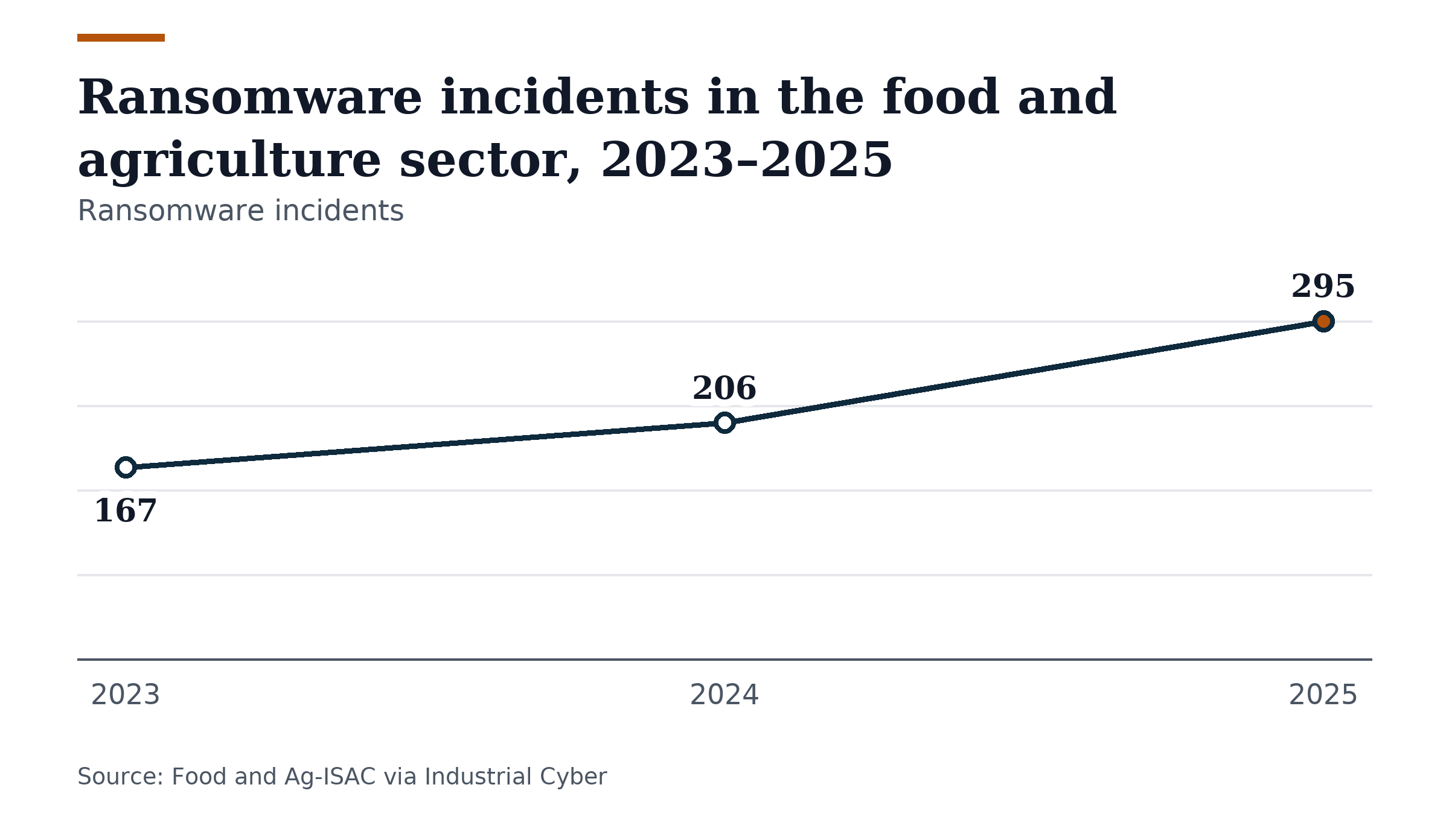
Ransomware incidents counted by the Food and Ag-ISAC reached 167 in 2023, 206 in 2024 and 295 in 2025. In August 2026, the ISAC said 227 incidents had been recorded by July 2026, and it described 2026 as potentially a heavy year for ransomware.
The watchdog urged agencies to implement rules and assess resources. USDA and the FDA said resources are limited for critical cybersecurity work, including sharing information and preparing for emergencies, and GAO warned the sector would remain more exposed until the agencies decide whether they can shift existing staff and resources or require additional resources. Significant economic and environmental consequences could follow attacks on food and agriculture supply chains, GAO said. Default passwords can be exploited to manipulate food quality and traceability data, potentially triggering recalls.
GPS-guided tractors and real-time soil sensors that connect to the internet can carry cybersecurity vulnerabilities, and compromised credentials can threaten production.
Join the discussion