

Key facts
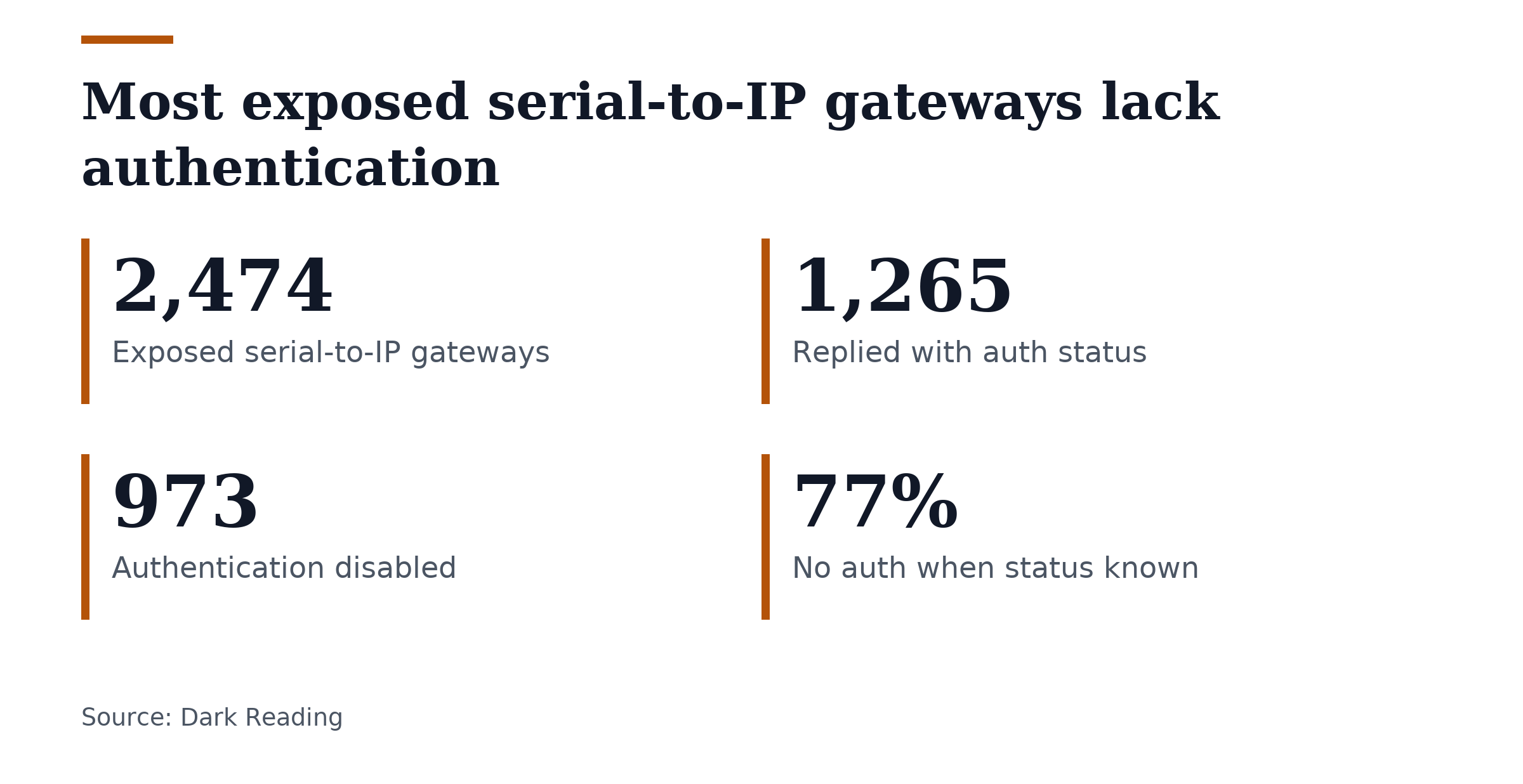
- Adrian Cheek, senior cybercrime researcher at Flare, searched the wider Internet for serial-to-IP gateways; 2,474 were exposed on the Web.
- Half of the 2,474 exposed serial-to-IP gateways were located in Russia.
- Around half of the devices, or 1,265, responded to unsolicited probes by providing their authentication status.
- Among gateways whose authentication status could be gleaned, 77% lacked authentication.
Adrian Cheek, senior cybercrime researcher at Flare, conducted internet scan research that found 2,474 serial-to-IP gateways exposed on the wider Internet.
Dark Reading reported that half of those exposed gateways were in Russia, describing the geographic distribution of discovered gateways. Roughly half of the devices, or 1,265, answered unsolicited probes by sharing authentication status information.
Among the devices that reported authentication status, 973 said authentication was disabled. Flare’s research indicated that 39.3% of all gateways exposed to the Internet had no authentication. When the authentication status could be gleaned, 77% of those gateways lacked authentication. Cheek said these devices ship with authentication turned off, which is the default configuration state.
These gateways move data between the Internet and industrial machinery in OT environments. Integrators place a gateway on a bench, connect factory equipment to a SCADA host for industrial control systems, then move to the next site, as Cheek described the typical deployment process. A single gateway can run one job for 10 or 15 years without anyone logging in again, reflecting the long operational lifespan without reauthentication.
Often, the person running the site does not know the gateway is there because someone else’s equipment included it, so the people running the site may not know the device is there. Activating security features can disrupt host-side software, and that is why operators often leave security features off. Older SCADA software and virtual serial port drivers may not function with secured modes, and enabling them can sever the field connection, describing compatibility issues with older systems. Updating firmware carries the same risk at a remote site without a spare unit.
This kind of gateway lets any actor reach sensitive OT systems, meaning operational technology, without exploiting a vulnerability. Attackers can use the vendor’s own tools, which helps malicious traffic blend into normal IT-to-OT communications. Cheek pointed to danger for mobile network operators and providers of private access point names, naming sectors the researcher said are at risk.
The 2025 Polish power grid intrusion, an example of APN pivoting, saw attackers use a private APN to move between a wind farm network and a power plant. The attack shut down seven serial-to-IP devices along with a water treatment system plus a steam turbine. Flare said 322 out of the 2,474 discovered devices were in address space held by known mobile operators in Europe and the Middle East.

Cheek tells OT operators to start securing their OT access layer by inventorying the devices they run, which he calls the first defensive step. Operators should check each cellular unit’s SIM plan and see if it gets a public address. They should ask the carrier for written confirmation about whether devices on private networks can reach each other or other customers’ devices. Cheek warned against assuming a managed product provides isolation because missing isolation in the Polish incident allowed an attacker to move between two unrelated organizations.
Cheek says to lock down data ports and login credentials and restrict which IP addresses may open a connection to control inbound access. Operators should limit serial-port access to the SCADA host and management-interface access to an engineering workstation.
He says to turn off unused services including the discovery service, Telnet, older SNMP, a network management protocol, and the Web interface. He says to remove SSH and Telnet, remote access tools, entirely from any device on the carrier network.
The researcher recommends a strict firewall separating the gateway from the control network. Cheek says someone should own newly purchased serial device servers. That person or team should get credentials, configuration details, and network information from system integrators.
It is more important to stop an attacker from locating and reaching a device than to depend on authentication or patching alone, Cheek said, reflecting his view that reachability restrictions take priority. He said a fully patched gateway with authentication enabled usually connects to serial-side equipment lacking its own security, a downstream equipment security gap.
RTUs are industrial controllers used in the field. Cheek said anyone who can reach the gateway gets everything behind it, showing the consequence of gateway reachability. “A meter, a drive, or an RTU will accept any correctly formed command that reaches it,” Cheek said.
Join the discussion