

Key facts
- Four previously undisclosed flaws in EPICS Base were patched after discovery by an autonomous system.
- CISA disclosed the vulnerabilities in advisory ICSA-26-300-01 published October 27, 2026, affecting EPICS Base 7.0.10 and earlier.
- The most severe flaw, CVE-2026-114595, scores 9.8 on CVSS and is an integer overflow in network request processing.
- CVE-2026-114597, rated 7.5 on CVSS, lets an attacker read beyond buffer boundaries, which can crash an application and expose data stored adjacent in memory.
CISA disclosed four previously undisclosed flaws in EPICS Base on Oct. 27, 2026, after an autonomous system found the vulnerabilities in control software used at particle accelerators and fusion research labs. The agency published the flaws in advisory ICSA-26-300-01.
The open source toolkit helps scientific facilities build control systems, with EPICS Base as the central component. Los Alamos and Argonne national laboratories created it to build and remotely control distributed SCADA (supervisory control and data acquisition) systems that link operators to physical equipment. About 90 significant scientific, academic and industrial sites around the world use it, including the Advanced Photon Source at Argonne and the fusion reactor control system at ITER. It runs in facilities across multiple countries, though standard review had not caught these flaws before.
The flaws affect EPICS Base version 7.0.10 and earlier and involve how the software processes Channel Access and pvAccess network traffic. CVE-2026-114595 carries a 9.8 CVSS score and stems from an integer overflow during network request processing. The second flaw, CVE-2026-114596, holds an 8.2 CVSS rating and consists of an out-of-bounds write able to destabilize a process or trigger denial of service.
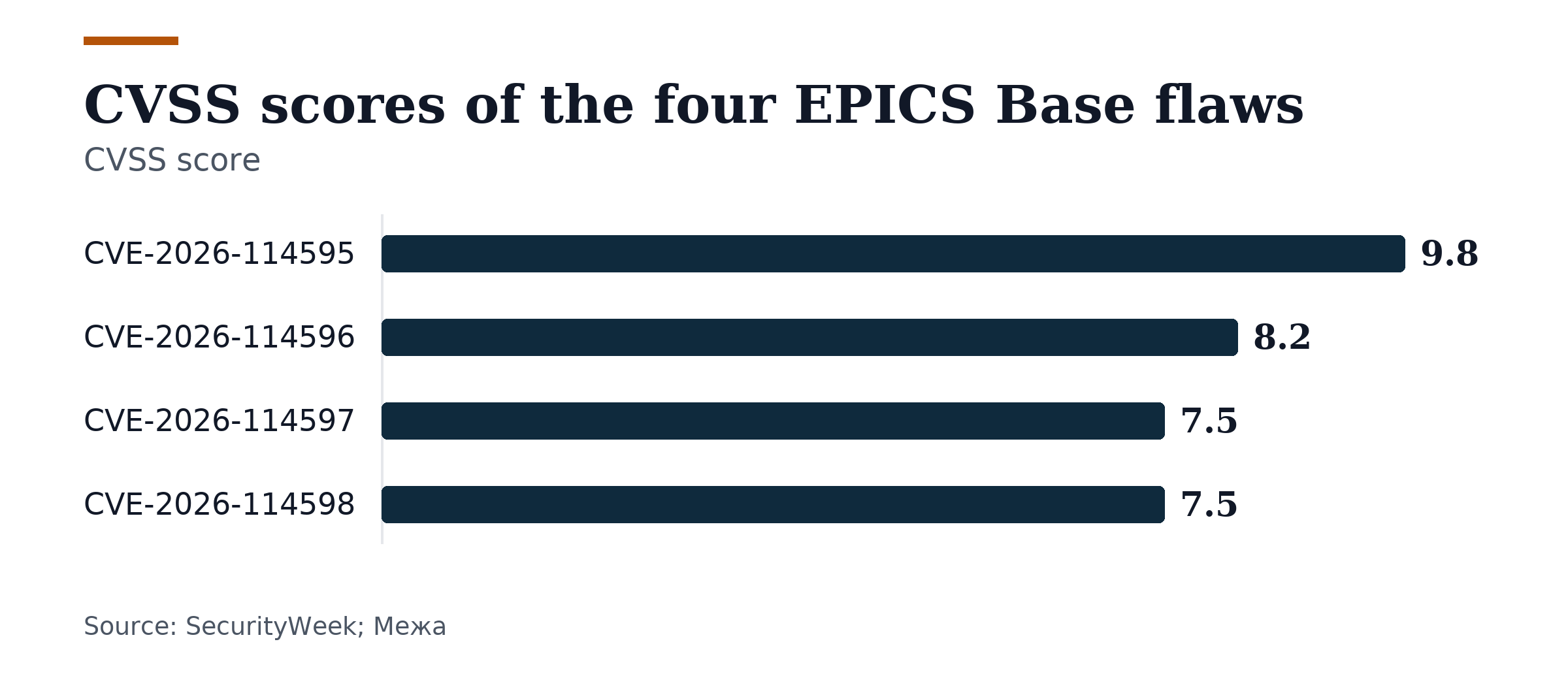
CVE-2026-114597 carries a 7.5 rating and permits an attacker to read beyond buffer boundaries, crashing an application and exposing data held nearby in memory. CVE-2026-114598, also at 7.5, is a type confusion problem set off by malformed network data that results in denial of service. Attackers need no authentication or user interaction, just network access to vulnerable EPICS services, usually on TCP 5064 for Channel Access or TCP 5075 for pvAccess.
Shubham Raj said, “All four can be triggered without authentication or user interaction.” The agency says exploitation may lead to denial of service, memory corruption, information disclosure from nearby memory, or possible arbitrary code execution. For the most severe flaw, the agency says incorrect memory sizing can follow after systems handle attacker-controlled data, corrupting memory, causing denial of service, or potentially allowing remote code execution. The agency said no one has reported publicly exploiting the flaws as of the advisory’s release date.
Code execution has not been achieved. Cipher demonstrated an attacker-controlled write past heap bounds and caused a process crash using AddressSanitizer, a tool that detects memory errors, but did not build a working remote code execution exploit.
Causal Security built Cipher, an autonomous AI agent that found the four vulnerabilities in roughly 3 hours and 49 minutes without any prior knowledge of EPICS. Raj said the initial probe needed no human intervention, and one instruction later authorized deeper exploitability testing.
Code history review indicates the defects originated roughly 14.5 to 31.5 years ago. Maintainers learned of the issues on June 9 and merged the patches across July and August.
The fixes arrived in version 7.0.11, released on Oct. 27, 2026, and CISA recommends updating to that version. Because the disclosure was coordinated, the agency released the patch alongside the alert rather than waiting weeks. CISA classifies the affected systems under the Critical Manufacturing sector.
Raj said an attacker could halt a controller while an experiment runs, interrupt measurements or commands, force a shutdown, and cause lost work, downtime and costly recovery. Raj said investigators do not need deep OT expertise or knowledge of accelerators and fusion reactors to look into the flaws. Changing specific physical processes requires extra knowledge, but software disruption or interrupted monitoring and control can still cause serious harm.
The number of internet-facing EPICS deployments is not known. Raj said a brief Censys scan turned up possible matches based on open ports, but none were confirmed as EPICS installations.
In 2026, Cipher found several critical paths of attack in electrical grid networks across North America and Europe, leading to a CISA advisory dated October 8. The same researcher’s work also produced disclosures involving Grid Protection Alliance’s openPDC and openHistorian, tools for power grid measurements, and the FreeRTOS-Plus-TCP embedded networking stack.
The AI Governance Institute said AI-assisted vulnerability discovery is a credible, fast-moving threat that operational technology security programs need to take seriously. It also said attackers can turn the ability used to uncover these flaws against defenders. Researchers cited by the institute said the top-rated flaw, at 9.8 out of 10 on CVSS, could allow attackers to seize full control of affected systems from afar.
When operators learn of a flaw rated 9.8 on CVSS, they must meet disclosure and notification obligations. Compliance teams should verify that incident response plans include vulnerabilities found through third-party AI tools. Organizations should task OT security and engineering teams with checking whether any systems run EPICS or depend on it as part of a vendor product.
Join the discussion