
Key facts
- Around 100 people broke into Microsoft's Amsterdam data-center construction site on Nov. 6, 2026, with some climbing a crane to hang a banner reading "FCK AI.".
- Demonstrators at the Amsterdam site also displayed banners linking Microsoft to Israel's government and to Palestine, while others protested data centers generally.
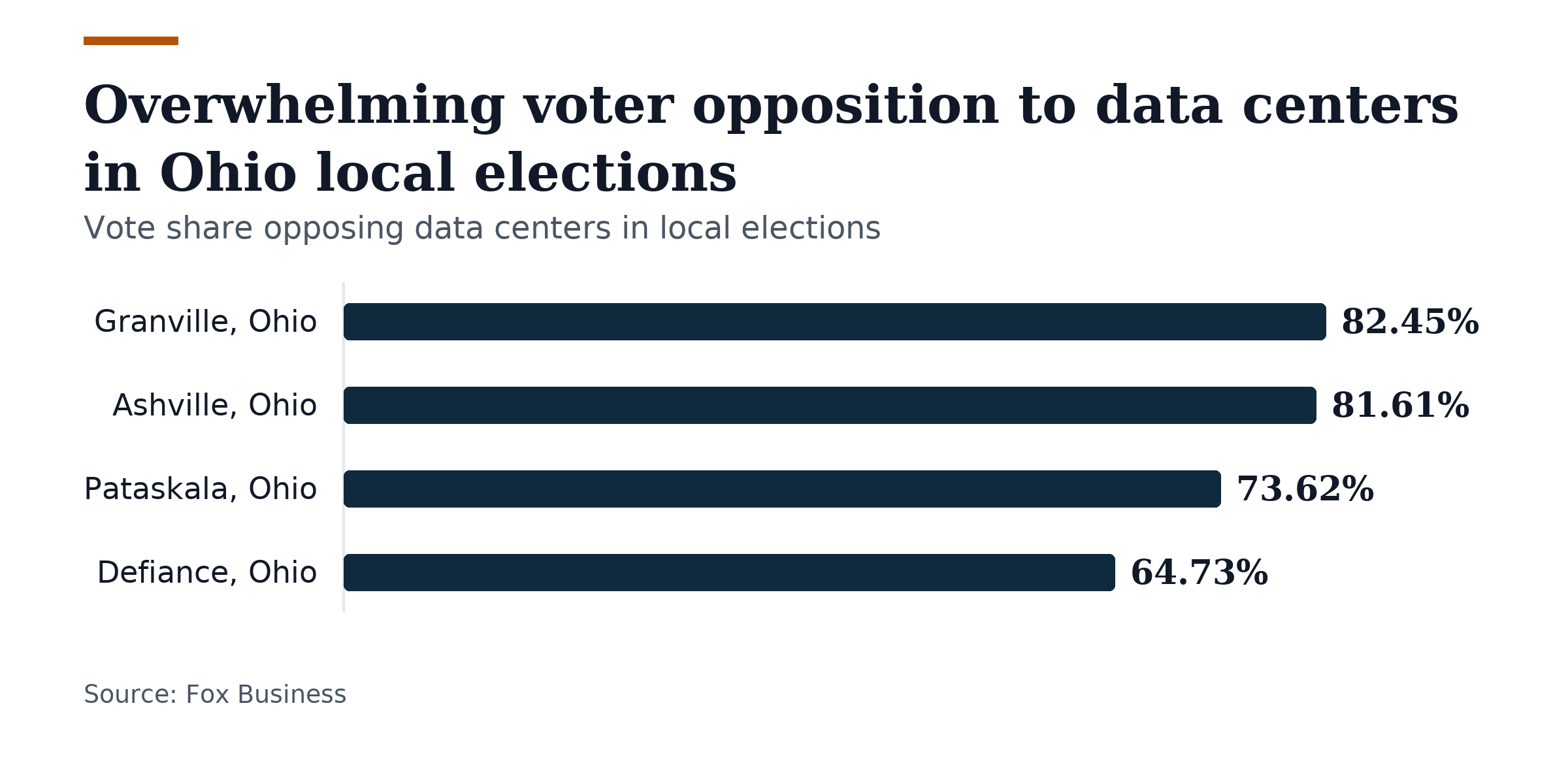
- Unofficial county election results show Defiance, Ohio, voters passed a charter amendment limiting data-center construction by 64.73% to 35.27%.
- Granville, Ohio, voters supported a comparable amendment by 82.45% to 17.55%.
Kotaku reported that around 100 people broke into Microsoft’s Amsterdam data-center construction site on Nov. 6, 2026, with some climbing a crane to hang a banner reading FCK AI. Fox Business and Gizmodo reported that Texas voters elected Democrat Gina Hinojosa over Gov. Greg Abbott on Nov. 3, 2026, and Georgia voters elected Democrat Keisha Lance Bottoms over Republican Rick Jackson on Nov. 3, 2026. Fox Business also reported that Ohio voters passed data-center-limiting charter amendments in Defiance, Pataskala and Granville on Nov. 3, 2026.
Demonstrators at the Amsterdam site also displayed banners linking Microsoft to Israel’s government and to Palestine, while others protested data centers generally. Amsterdam had announced in 2025 that it would no longer approve data-center projects submitted after the end of 2023 or expand approved sites, citing a lack of space and power, and would not consider new pitches until 2030.
Hinojosa ran on a plan to pause new data-center projects and strengthen protections for the environment and electricity ratepayers. Bottoms made greater accountability for data-center developers a central part of her campaign, and data-center development was a major attack point in the Georgia gubernatorial race.
Unofficial county election results showed Defiance, Ohio, voters passed a charter amendment limiting data-center construction, with 64.73% in favor and 35.27% opposed, while Pataskala voters approved a data-center charter amendment with 73.62% in favor and 26.38% opposed, part of a cluster of Ohio measures restricting development. Granville voters backed a comparable amendment by 82.45% to 17.55%, but Ashville voters turned down a data-center referendum, with 81.61% opposing and 18.39% supporting, rejecting it by a wider margin than the other Ohio measures. Ohio also elected Democrat Amy Acton as governor on Nov. 3, 2026; she supports a moratorium and stricter regulations on data centers, adding to the wave of Democrats backing data-center restrictions.
By contrast, roughly three-quarters of voters in Harwood, North Dakota, rejected proposed restrictions on industrial development, showing not every community moved to limit projects. Fox Business, citing The Washington Post, reported that voters in at least 38 jurisdictions passed measures limiting or blocking data centers, with many passing by wide margins that underscored the intensity of opposition where projects were directly on the ballot.
Polling cited by AP found that 56% of respondents considered data centers a crucial or major factor in how they voted in the midterms, and 76% opposed building data centers within their own community, in polling tied to the U.S. midterm elections and the global backlash against data-center development. The Washington Post, ABC News and Ipsos found before the election that seven in 10 Americans, including most Republicans, opposed building new data centers in their own communities. In an election-day poll cited by The Washington Post, 56% of voters said artificial intelligence and data centers were a major or crucial factor in how they voted on Nov. 3, 2026, though the issue ranked last among five topics surveyed.
More than 145 data-center projects nationwide faced delays or cancellations through early August 2026, according to S&P Global figures cited by The Washington Post, with public opposition accounting for most of those setbacks. A Data Center Watch study found that over 75 data-center projects across the country, valued at about $130 billion, faced blocks or delays in the first three months of 2026, the highest total since tracking began in 2023. Opposition was disrupting projects beyond the ballot box, posing a challenge to an industry pouring billions into AI infrastructure. Data Center Map lists 4,378 data centers across the United States, with Virginia at 631, Texas at 464 and California at 287, giving Virginia the largest concentration.
OpenAI said on Nov. 5, 2026 that it would cover the entire electricity cost for the data centers it owns and operates, ask for community input, release construction plans and stop using nondisclosure agreements with public officials, as major technology companies responded to public scrutiny over AI infrastructure costs. The company also released a policy blueprint encouraging lawmakers to adopt similar standards, and Chief Global Affairs Officer Chris Lehane told reporters the firm was laying out lessons learned and committing to applying them going forward. OpenAI said the announcement followed the election results, although the blueprint had been in development since August and built on earlier pledges to protect ratepayers and address community concerns; the company is targeting hundreds of billions of dollars in computing infrastructure spending by 2030 as it seeks to expand rapidly to meet AI demand.
Dan Diorio, executive vice president of state policy and government affairs at the Data Center Coalition, said data centers bring jobs, local tax revenue and investment, and that the industry supports digital infrastructure, energy reliability and affordability, and long-term responsible economic development. Industry representatives argue that data-center investment provides economic benefits to hosting communities.
Opposition to data centers in the United States has surged in recent months, evolving from neighborhood resistance into a policy fight over land use, electricity costs and water access. Monterey Park, California, became the first US city to ban large-scale data centers citywide after residents voted to prohibit them permanently in June 2026, and New York state legislators passed a one-year moratorium on new hyperscale data centers that same month.
Port Washington, Wisconsin, voted overwhelmingly in April 2026 to limit future data centers through the nation’s first referendum of its kind, while Connecticut, Missouri and Maine communities have passed their own moratoriums or bans. As of June 2026, 14 states had considered or were considering moratoriums on data centers, according to a blog post by the Rockefeller Institute of Government, showing how far state-level resistance had spread. Local actions spanned several states beyond California, New York and Wisconsin, and the resistance reflected a national trend affecting state-level policy across the country.
Arizona Public Service is seeking a 45% rate increase for extra-large energy users, most of whom are data centers, while residential customers would see a roughly 14.5% increase under the plan, raising worry that households would bear AI infrastructure costs through higher utility bills. Arizona lawmakers also acted to raise taxes on data-center developers through a three-year suspension of a sales tax exemption, with the goal of moving more of the tax burden to those companies.
Gallup’s March 2026 survey found that 70% of the United States opposes construction of an AI data center nearby, with 48% expressing strong opposition; half of respondents were concerned about resource impact, while 22 percent cited quality-of-life concerns. Gallup said the intensity of opposition means proposed data centers are likely to spur grassroots activism and legal challenges, and that AI infrastructure could become an important campaign issue in local and state elections in 2026. Gallup’s findings suggested the issue would influence elections at multiple levels.
Ben Green, an assistant professor at the University of Michigan School of Information and a faculty associate at the Berkman Klein Center for Internet and Society, said in a Harvard Gazette interview that liberals and people on the left cite environmental concerns about data centers and distrust of AI companies, while many conservatives are also upset. Researchers at Brookings said local opposition is likely to soon become the leading constraint on data centers.
Local opposition is emerging as a practical constraint on the country’s AI expansion. Federal authorities increasingly treat data centers as strategic infrastructure tied to competitiveness, but local resistance limits where they can locate.
Residents close to AI data-center projects have reported deafening noise pollution, higher utility bills, water shortages, fears over harmful air pollution and health dangers, and worries that property values will fall. Resistance to the enormous physical systems behind AI has spread more quickly than wider worry about the technology, fueled by local complaints about construction and daily operations. A preliminary study has linked data centers to higher land-surface temperatures in surrounding areas, extending environmental concerns beyond energy and water use to localized heating effects. Many planned data centers sit in rural areas, stoking worries about losing farmland, while part of the backlash also comes from fear of the technology itself rather than only its infrastructure because leaders of AI labs have promoted existential risks such as mass unemployment and biological warfare.
Texas has just under 600 data-center projects, according to Data Center Map, with a good share still planned or in construction. Georgia’s Atlanta area has emerged as one of the country’s fastest-growing data-center markets, according to CBRE, and development was prominent enough in the state to shape the gubernatorial campaign.
Democrats Clara Pratte and Jonathon Hill are poised to disrupt the Republican majority on Arizona’s utility commission after vowing to limit utility price increases linked to data-center development, while utility commission contests across 10 states looked set to influence how AI data centers link to the power grid. Democrats also flipped a Georgia utility commission that Republicans had dominated for 30 years, giving Democrats control over utility policy affecting data-center power costs. Mark Pinsley, the Lehigh County comptroller, won a Pennsylvania Senate district race and is pushing for a statewide moratorium on hyperscale data centers; the seat flipped to the Democrat after featuring the same two candidates as four years earlier.
Gizmodo framed the midterms as the first proxy election on the AI industry and said the results are likely to lead to stricter local regulations and moratoriums, hampering the pace of AI infrastructure development. The outlet said the election outcomes provide evidence of how unpopular the technology’s trajectory is among Americans.
Elon Musk posted on X on Nov. 4, 2026, that data centers in space look pretty appealing right now, a post reflecting industry unease with land-based data-center development after the elections. Sam Altman posted on X on Nov. 3, 2026, that people should not cede control of the future to superintelligence and that this should ultimately constrain AI progress, a comment acknowledging a shifting political order around AI infrastructure.
Join the discussion